



Fact Sheets And Publications
- Ask Extension
- Health & Well-being
-
Agricultural Programs
- Agribusiness
- Animal Science
- Beginning Farmer Program
- Commercial Crops
- Delaware Soil Testing Program
- Disease Management
- Farm Vitality and Health Project
- Irrigation
- Nutrient Management
-
Insect Pest Management
- Insect Trapping Program
- IPM Hot Topics
- Commercial Field Crop Insect Management
- Commercial Field Crop Disease Management
- Commercial Fruit & Vegetable Crop Pest Management
- EIPM Implementation Projects
- Pollinators
- Research and Extension Demonstration Results
- Brown Marmorated Stink Bug (BMSB) Management, Research, and Resources
- Publications
- Pesticide Safety Education Program
- UD Plant Diagnostic Clinic
- Variety Trials
- Weed Science
- Certified Crop Advisor Program
- Poultry Biosecurity
- CARE
- Delaware Agriculture Week
- 4-H
- Horticulture
Tar Spot of Corn
September 2025 | Written by: Drs. Alyssa Betts and Madeline Henrickson
Pest Background
Tar spot is caused by the fungal pathogen Phyllachora maydis.
Under favorable conditions for disease, yield loss on susceptible hybrids can be severe.
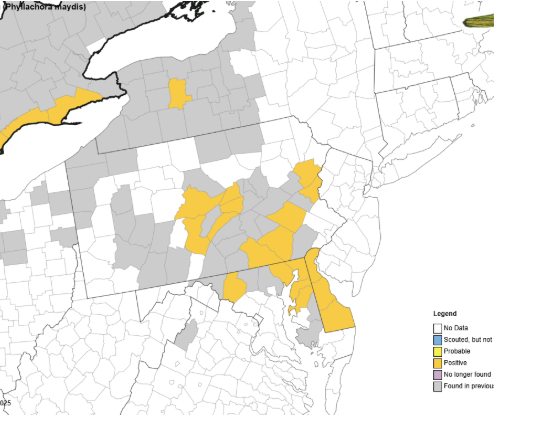
Tar spot was first identified in DE at the end of 2023 and has been identified in all three countries for the 2025 season (Fig 1)
Identification
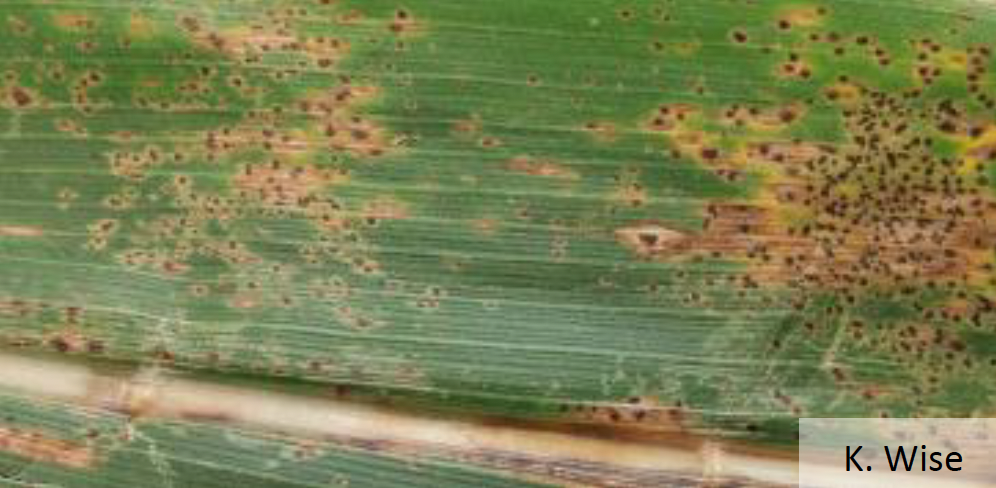
Symptoms include small, black specks (stroma) on the upper and lower surface of corn leaves (Fig 2).
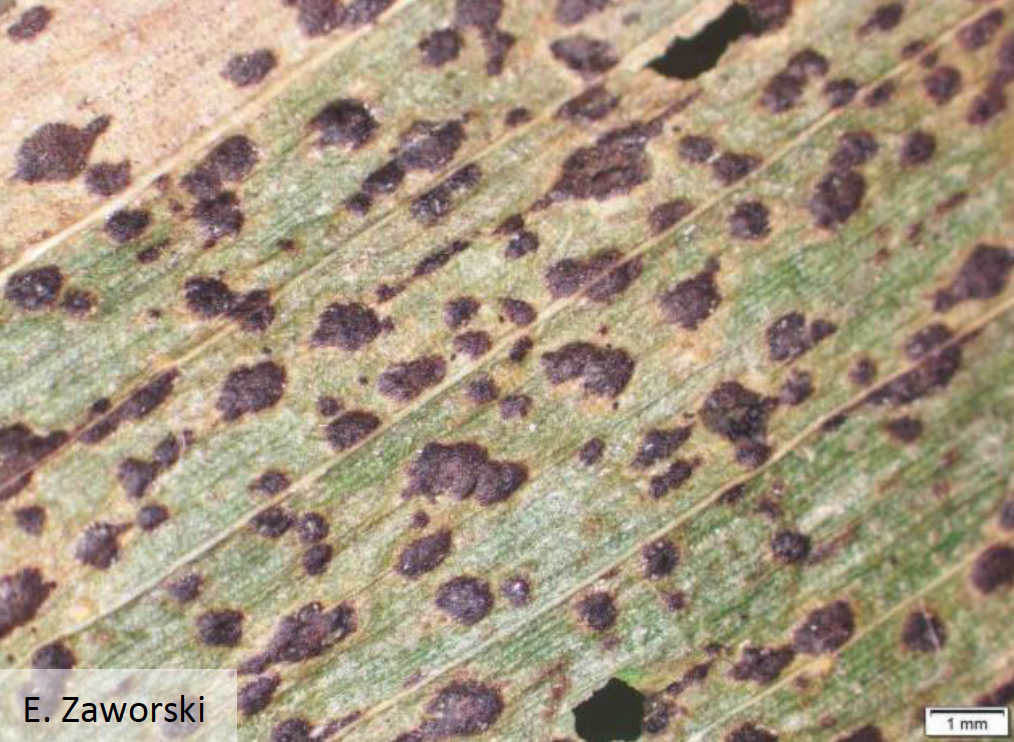
Mature common and southern rust pustules that transition from orange-red spores to production of black teliospores can be mistaken for tar spot.
Rust spores or insect frass/poop can be scraped away with a fingernail, but tar spots cannot be scraped off the leaf (Fig 3).
- Tar spots can also form on leaf sheaths, husks, and tassels.
Management
Corn is the only known host for Phyllachora maydis. There are diseases caused by different pathogens that go by the same common name, particularly in ornamentals.
The pathogen will overwinter in corn residue.
High relative humidity and prolonged leaf wetness favor disease. Epidemics that start earlier in the season result in greater chance for yield loss.
Many fungicides are now labeled for tar spot, and the best economic return has been shown on a single application made between VT-R3.
References
Crop Protection Network (2022, Jan 24). Tar Spot of Corn. Retrieved from: https://cropprotectionnetwork.org/encyclopedia/tar-spot-of-corn
UD Cooperative Extension
This institution is an equal opportunity provider.
In accordance with Federal law and U.S. Department of Agriculture policy, Cooperative Extension is prohibited from discriminating on the basis of race, color, national origin, sex, age, or disability.
The University of Delaware is an Equal Opportunity Institution and Provider. Visit UD’s Office of Civil Rights and Title IX Compliance to learn more.
Additional Links
531 South College Avenue Newark, DE 19716 (302) 831-2501