



Ants in My Plants: Pavement Ant Feeding on Vegetable Transplants
Ants in My Plants: Pavement Ant Feeding on Vegetable Transplants
December 2025 | Written by: David Owens, Veronica Yurchak and Ben Sammarco
University of Delaware Carvel Research and Education Center
University of Maryland Wye Research and Education Center
Introduction
Over the last few years, several instances of ants damaging vegetable transplants have been reported on the Delmarva Peninsula in a manner unlike the more usual ant-plant interactions of feeding on extrafloral nectaries or tending aphid colonies to feed on honeydew secretions. Instead, ants were found girdling the base of stems, resulting in the eventual collapse and death of the plant. Where ants were collected and identified by a taxonomist, they have come back as ‘Pavement Ant’ – Tetramorium immigrans. However, several other species of ants are known to occasionally damage healthy vegetation, especially fire ants (Solenopsis spp., esp. S. invicta and S. richteri) further south and Allegheny mound ants (Formica exsectoides). Several Formica species are known to occasionally clear ground and prevent seedling establishment within several yards of their mounds. This allows sunlight to warm the soil where the brood nest is. In the tropics, many other ant species are known to damage plant structures, not just transplants. In one study, okra blossoms and pods were most often attacked, followed by eggplant and cowpea (Kavya 2023). This fact sheet focuses specifically on pavement ants and their potential to damage vegetable transplants.
Biology
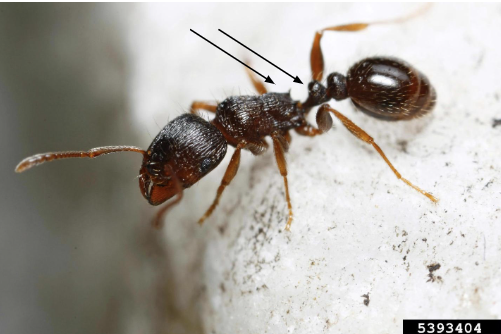
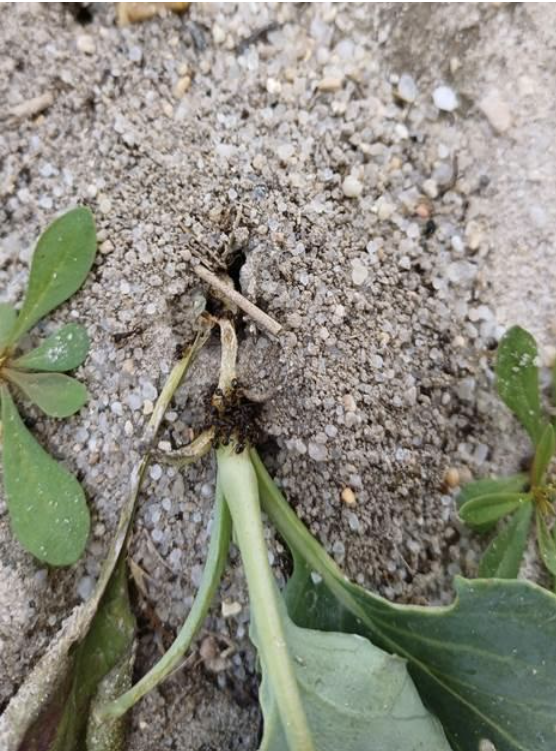
Pavement ants commonly nest along sidewalks, driveways, and other hard-scape surfaces, but they can establish colonies anywhere there is exposed soil. As they excavate nest burrows, they leave the tailings in a ‘volcano-shaped mound’ (Davis et al. 2020). Pavement ants are dark colored ants with two nodes, one pair of thoracic spines, and parallel grooves on their head and thorax (Fig. 1). Colonies are headed by a single queen. Nests are often located near moisture, heat sources, rocks, mulch, wood piles, and underneath other hard surfaces or debris. When nesting in bare soil, and especially sandy soil, they tend to establish colonies at the base of plants, possibly for structural stability (Bruder and Gupta 1972). Pavement ants forage up to 30 feet from their colony and are typically attracted to sweet, greasy foods, dead insects, seeds, pet food, and carbohydrate sources (Davis et al. 2020). Pavement ants are known to damage plants; however, it is not understood why or what dictates this behavior. It is possible they damage vegetable transplants seeking sugars photosynthesized from the leaves.
Plants attacked
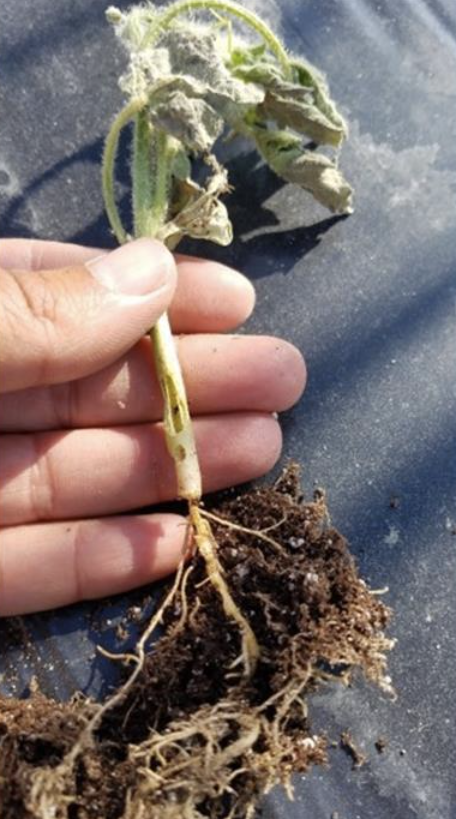
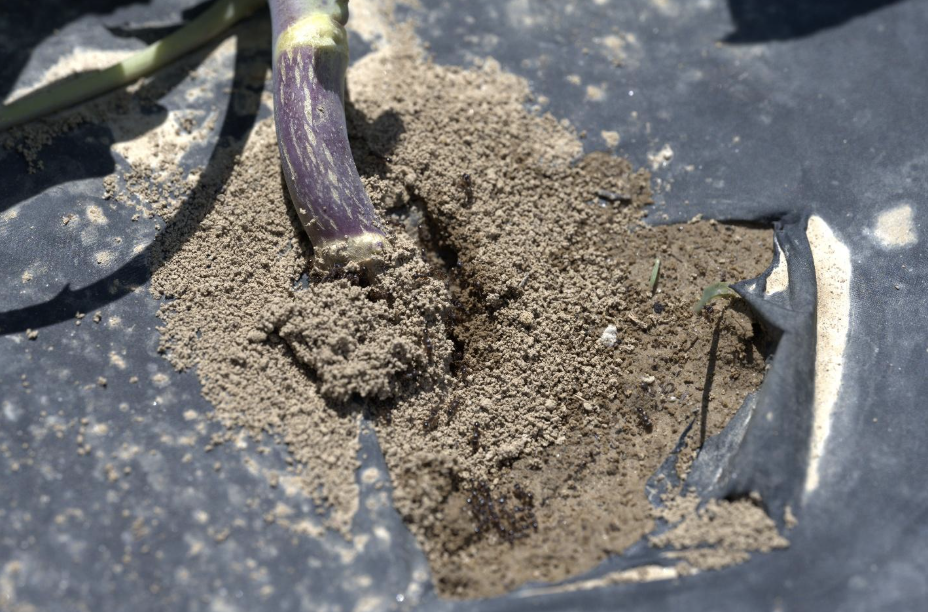
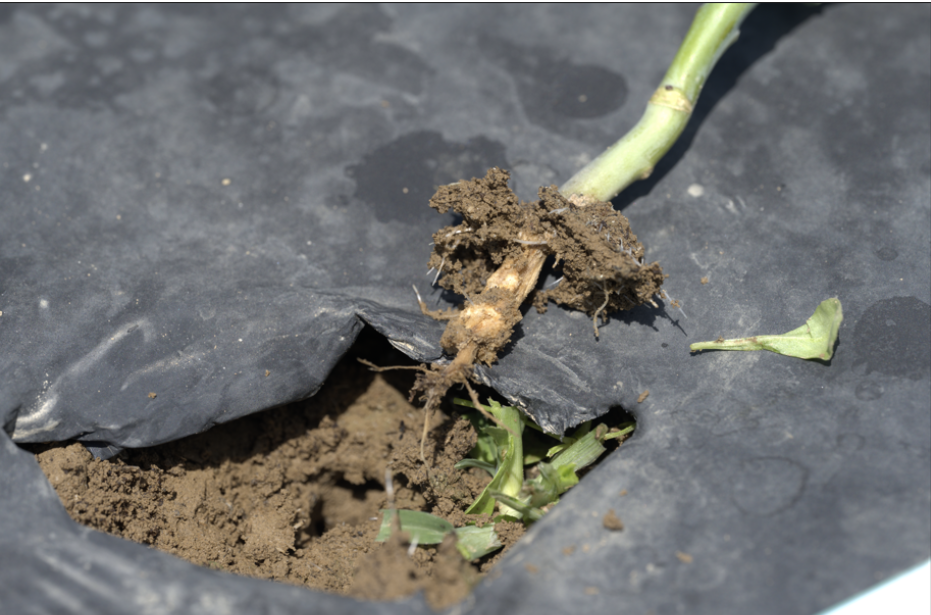
In 2020 and 2021, ants were observed tunneling out young watermelon transplants at the end of May and early June (Figure 2). Ant mounds could be seen at the base of many but not all affected plants. In one field, ants heavily damaged the planting over a half-acre. In 2024 and 2025, ants were observed girdling cabbage transplants in July and broccoli transplants in May (Figures 3-5).
Damage to transplants may occur for several weeks after transplant. It is unknown what environmental conditions may cause pavement ants to attack vegetables, or if specific plant densities are at an elevated risk for attack. Damage has occurred in fields with coarse sandy soil and silt loam soils, fields clear of weeds and fields with rye strips. Watermelons were grown on plastic, broccoli was grown on both plastic and bare soil, and cabbage was grown on bare soil at the time of attack.
Control
Ants only appear on labels for specific bait formulations. Insecticides labeled for vegetables do not list ants on their labels. Agriculturally-labeled baits include Clinch Ant Bait (a.i. abamectin), Esteem (a.i. pyriproxyfen), Carbaryl 5% Bait (carbaryl), Extinguish Professional Fire Ant Bait (a.i. Methoprene), Seduce insect bait (a.i. Spinosad) and Fertilome Come and Get It Fire Ant Killer (a.i. spinosad). Read labels before applying any pesticides. In home gardens, Hi-Yield ant killer granules (a.i. bifenthrin) can also be used. Ant baits may be slow-acting, especially the insect growth regulators (methoprene and pyriproxyfen), which require several weeks to destroy colonies.
Contact insecticides used for home and structure treatment include pyrethroids, fipronil, neonicotinoids, and indoxacarb. The pyrethroids are also known to be repellent to ants. It is conceivable that a soil broadcast application or a banded application concentrated at the base of sensitive plants would help reduce ant damage. In a test to assist a farmer with controlling ants affecting watermelon transplants, an imidacloprid soil drench was effective at killing ants, but the transplants that were being attacked had been treated prior with imidacloprid
Organic controls, including diatomaceous earth, mixtures of garlic and hot pepper, pyrethrum drenches, and boiling water poured onto the soil, have not been found to effectively eliminate plant-damaging ant colonies.
Effective cultural practices to prevent ant damage to vegetables are not yet known. Recommended cultural practices for structures include reducing water sources, but this is not feasible in vegetable production, and damage has occurred in plots before receiving supplemental irrigation. Removing food is an important management step indoors, but difficult to achieve in fields.
References
Bruder, K. W. and A. P. Gupta. 1972. Biology of the pavement ant, Tetramorium caespitum (Hymenoptera: Formicidae). Annals of the Entomological Society of America 65: 358-367.
Davis, Ryan S., L. Spears, and A. Taylor. 2020. Pavement Ants (Tetramorium immigrans Santschi). Utah Pest Fact Sheet ENT-219-20. https://digitalcommons.usu.edu/cgi/viewcontent.cgi?article=3326&context=extension_curall
Kavya, K. T. 2023. Management of phytophagous ants in vegetable crops under homestead cultivation. Master of Science thesis. Kerala Agricultural University.
UD Cooperative Extension
This institution is an equal opportunity provider.
In accordance with Federal law and U.S. Department of Agriculture policy, Cooperative Extension is prohibited from discriminating on the basis of race, color, national origin, sex, age, or disability.