



Safeguarding Delaware’s Produce: Training Farmers to Prevent Illness and Economic Loss while Remaining Compliant with Rules (2025)
Safeguarding Delaware’s Produce: Training Farmers to Prevent Illness and Economic Loss while Remaining Compliant with Rules (2025)
Written by: Jennifer Jones | Collaborators: Kali Kniel
RELEVANCE
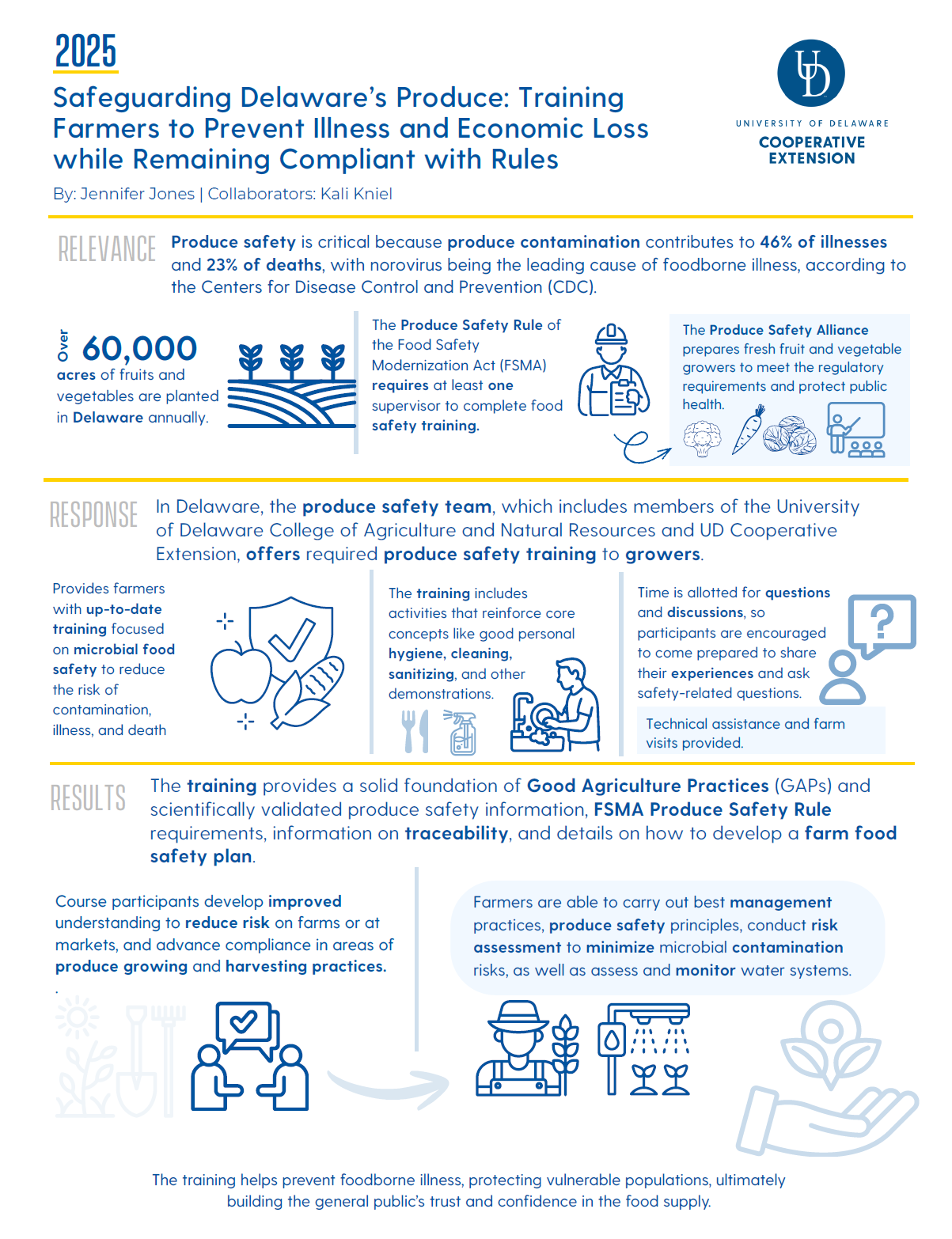
Over 60,000 acres of fruits and vegetables are planted in Delaware annually. Produce safety is critical because produce contamination contributes to 46% of illnesses and 23% of deaths, with norovirus being the leading cause of foodborne illness, according to the Centers for Disease Control and Prevention (CDC). The Produce Safety Rule of the Food Safety Modernization Act (FSMA) requires at least one supervisor or responsible party from a covered farm to complete food safety training. Standardized national training, made available by the Produce Safety Alliance, and enhanced by trainers prepares fresh fruit and vegetable growers to meet the regulatory requirements and protect public health.
RESPONSE
In Delaware, the produce safety team, which includes members of the University of Delaware College of Agriculture and Natural Resources and UD Cooperative Extension, offers required produce safety training to growers. The goal of the program is to provide farmers with up-to-date training and information focused on microbial food safety to reduce the risk of produce contamination, illness, and death while ensuring farm practicability, minimizing economic loss and protecting vulnerable populations. Since 2016, more than 425 participants have undergone training in person or virtually. Participants range from large farm owners to small farm owners, food safety professionals, farmers market vendors, and emerging farmers. The training includes activities that reinforce core concepts like good personal hygiene, cleaning, sanitizing, and other demonstrations. There is time allotted for questions and discussions, so participants are encouraged to come prepared to share their experiences and ask safety-related questions. Participants leave with a plethora of information, including a detailed handout of a low-cost hand washing station to take back and construct on their farm for employees and visitors. Produce safety team members also provide technical assistance and farm visits to support growers’ produce safety needs after the training.
RESULTS
The training provides a solid foundation of Good Agriculture Practices (GAPs) and scientifically validated produce safety information, FSMA Produce Safety Rule requirements, information on traceability, and details on how to develop a farm food safety plan.
Course participants develop improved understanding to reduce risk on farms or at markets, and advance compliance in areas of produce growing and harvesting practices. Participants practice implementation of risk-reduction strategies on the farm useful in identification of sources of microbial contamination (including animals, workers, water, and soil amendments). Farmers are able to carry out best management practices, produce safety principles, conduct risk assessment to minimize microbial contamination risks, as well as assess and monitor water systems.
PUBLIC VALUE STATEMENT
The Delaware produce safety team training has helped growers improve food safety practices on their farms, ensuring that the food they produce is safe for people to eat. The training helps prevent foodborne illness, protecting vulnerable populations, ultimately building the general public’s trust and confidence in the food supply.