



Fact Sheets And Publications
Seedcorn Maggot Management
October 2026 | Written by David Owens and Ben Sammarco
Introduction
Seedcorn maggot (SCM) (Delia platura (Meigen), Diptera: Anthomyiidae) is one of several species of root maggots that are pestiferous in early spring. Seedcorn maggots damage and destroy seedlings and young transplants. Adults emerge from overwintering pupae between late February and early April and can be numerous on warm, sunny days. Upon emergence, it may take flies several days to mate, with a preoviposition period around 7-10 days (Harukawa et al. 1934). Adults may be active for many weeks, ovipositing in freshly disturbed soil rich in organic matter. Larvae spend 2-3 weeks feeding on organic matter in the soil before pupating and emerging as adult flies. There are 2-3 generations in the spring. Flies may aestivate in summer (Funderburk et al. 1984) before resuming activity in late summer or fall. Flies have been observed emerging from the soil in barley and wheat fields that had been amended with poultry manure, and may be active into November.
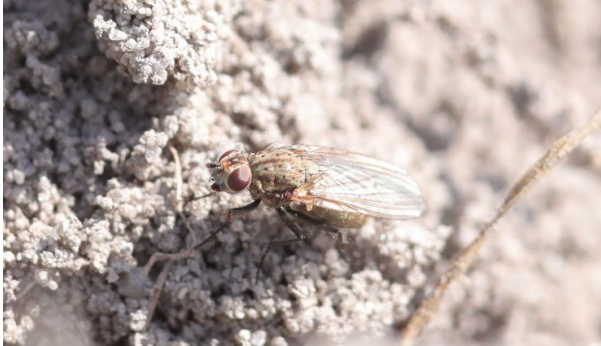
The overwintered flies and first-generation flies represent the most damaging generations. Adult oviposition activity and maggot damage is associated with cool, wet, overcast conditions. Anecdotally, maggot damage may be more prevalent on Delmarva than in other places in the mid-Atlantic, possibly because of the greater use of poultry manure as fertilizer, and a relatively high amount of vegetable and small grain production resulting in an abundance of tilled soil in the fall providing overwintering habitats. Other Delia spp. include bean seed maggot (D. florilega), cabbage maggot (D. radicum), and onion maggot (D. antiqua). On Delmarva, all recent reports of maggot damage received in field and processing crops have been caused by seedcorn maggot.
Predicting SCM Activity
Seedcorn maggot adult emergence can be predicted based on degree day models, using a biofix date of January 1, a base development temperature of 39°F, a maximum high temperature of 86°F, and a target of 360 F degree days and 1080 degree days for overwinter fly and first generation fly emergence, respectively (Holm and Cullen 2012). It should be noted that flies will begin emerging from soil well before peak emergence. DD = (Tmax (up to 86°F)+ Tmin/2 )- baseT (39°F) Georgetown DE peak O.W. fly emergence dates for the last several years are:
| 2026: March 23 | 2022: March 20 |
|---|---|
| 2025: March 29 | 2021: March 31 |
| 2024: March 15 | 2020: March 11 |
| 2023: March 2 | 2019: April 4 |
From peak emergence to pupation, degree day units are:
• Preoviposition period: 65 FDD
• Egg development: 54 FDD
• Larval Development: 367 FDD
• Total: 486 DD.
Note: Funderburk et al (1984) calculated 420 DD but also recommended adding 100 DD to account for differences between air temperature and soil temperature. Thus, the majority of larvae should be entering the pupal stage between 480 and 520 FDD, and this window is predicted to be a low-risk crop planting window. An alternative degree day calculation to identify low risk windows would be to start degree day accumulation after the date of tillage, cover crop or poultry manure incorporation. Predicting low SCM active planting windows in April and May is much more difficult, as adults live for several weeks, oviposit over a 7–14-day period of time, and fly emergence becomes less synchronized. (Temperature data and development timing based on experiments conducted by Harukawa et al. 1934, Sanborn et al. 1982, and Funderburk et al. 1984).
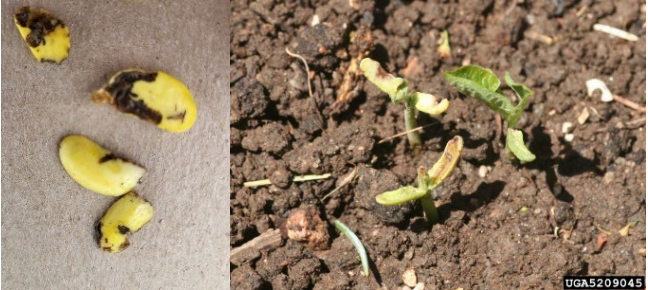
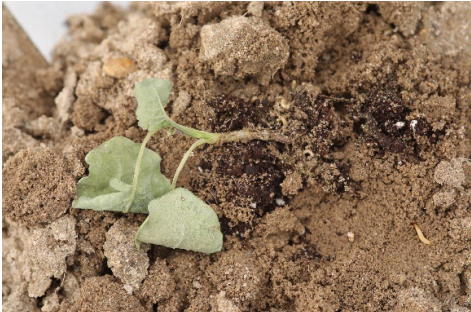
Field Attraction, Host Susceptibility and Damage Adult SCM are attracted to disturbed soil, especially those with organic matter incorporated. This can be from crop residue, cover crop incorporation (especially legumes), or poultry manure incorporation. Bacterial volatiles from the decaying organic matter are highly attractive to flies (Hough-Goldstein and Bassler 1988). Females oviposit in soil cracks and crevices. Maggots feed on both decaying organic matter and plant tissue such as developing seedlings and roots. Larvae need soil moisture greater than 10% to develop (Harukawa et al. 1934). Damage to germinating seedlings is worse when planting into cold, wet soil or when cold, wet conditions follow planting, and especially if the weather was fairly warm and sunny when the field was tilled and just before planting. Such conditions favor adult activity, and cold wet, cloudy conditions favor larval activity and slow seedling germination, prolonging maggot damage to seedlings. In Vea et al.’s (1975) lab tests, 40 maggots/seed were needed to kill corn seedlings, 20 maggots for soybean and peas, 10 maggots for kidney bean, 5 maggots for snap bean and lima bean, and 2-4 maggots for cucurbits. Similar patterns were observed in field plots by Hough-Goldstein and Hess (1984). Peas, corn, and cucurbits show little above-ground symptoms. Impacted cucurbit stands result in failure to emerge. In Carvel Research and Education Center (REC) seed treatment trials, treatment differences in sweet corn trials are slight, generally only occurring under suboptimal, cold soil conditions and very high SCM pressure. In Delaware, soybean stand loss occasionally occurs, but often an agronomically viable stand (greater than 60-70,000 plants/acre) can still be achieved. Significant stand loss has been observed in fields where heavy crop residue, cover crops, or poultry manure were incorporated aggressively and a period of cloudy, wet weather occurred shortly after planting. Tilled snap beans planted in late April to late May often experience SCM stand loss. Unlike soybean, the ability for snap beans to compensate for reduced stands is poor. Affected soybean and snap bean often appear stunted, the cotyledons may have black, thin gouge marks that differ in appearance from slug feeding, and the growing points may be destroyed resulting in ‘snakehead’ plants or Y-shaped plants, if they recover. Underground, the stems will swell. Some producers are planting snap beans without tillage, successfully reducing SCM impact.
Peas are more resilient to SCM damage, and fields may appear undamaged until flowering and podding when the compromised root system and secondary pathogens begin affecting plant health. Virtually any seedling can be damaged by SCM. In addition to the above crops, at the Carvel REC spinach, onions, bulb radish, faba bean, potatoes, broccoli and cucurbit transplants have all been damaged by SCM in recent years. For research trials, it is sometimes desirable to ‘bait’ a field. Historically, researchers prepared fields for SCM trials by incorporating cover crops such as alfalfa or rye, and/or spreading meat and bone meal over plots and in furrows, with exact amounts differing among research studies. Funderburk and Pedigo (1983) used 1 liter per 5 row meters. At the Carvel REC we have at times incorporated rye, Austrian winter peas, and poultry manure at rates of 2-4 tons per acre as well as spreading moistened kibble dog food high in meat meal. In addition to attracting SCM, dog food attracts birds and raccoons to the field.
Trapping SCM
A Delia spp lure is available from AgBio. It is a long lasting and foul-smelling lure that is highly attractive to SCM. The lure can be used with sticky cards or suspended over a yellow bowl of soapy water. In a test comparing fly capture on baited and non-baited sticky cards, the lures remained effective for more than 5 weeks and increased fly capture 2-12x (Kuhar et al. 2006). No thresholds or recommendations have been made based on trap captures, but this can be an effective tool to know when flies are active.

Management
The most important factors for SCM control are seed treatment, planting depth, planting time relative to SCM emergence, organic matter incorporation, and weather conditions following planting.
Planting Depth - In 2020, peas were planted with a drill just after peak SCM emergence and following poultry manure incorporation at the Carvel REC. The only plants to emerge in untreated plots were shallow seed less than ½ inch deep, with progressively more severe damage occurring the deeper pea seed was planted.
Planting Time - In a 2025 field survey of 7 fields planted between March 11 to April 17, fields that experienced the greatest level of SCM damage were planted within 7 days of predicted peak SCM emergence (March 28-29). Trap counts peaked the same week. In that year, early planted fields (March 11 and 14) and a late planted field (April 17) experienced negligible SCM injury and fly trap capture after planting.
As noted above, predicting low SCM risk periods in later spring is more difficult, and risk may be driven more by soil moisture and weather conditions at and immediately after planting. In 2023, a snap bean field in Milford, DE planted as late as May 24 was heavily damaged by SCM; cloudy wet conditions occurred for three days immediately following planting. No reports of significant damage have been received in recent years from plantings of any crop after the month of May.
Field Conditions - Brust et al (1997) studied soil temperature and SCM damage to melon transplants. Soil temperatures below 64 F resulted in significant transplant damage, but soil temperatures above 70 F resulted in very little SCM damage.
Low spots in fields with greater organic matter content tend to experience more SCM injury than higher, sandier portions. Fields planted with poultry manure, and especially when planted near peak SCM emergence dates tend to experience greater SCM damage.
In-Furrow, Broadcast, or PPI treatments - Diazinon (IRAC group 1B) is labeled for pre plant incorporated for various soil pests and does control SCM better than any other tested treatments under high pressure conditions, but availability is low, and the manufacturer ceased production at the end of 2025.
Certain bifenthrin products (IRAC group 3A) have seedcorn maggot suppression on their labels, mostly for use as an in-furrow or pre-plant incorporated use pattern. Anecdotally, consultants comment that it helps when pressure is low to moderate, but with heavy pressure it might not perform as well. In Arizona cantaloupe trials, bifenthrin applied in-furrow performed better than as a T-band spray over the furrow. Overall efficacy was excellent (Palumbo 2013).
Verimark (cyantraniliprole; IRAC group 28) is labeled as an in-furrow or surface band application for legume vegetables. It provides suppression only.
Nurizma (broflanilide; IRAC group 30) is also labeled for in-furrow use in corn and sweet corn. It has not been extensively tested at the Carvel REC, and trials with it experienced significant cold-temperature stress. Rivera et al. (2025) had good SCM control using broflanilide and isocycloseram in furrow in fava beans.
In 2023 and 2025, a broadcast treatment of bifenthrin or bifenthrin + Mustang Maxx (zeta-cypermethrin) was applied to commercial pea fields within 2 days after planting, but NOT incorporated into the soil. There was no difference in stand or plant injury in 2023 and only a small difference in SCM injury in 2025 in an unreplicated strip.
Lambda-cyhalothrin applied to the soil surface a few hours after planting resulted in a similar stand as seed treatments in a trial performed in Washington state in 2004 on dry beans (Waters et al. 2005)
At this time, given scarce research, no recommendation can be made for treating fields with a broadcast insecticide after planting targeting adults.
Seed Treatment - The commercial standard for most vegetable crops is thiamethoxam (IRAC group 4A neonicotinoid). Neonicotinoid insecticides are widely used both in vegetables and in field crops, but impacts to pollinator insects have driven some states to curtail their use. Thus, much recent research has focused on alternative insecticides, some of which are labeled for the crops tested and others not. Current active ingredients and crops that products are labeled for are indicated in the table below:
| Active ingredient* | Sweet Corn | Peas, succulent | Soybean | Snap Bean | Dry beans and peas | Cucurbits |
|---|---|---|---|---|---|---|
| clothianidin | X | X | ||||
| imidacloprid | X | X | X | X | X | |
| thiamethoxam | X | X | X | X | X | X |
| chlorantraniliprole | X | X | ||||
| cyantraniliprole | X | X | ||||
| spinosad | X | |||||
| isocycloseram | X | |||||
| bifenthrin | X | X | X | X | ||
| Burkholderia | X | X | X | X | X |
*Not all products or seed treatments with these active ingredients are labeled for all of these crops or use patterns. Check labels before using any product.
In sweet corn, all non-neonicotinoid alternatives tested by Salgado et al. (2025) were effective. Cyantraniliprole and spinosad can provide similar control as thiamethoxam in snap bean but are not yet available. In dry beans, none of the alternative insecticides were as effective as thiamethoxam.
Pea trials have been conducted at the Carvel REC in 2020, 2023 and 2026. In 2023, peas were planted following incorporation of winter peas and poultry manure at 2 tons per acre. Peas planted on March 9 experienced greater than 90% stand loss in the untreated check, 75% stand loss with thiamethoxam, 60% stand loss spinosad, (not labeled for peas). A later planting date of April 25 with cover crop incorporation but no manure resulted in no significant treatment differences. A 2020 trial with spinosad resulted in the same level of protection as chlorpyrifos, which is no longer registered.
Equento (isocycloseram) was registered as a seed treatment for dry legumes only in 2025. This active ingredient provided superior SCM control as compared to the Cruiser standard in a 2026 pea trial at the Carvel REC.
I hypothesize that active ingredients that are mobile in plant tissue such as diamides and neonicotinoids will perform more reliably in high SCM pressure conditions in snap beans, soybean, and cucurbits where the cotyledons emerge from the soil and actives that are less mobile (ex spinosad, isocycloseram, broflanilide) will perform the best in crops like peas and sweet corn where the cotyledons remain below ground. Excessive rainfall shortly after planting can reduce water soluble insecticide concentration, resulting in decreased efficacy. The table below is modified from (Salgado et al. (unpublished) and may help explain some producer concerns regarding maggot damage to treated soybean seed planted prior to rain events.
| Insecticide | Soil organic carbon sorption mL/g | Solubility in water mg/L |
|---|---|---|
| thiamethoxam | 56 | 4,100 |
| clothianidin | 160 | 327 |
| cyantraniliprole | 241 | 14.2 |
| imidacloprid | 243 | 610 |
| chlorantraniliprole | 362 | 0.88 |
| isocycloseram | 5,618 - 14,444 | 1.2 |
| spinosad | 34,600 | 7.6 |
| Lower values indicate greater soil mobility | Higher values indicate greater leaching potential |
Planting Date
Pea planting date trials were conducted at the Carvel REC in 2022, 2023 and 2025. In 2022, a winter pea cover crop and poultry manure were incorporated before planting and peas planted the day of incorporation, 13 days and 20 days after incorporation. All planting dates experienced severe stand loss, with the greatest stand loss occurring in the 13-day planting. In 2023, winter peas and 2 tons of poultry manure were incorporated on March 7, and peas planted with or without Cruiser 3, 14, and 29 days after incorporation. In all three planting dates, the insecticide seed treatment protected stands, stand establishment was greatest 29 days after incorporation and lowest 14 days after incorporation. Due to cool weather, degree day accumulation was slow, and the 29-day planting still occurred about 7 days before enough degree days had accumulated for maggots to begin pupating.
In 2025, peas were planted 1, 14, and 21 days after poultry manure incorporation (March 27). Maggots reduced stands 50+% in the 1-d and 14-d plots and the 21-d no-insecticide plots. Stand was most severely compromised 14 days after incorporation.
Stale seed beds may be effective for SCM management, but only if plants have insecticide treatment or 480 degree days have accumulated. Depending on the time of the year, this may require 3-4 weeks. Alternatively, fields tilled and worked 10 days or more before predicted overwintered fly emergence should be at lower SCM risk.
Damage to Transplants
SCM damage can occur to transplants. In 2026, severe damage occurred to broccoli transplants planted on April 1 (peak SCM degree days occurred on March 23, soil T was 59.9°F). Verimark (cyantraniliprole) is labeled in onion, brassicas, root vegetables and cucurbit crops for root maggot suppression when used as an in-furrow spray, transplant tray drench, or transplant water treatment. In brassicas, it would have the added advantage of providing early Lepidoptera control. Banded applications might not perform as well (Palumbo 2013). In cucurbits, neonicotinoid tray drenches should also provide SCM control and are sometimes used by producers for aphid management.
References
Brust, G. E., R. E. Foster, and W. Buhler. 1997. Effect of rye incorporation, planting date, and soil temperature on damage to muskmelon transplants by seedcorn maggot (Diptera: Anthomyiidae). Environ. Entomol. 26: 1323-1326.
Funderburk, J. E., and L. P. Pedigo. 1983. Effects of actual and simulated seedcorn maggot (Diptera: Anthomyiidae) damage on soybean growth and yield. Environ. Entomol. 12: 323-330.
Funderburk, J. E., L. G. Higley, and L. P. Pedigo. 1984. Seedcorn maggot (Diptera: Anthomyiidae) phenology in central Iowa and examination of a thermal-unit system to predict development under field conditions. Environ. Entomol. 13: 105-109.
Harukawa, C., R. Takato, and S. Kumashiro. 1934. Studies on the seed-corn maggot. IV. https://ousar.lib.okayamau.ac.jp/files/public/4/49788/2016052809564499009/ boi_006_002_219_253.pdf
Holm, K. and E. Cullen. 2012. Insect IPM in organic field crops: seedcorn maggot. University of Wisconsin Extension fact sheet A3972-01
Hough-Goldstein, J. A. and K. A. Hess. 1984. Seedcorn maggot (Diptera: Anthomyiidae) infestation levels on five crops. Environ. Entomol. 13: 962-965.
Hough-Goldstein, J. A. and M. A. Bassler. 1988. Effects of bacteria on oviposition by seedcorn maggots (Diptera: Anthomyiidae). Environ. Entomol. 17: 7-12.
Kuhar, T. P., W. D. Hutchison, J. Whalen, D. G. Riley, J. C. Meneley, H. B. Doughty, E. C. Burkness, and S. J. Wold-Burkness. 2006. Field evaluation of a novel lure for trapping seedcorn maggot adults. Plant Health Progress doi:10.1094/PHP-2006-0606-01-BR.
Palumbo, J. C. 2013. Seedcorn maggot control with infurrow and soil surface band insecticide applications on cantaloupes, 2012. A. M. T. 38: E19
Rivera, D., A. Del Pozo-Valdivia, and T. Kuhar. 2025. Efficacy of in-furrow insecticides for control of seedcorn maggot in fava bean in Virginia, 2024. A. M. T. 50:tsaf111.
Salgado, L.D., Salgado, L.D., R. L. Groves, D. Owens, T. D. Waters, E. C. Burkness, W. D. Hutchison, F. Yang, B. A. Nault. 2025. Performance of novel alternatives to neonicotinoid insecticide seed treatments for managing seedcorn maggot (Diptera: Anthomyiidae) in large-seeded vegetable crops. Crop Prot. 197, 107355, https://doi.org/10.1016/j.cropro.2025.107355
Sanborn, S. M., J. A. Wyman, and R. K. Chapman. 1982. Threshold temperature and heat unit summations for seedcorn maggot development under controlled conditions. Ann. Entomol. Soc. Am. 75: 103-106.
Vea, E. V., D. R. Webb, and C. J. Eckenrode. 1975. Seedcorn maggot injury. New York Food and Life Sciences Bull 55.
Waters, T. D., D. B. Walsh, and R. P. Wight. 2005. Insecticidal efficacy and treatment methods against seedcorn maggot, 2004. A. M. T. 30: E2.
Funding for some of the research summarized in this document was provided by DE SPCBGP FB-23-10.
This document was graciously reviewed by Dr. Brian Nault (Cornell University), Dr. Leonardo Salgado (Arizona State University), and Dr. Tom Kuhar (Virginia Tech).
UD Cooperative Extension
This institution is an equal opportunity provider.
In accordance with Federal law and U.S. Department of Agriculture policy, Cooperative Extension is prohibited from discriminating on the basis of race, color, national origin, sex, age, or disability.