



Predatory Mites: Mite-ier Than Other Pest Controls!
Predatory Mites
Updated March 2025 | Written by: Emma Giancola- Ornamental Extension Entomology Intern
Brian Kunkel- Ornamentals IPM Extension Specialist University of Delaware
Written by: Emma Giancola- Ornamental Extension Entomology Intern and Brian Kunkel- Ornamentals IPM Extension Specialist University of Delaware
The Problem
Spider mites
Cyclamen mites
Broad mites
Rust & other eriophyid mites
Bulb mites
Thrips
Whiteflies
Scale insects

The above species can harm or cause visible damage (Figure 1) to plants. Pest mites use piercing/sucking mouthparts to feed on plants and can spread rapidly from plant to plant. This damage can injure or kill plants.
These pests can be controlled with pesticides, or...
Solution: Predatory Mites!
Common Genera
Phytoseiulus
Amblyseius
Neoseiulus
Other Genera
Metaseiulus
Galendromus
Over 2,500 other species of predatory mites!
They Will Eat
All life stages of their mite prey
Eggs and immatures of non-mite prey

What Do They Look Like?
Pest mite appearance (use a hand lens):
As Eggs
Small, on the underside of leaves
Spherical
Opaque or colored
As Larvae
6 Legs
As Nymphs
Slightly larger than larvae, 8 legs
As Adults
Extremely tiny, round, spotted bodies (females rounder than males), 8 legs
Generally, green color when smashed/streaked

What Do They Look Like?
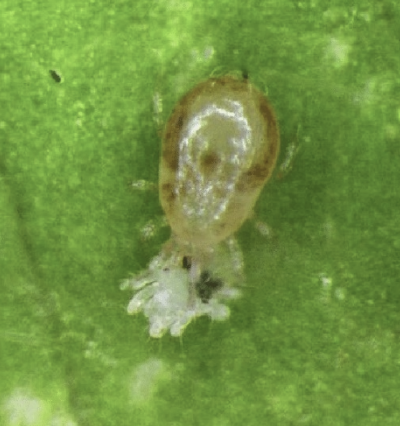
Predatory mite appearance (use a hand lens):
As Eggs
Small, on the underside of leaves
Oblong
Translucent white
As Larvae
Oval-shaped, 6 legs
Translucent white or light brown
As Nymphs
Slightly larger than larvae, 8 legs
As Adults (Figures 3 and 4)
Extremely tiny, but slightly bigger than
prey
Translucent white, light brown, green, red,
or orange, 8 legs (Figure 4)
Move more quickly than pest mites
Often orange when smashed/streaked
How Do I Use Them?
Getting Predatory Mites
Encourage naturally by using an untouched plant reservoir
Purchase sachets of predators
May need to be reintroduced if they leave after decimating the prey population
Keeping Predatory Mites
Avoid use of broad-spectrum insecticides
This will kill the predators along with the pests!
UD Cooperative Extension
This institution is an equal opportunity provider.
In accordance with Federal law and U.S. Department of Agriculture policy, Cooperative Extension is prohibited from discriminating on the basis of race, color, national origin, sex, age, or disability.