



M.S. in Animal Health (Non-thesis)
Dive in UD’s M.S. in Animal Health and prepare for veterinary school: youtube.com/watch?v=1f6dCpVWciU
M.S. in Animal Health (Non-thesis)
Our program provides students with theoretical, technical, and practical training relevant to advancing career opportunities in animal science. This program is ideal for recent graduates aiming to expand their knowledge and experience base prior to entering into a professional degree program or the workforce. We also welcome returning students looking to advance their careers.
The program can be completed in one year as a full-time student or approximately two years as a part-time student. Students work with their advisor to develop an individualized plan of study. Many graduates of the program continue to veterinary school; others enter skilled positions in animal or human health industries.
Jump to: Admissions Requirements | Application Deadlines | Curriculum | Cost of Attendance

Admissions requirements
Competitive applicants demonstrate an ability to thrive in this advanced training program. This includes:
- an undergraduate degree in animal science, biology, or a related field,
- an undergraduate GPA of 3.0 or greater, and
- strong letters of support from three recommenders.
View specific application and admission requirements through the application portal on the Graduate Admissions website.
Alumni spotlight
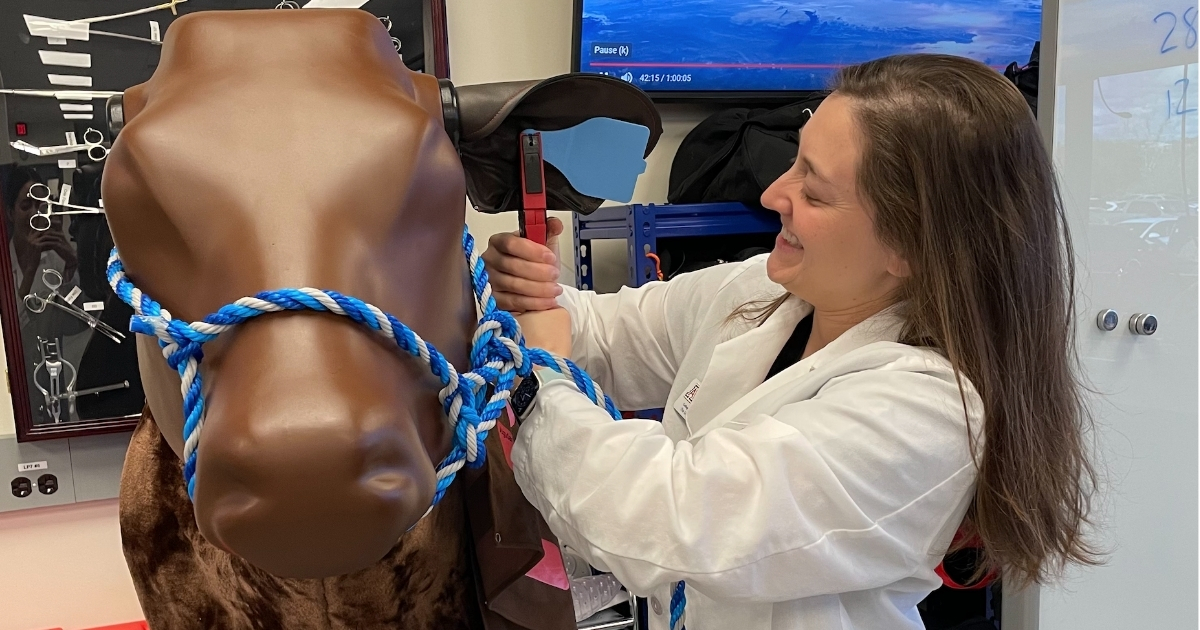

Application deadlines
Applications are considered on a continuing basis to allow for admittance in the fall, spring, or summer semesters.
Fall semester
- June 1 (international applicants)
- Aug. 15 (U.S. citizens)
Spring semester
- Nov. 1 (international applicants)
- Jan. 15 (U.S. citizens)
Summer semester
- April 1 (international applicants)
- May 1 (U.S. citizens)

Curriculum
This degree provides students with a strong theoretical foundation in veterinary biosciences, biotechnology, and One Health, practical experience with advanced molecular biology techniques, statistical skills, and research experience.
To accomplish this, students complete 30 credits of graduate coursework that include:
9 credits of coursework in host-pathogen interactions;
6 credits of coursework in nutrition and immunology;
9 credits of technical and practical training that provides real-world, hands-on skills;
3 credits of coursework related to statistical analysis of biological data; and
3 credit individualized research experience in a faculty member’s laboratory.
Complete degree requirements and course options can be found in the graduate catalog.

Cost of attendance
There are no scholarships or financial aid available for this degree program. The program requires 30 credits of coursework at a current cost of $1,116 per credit hour.
Most students are employed either full-time or part-time while completing the program. Due to the hands-on nature of the training, most courses are in-person and require students to live in or near Newark, Delaware.
The University of Delaware’s Graduate College website includes a variety of resources for prospective students, including estimates of the costs of attendance for graduate school.
Contact us
Tanya Gressley
Associate Dean, Graduate Programs
Office location:
531 S. College Avenue
032 Townsend Hall
Newark, DE 19716
Core Areas and Course Requirements
For the most up to date requirements, make sure to visit the graduate catalog.
Students will take courses from in Host-Pathogen Interaction (9 credits), Nutrition-Immunology (6 credits), Technical and Practical Training (9 credits), Research Training and Data Analysis (3 credits), and an Individual Research Experience (3 credits), resulting in a total of 30 credits. The Individual Research Experience is typically completed in the student’s final semester.
Most courses are only offered once a year (Fall or Spring), and some courses are offered every other year. Students should meet with their advisor at least once each semester to select courses and discuss degree progress.
Host-Pathogen Interaction Core (9 credit hours, 3 must be in ANFS)
- ANFS 635 Animal Virology (Fall)
- ANFS 639 Food Microbiology (Fall)
- ANFS 640 Comparative Histopathology (alternating Spring semesters)
- ANFS 648 Current Topics in One Health (Spring)
- ENWC 611 Insect Pest Management (Fall)
- BISC 625 Cancer Biology (Spring, may not be open to ANFS)
- BISC 682 Bacterial Pathogenesis (Spring)
Nutrition-Immunology Core (6 credit hours, 3 must be in ANFS)
- ANFS 624 Monogastric Nutrition (Fall odd years)
- ANFS 636 Immunology of Domestic Animals (Fall)
- ANFS 654 Advanced Ruminant Nutrition (Fall even years)
- ANFS 655 Gut Health of Domestic Animals (alternating Spring semesters) ANFS 675 Veterinary Biochemistry (Spring)
- NSCI 640 The Immune System & Behavior (Spring)
Technical and Practical Training (9 credit hours)
| Department | Course # | Course Title (semester) |
|---|---|---|
| ANFS | 644 | Bioinformatics (Infrequent) |
| ANFS | 650 | Applied Biomedical Communications (alternating Spring semesters) |
Animal Health MS – Course Requirements
| Department | Course # | Course Title (semester) |
|---|---|---|
| ANFS | 671 | Paradigms in Cell Signaling (Infrequent) |
| BINF | 644 | Bioinformatics (Fall, Spring) |
| BINF | 650 | Protein Modifications (Spring, not spring 2024) |
| BINF | 694 | Systems Biology I (Fall) |
| BMEG | 679 | Introduction to Medical Imaging Systems (not offered fall or spring 2024) |
| CHEM | 624 | Practical Mass Spectrometry (Spring; not spring 2024) |
| CHEM | 645 | Protein Structure and Function (Spring; not spring 2024) |
| CHEM | 646 | DNA-Protein Interactions (Fall; not fall 2024) |
| MMSC | 603 | Research Design (Summer, Fall) |
| MMSC | 608 | Molecular Prep. Techniques (Fall) |
| MMSC | 625 | Basic Recombinant DNA Techniques (Fall) |
| MMSC | 626 | Protein Purification and Characterization (Spring) |
| MMSC | 627 | Flow Cytometry (Spring) |
| MMSC | 635 | Practical Genomics, Proteomics & Bioinformatics (Fall) |
| MMSC | 651 | Cell and Tissue Culture Techniques (Spring) |
| MMSC | 691 | Human Molecular Genetics (Winter, Spring, Summer, Fall) |
| MMSC | 692 | Applications of Molecular Diagnostic Techniques (Spring) |
Research Training and Data Analysis (3 credit hours)
| Department | Course # | Course Title |
|---|---|---|
| BISC | 643 | Biological data analysis (Fall) |
| STAT | 608 | Statistical Research Methods (Spring, Summer, Fall) |
| STAT | 656 | Biostatistics (Spring, Summer) |
Individual Research Experience (3 credit hours of ANFS 668)
- Arranged with Advisor
Course offerings vary each semester and year. Most courses are available only in the fall or only in the spring, and some courses are taught only once every two years. The semester when courses are typically offered is outlined above, though this is subject to change. Make sure you meet with your advisor as you complete the Planned Program of Study Approval Form, as your advisor will likely have insight into when courses are offered. We recommend picking several back-up courses as substitutes if planned courses are unavailable.
Make sure the correct term is selected and then search using the Course ID. You can use partial Course IDs to see more complete lists (for example ANFS 6... will list all the 600 level ANFS courses).
Once you have found the courses you are interested in, try to register by following the steps indicated by the registrar.
In many cases, graduate-level courses have prerequisites, and the registration system may not recognize that you have taken an appropriate prerequisite, especially if it was taken at a different institution. If you are unable to register for the course, email the course instructor, your advisor, or the graduate program director for assistance with being placed in the course.
Students enrolled full time must take at least 9 credits each fall and spring semester. Full time students typically take a maximum of 12 credits, but additional credits may be taken with the approval of the student’s advisor and the Graduate College. Students electing to take between 1 and 8 credits are considered part time. Enrollment is not required in the winter or summer terms to maintain full or part time status, but students who do not take courses in the fall or spring must apply for a leave of absence. International students studying at UD on a visa must maintain full time status. Please familiarize yourself with UD’s academic policies.
Course substitutions are permitted with the approval of the advisor and graduate program director.
Full-time students will typically complete the degree in one or one and a half years. Part-time students who are also working will typically complete the degree in about two years.
Example schedules for students aiming to complete their degrees in one or two years are below. There are many schedule options, and student interests and course offerings vary. These are just examples to demonstrate how a student might complete the degree.
Schedule Example (One Year to Complete Degree)
Example only. Students will work with their advisor to create a personalized plan.
Fall Semester (12 credit hrs.)
- ANFS 635 Animal Virology (3 cr.)
- ANFS 654 Advanced Ruminant Nutrition (3 cr.)
- BISC 643 Biological Data Analysis (3 cr.)
- MMSC 603 Research Design (3 cr.)
Winter Term (3 credit hrs.)
- MMSC 691 Human Molecular Genetics (3 cr.)
Spring Semester (12 credit hrs.)
- ANFS 636 Immunology of Domestic Animals (3 cr.)
- ANFS 675 Veterinary Biochemistry (3 cr.)
- BISC 625 Cancer Biology (3 cr.)
- MMSC 626 Protein Purification (3 cr.)
Summer Term (3 credit hrs.)
- ANFS 668 Research* (3 cr.)
Schedule Example (Two Years to Complete Degree)
Example only. Students will work with their advisor to create a personalized plan.
First Fall Semester (9 credit hrs.)
- ANFS 635 Animal Virology (3 cr.)
- ANFS 654 Advanced Ruminant Nutrition (3 cr.)
- MMSC 608 Molecular Preparatory Techniques (3 cr.)
First Spring Semester (6 credit hrs.)
- ANFS 636 Immunology of Domestic Animals (3 cr.)
- MMSC 626 Protein Purification (3 cr.)
Summer Semester (0-3 credit hrs.*)
- Required course — Student can take a course to offset the load of a fall/spring semester, but summer courses are not required.
Second Fall Semester (6 credit hrs.)
- BISC 643 Biological Data Analysis (3 cr.)
- MMSC 603 Research Design (3 cr.)
Second Spring Semester (9 credit hrs.)
- ANFS 675 Veterinary Biochemistry (3 cr.)
- BISC 625 Cancer Biology (3 cr.)
- ANFS 668 Research* (3 cr.)
Graduate Application and Admission Process
Types of Degrees and Financial Support
The Department of Animal and Food Sciences offers 3 non-thesis MS degrees (MS in Animal Health, Applied Animal Science and Food Technology) and 3 thesis or dissertation-based MS and PhD degrees (MS in Animal Science; MS in Food Science; PhD in Animal and Food Science). Students admitted into non-thesis MS programs are responsible for paying tuition and no scholarship support is available. Students admitted into thesis or dissertation-based programs are supported with research or teaching assistantships.
Admission Process for Non-Thesis Programs
Applications for the non-thesis programs are reviewed on a rolling basis by the Graduate Advisory Committee. Applicants with a competitive GPA (typically > 3.0), a relevant undergraduate degree, and strong letters of support are most likely to be admitted. There are no scholarships or funding available for non-thesis students. Students wishing to apply to those programs can do so online through Graduate Admissions to UD.
Admission Process for Thesis or Dissertation-Based Programs
A student is accepted into a thesis or dissertation-based program only if a faculty member possessing adequate financialsupport agrees to admit and advise thatstudent. Forthisreason, formal application to the Animal Science MS, Food Science MS or Animal and Food Science PhD program should be delayed until such time as a tentative agreement of support is reached with a potential advisor.
Faculty members who advise students in the MS program in Food Science or the PhD in Animal and Food Sciences with a focus on food science are Dr. Chen, Dr. Kniel, Dr. Tan, and Dr. Wu. Faculty members who
advise students in the MS program in Animal Science or the PhD in Animal and Food Sciences with a focus on animal science are Dr. Abasht, Dr. Dutta, Dr. Gressley, Dr. H. Li, Dr. Y. Li, Dr. Muyyarikkandy, Dr. Parcells, Dr. Pisano, Dr. Schmidt, and Dr. Yitbarek. The only way to find out whether a faculty member has a position available is to contact them by e-mail; be sure to include a statement of introduction and a resume for review. Applicants should follow-up with a repeat e-mail if a response is not received in a reasonable amount of time (~2 weeks). Applicants who do not receive a response can assume that the faculty member does not have a position av available. Due to the limited availability of faculty with
assistantships, applicants should only formally apply if encouraged to do so by a potential faculty advisor. Students who have been encouraged to apply should apply online through Graduate Admissions to UD.
At the request of a faculty member, the department’s Graduate Studies Committee will review an application and make a recommendation to the Department Chair.
Please understand that applicants are not reviewed for possible acceptance unless a potential advisor has an interest in advising a specific student and explicitly requests that an evaluation be conducted. This means that applicants should check with potential advisors to determine the status of their application.
If a decision is made to admit, the student will receive a letter of acceptance from the graduate office and an offer letter from the department outlining responsibilities, assistant type and funding level, health benefits, and other important information. Applications that have not been reviewed at the request of a faculty member will be rejected without review.
Application Deadlines
Formal application deadlines: For the fall semester (start approximately September 1), students must apply by June 1 (international applicants) or August 1 (domestic applicants) of that calendar year. Dates for the spring semester (starting approximately February 1) are December 15 (international applicants) or January 15 (domestic applicants). Non-thesis programs can also begin in the summer (approximately June 1), and the corresponding application deadlines are April 1 (international applicants) and May 1 (domestic applicants).
Other notes on the application timeline: Applicants are encouraged to apply well in advance of the deadlines, as delays may occur, particularly for students requiring a visa. Students applying to thesis- or dissertation-based programs should apply as soon as encouraged to do so by a faculty advisor.
Application Fee
The department does not provide application fee waivers. Occasionally, a faculty member wishing to accept a student into a thesis- or dissertation-based program in their lab will pay the application fee. In such a case, the supporting faculty member will contact the graduate program coordinator to arrange to pay the application fee.
Test Requirements
The department does not require the GRE. Students from non-English-speaking countries are required to demonstrate English proficiency prior to admission. Students whose previous degrees were conducted at English-speaking institutions are exempt from this requirement.
Applicants with additional questions may contact Graduate Program Director Tanya Gressley or Graduate Program Coordinator Krista Urbaniak.