Agricultural policy making

Graduate Programs
The Department of Applied Economics and Statistics offers graduate master’s programs focused on the study of quantitative economics, international agricultural trade, economic development and resource economics, marketing and policy.
Graduate degree programs include:
1. M.S. in Agricultural and Resource Economics
3. M.S. in Applied Statistics (online)
4. Ph.D. in Statistics Data Science
Additionally, the department participates in the interdisciplary M.S. in Data Science program. Degree requirements include coursework from three departments (and colleges): the Department of Mathematical Sciences (Arts and Science), the Department of Applied Economics and Statistics (Agriculture and Natural Resources) and the Department of Computer and Information Sciences (Engineering).
UD ranks in the Top 100 Graduate Programs in Statistics.

Research News
-
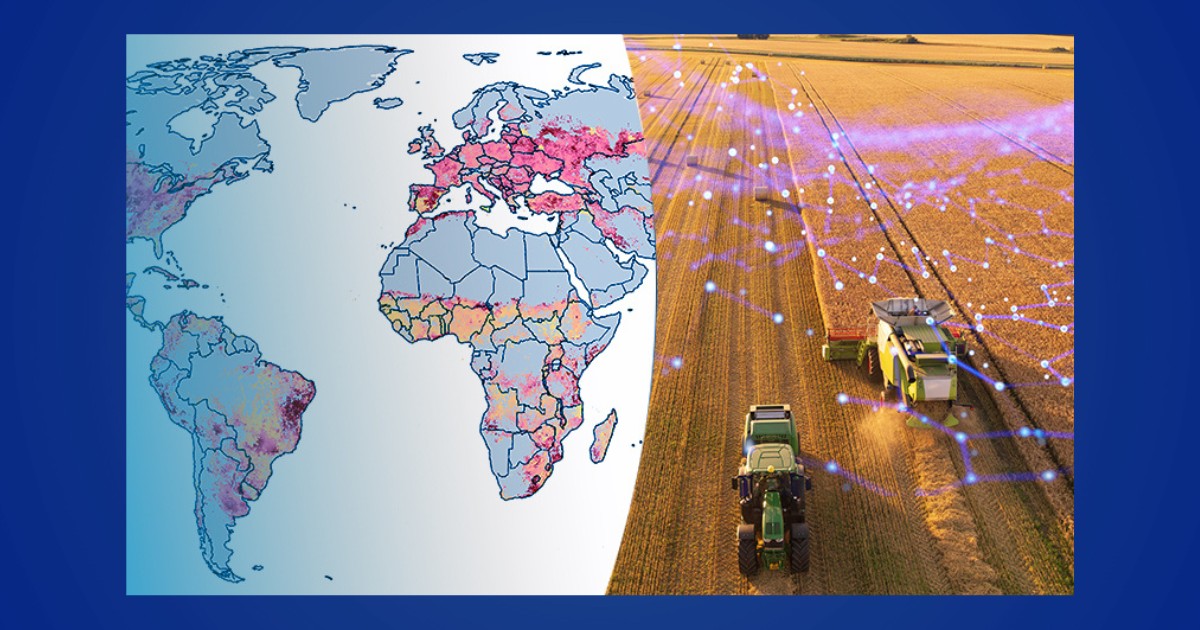
Global crops and drought
July 30, 2026 | Written by Adam Thomas | Illustration by Jeffrey C. ChaseA new study from the University of Delaware’s Kyle Davis examined production losses for 17 major crops accounting for three-quarters of the world’s food production and found that portions of the Midwestern United States, eastern Brazil, eastern Spain, and central and northern India were among the areas most sensitive to droughts. -
AI flower power
July 27, 2026 | Written by Katie Peikes | Photo illustration by Jeffrey C. ChaseYin Bao, University of Delaware assistant professor of digital agriculture, built a specialized AI tool called FLORIST to automatically analyze thousands of plant photos taken by everyday people, instead of manually sorting through 44,000 images. FLORIST efficiently filtered out the vast majority of photos that did not show active flowering, narrowing the dataset. Bao says the main takeaway is blending widespread public observations with deep genetic research gives a more complete understanding of how species evolve to survive in the wild. -
Phosphorus detective
July 16, 2026 | Written by Katie Peikes | Photos by Kathy F. Atkinson and courtesy of Deb JaisiPhosphorus gives plants their daily nutritional needs. But whatever phosphorus a plant can’t consume creeps into waterways and speeds up algae growth that can kill fish and aquatic plants. Fascinated by these properties, University of Delaware professor of Environmental Biogeochemistry Deb Jaisi has dedicated his academic career to exploring phosphorus and its presence in the environment. His innovative research has unlocked new ways to pinpoint where the phosphorus causing environmental damage is coming from.