



Applied Economics M.S.

Our M.S. in Applied Economics program encourages students to use analytical skills to engage with meaningful questions about human behavior in various economic contexts.
These are the questions they see on the news; the questions that consulting firms, local and state governments, and the federal government are working on, engaging society to analyze the economic challenges happening every day. Our master’s degree students are trained to develop a well-rounded understanding of how to solve those meaningful and policy-relevant questions. Our graduates are equipped for careers in all expanses of economics.
Jump to: About | Application Deadlines | Hands-On Research | Course Spotlights | FAQ | Related Programs
About
In this program, students will gain:
Theoretical knowledge in microeconomics and primary data collection necessary to complete human dimensions research;
Quantitative skills in econometric modelling as well as best methods for data collection, management, and analysis;
Competencies in behavioral economics, environmental economics, experimental economics, research methods, agriculture and food policy, resource economics, and/or stated preferences; and
Critical thinking, oral and written communication skills by composing and presenting a thesis.

Ready to Apply?
Program Contacts

Maik Kecinski
Graduate Director of the Center for Experimental & Applied Economics

Erma W. Wolpert

Our graduate students work one-on-one with faculty advisors to design and implement their thesis research. Students also build their professional networks through seminars, conferences, and unique opportunities to engage with experts in our field.
Associate professor of applied economics

From Day One, our graduate students are completely immersed in research. You will do everything from brainstorming an idea to publishing a paper. Along the way, students will develop a solid theoretical and analytical foundation.
Additionally, our program gives students access to behavioral and experimental economics that most other programs don’t have. Our Center for Experimental and Applied Economics boasts world class faculty who are working on numerous economic issues on a large scale as well as general behavioral economic theory.
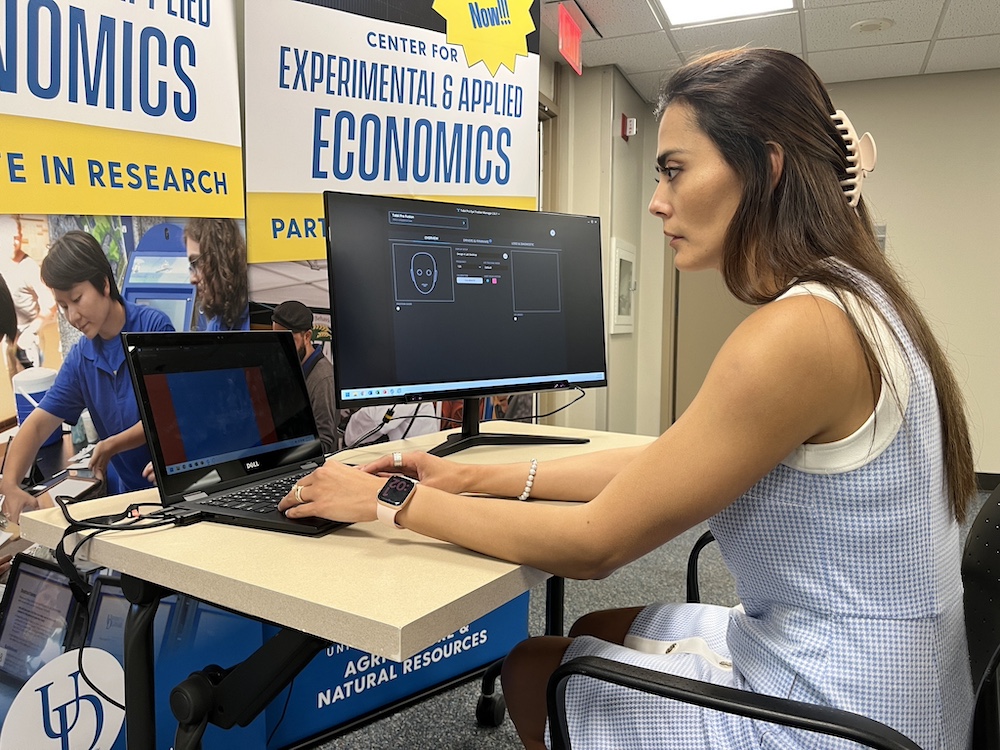
The Center for Experimental and Applied Economics offers numerous opportunities for our graduate students to get involved in research that explores economic and consumer behaviors and the forces behind human decision-making. Affiliated researchers have secured more than $77 million in external funding.
I had an extremely hands-on experience in all aspects of my research project...My advisor and I also published our findings in a peer-reviewed journal, which was really exciting! This program prepared me for multiple avenues in my career and sparked my curiosity in the field of applied economics.
UD alumna

Study of consumer theory (demand), theory of the firm (supply), and market equilibrium (putting demand and supply together). This includes a look at more advanced approaches to microeconomic theory, such as social preferences, behavior in the commons, market failures, risk and uncertainty, and review of recent literature. This course is math-heavy and requires a solid understanding of calculus.
Students analyze human behavior to explain the economic decisions people make. This course dives into the foundational models and ideas behind behavioral economics. The goal is to better understand human decision making and improve policy recommendations in response to behaviors that relate to various real-world scenarios.
Learn about lab and field experimental techniques and randomized controlled trials through this course. Students will learn about classic experimental games and read related literature that helps them understand what goes into experimental economics research. Students will replicate previously published experiments and write up results for their final project.
Students develop and analyze surveys and experiments that collect data for economic research. Methods taught include contingent valuation, conjoint analysis, discrete choice experiments, and experimental auctions. Students must have completed prerequisites APEC 801 and STAT 673.
This course offers training in applied economic and statistical research, providing both foundational knowledge and hands-on experience. Our journey begins with the nuts and bolts of multivariate regression analysis, taking a deep dive into the applications of Ordinary Least Squares (OLS) models. As we progress, you will be introduced to logistic models, simultaneous equations, time series data, and panel data analysis.
Our students don’t just analyze data, they design the surveys and experiments that generate it. Understanding how good data is created, and when it can be trusted, sets them apart whether they pursue a Ph.D. or careers in government or industry.
Genuardi Associate Professor of Food and Agribusiness Marketing

How to apply?
Applications are due by February 1 each year to be admitted in our Fall Semester (August) cohort. Due to course scheduling, we require students to begin the program in the Fall Semester.
Applications received after February 1, may be considered but it is unlikely that late applicants will be selected for graduate assistantships as these decisions are typically made in early February.
You may submit your application via this website.
There is a $75 application fee. Fee waivers are only granted for specific programs, including our Borel Global Fellows Program (see the “Criteria and Eligibility” section for more information about who is eligible for the Borel program). Waivers are not granted for direct applicants to the AREC program. View additional application fee details.
Application checklists and additional information for domestic and international students can be found on the Graduate Admissions at UD webpage.
- Copies of official transcripts are required at the application stage from each institution where you have:
- earned (or will earn) a degree;
- studied for one semester or more;
- earned 12 or more hours of credit; or
- taken classes that relate to your graduate study interests.
- Unofficial transcripts are allowed at the application stage. Official transcripts are required after admission to the program. Please review the UD Graduate College’s requirements.
- Official GRE scores are required. UD’s institution code is 5811. Please review the UD Graduate College’s requirements.
- English Language Proficiency Test Scores are required for non-exempt international students. Students for whom English is not their first language must meet a minimum of 100 on the TOEFL IBT examination. Please review the UD Graduate College’s requirements.
The application requires a personal statement, three letters of recommendation, and your CV/resume.
- Personal statement - In your personal statement we ask you to outline your educational plans and career goals and discuss how your proposed plan of graduate study relates to them. Some areas of discussion might include: Specific attributes of the program at UD that lead you to believe that this degree is appropriate to help you achieve your professional objectives. Within the area of study you have selected, are there areas of special interest to you?
- Three letters of recommendation
- CV/resume
- Additional information - You will also be given an opportunity to provide information about additional relevant experiences in the following topic areas: community involvement and/or service; leadership; overcoming social, economic, or physical barriers; personal and/or professional ethics; coachability; additional experiences. Responses for each topic area are limited to 300 words. This section is optional.
All application materials and an applicant’s potential to excel and contribute to our department are considered. We evaluate an applicant’s academic record, work and personal experiences, ability to enrich our program with wide-ranging perspectives and knowledge, and interest in conducting research that aligns with research programs in our department.
Competitive applicants typically have an undergraduate GPA of more than 3.0 on a 4.0 scale, and most successful applicants have GPAs above 3.5 on a 4.0 scale.
Competitive applicants have a strong background in economics and statistics and a solid understanding of calculus.
GRE scores above the 60th percentile will increase the applicant’s chances of admission, and more weight is placed on the Quantitative Reasoning score. There is not a set minimum requirement for GRE scores.
- TOEFL / IELTS: AREC complies with the UD Graduate College’s requirements for demonstrating English language proficiency.
A waiver of proof of English Proficiency is allowed when:
A bachelor’s, master’s, or doctoral degree has been or will be earned from a university recognized by the ministry of education in a country where English is the primary language. Our list of approved countries includes Anguilla, Antigua, Australia, The Bahamas, Barbados, Belize, Bermuda, Cameroon, Canada (except the province of Quebec), Cayman Islands, Dominica, Grenada, Ghana, Guyana, Ireland, Jamaica, Kenya, Liberia, Montserrat, New Zealand, Nigeria, Puerto Rico, St. Kitts and Nevis, St. Lucia, St. Vincent, Singapore, South Africa, Trinidad & Tobago, Turks and Caicos, The United Kingdom, Zambia and Zimbabwe.
A bachelor’s, master’s, or doctoral degree has been or will be earned from a college or university located in the United States and accredited by a regional accrediting association.
Cost and admission
- Details about graduate fees and financial aid can be found on the Graduate Catalog Fees and Financial Aid webpage.
- Graduate assistantships: Funding includes a stipend plus a tuition waiver and health insurance. The 2026-27 minimum stipend for nine-month contracts, at 20 hours per week (on average), is $36,000 for master’s students.
- We are able to offer funding through graduate assistantships to a few students each year.
You will be notified about acceptance and funding by the beginning of March.
An applicant who receives an offer of financial support is required to reply in writing by April 15. Earlier communication about the applicant’s decision is encouraged and appreciated. Learn more about accepting or declining offers.
We require students to begin the program in the fall semester.
Once you start the program
You do not need to be in communication with a faculty member before you apply. If you are interested in working with a particular faculty member you may state your interest in your personal statement, but this is not required. If your interests align closely with one of our faculty members, we encourage you to reach out to them directly and discuss whether they are seeking graduate research assistants.
Our faculty are engaged with a variety of exciting research projects that continue to change and evolve. We recommend reviewing the list of Faculty advisors to learn more about each faculty member’s research program.
Program completion
Our MS program offers students an excellent environment to develop the skills needed to achieve many career goals. We are proud to say that graduates with a MS in Applied Economics from the University of Delaware have many options. Some of our MS graduates continue on to Ph.D. programs, whereas others decide to work for various private entities, government agencies, and non-governmental organizations (NGOs).
Sorry, no results found.