



Category: Plant and Soil Sciences
Meet our new faculty: Alexandra Huddell
January 16, 2024 Written by Dante LaPenta | Photo by Michele Walfred
New University of Delaware faculty member Alexandra Huddell is keeping nitrogen in line!
“Nitrogen is extremely important in producing food,” said Huddell, who joined the Department of Plant and Soil Sciences in Fall 2023. “With that said, nitrogen does not always stay in place where we want it to. A significant amount of the nitrogen applied to crops escapes to local waterways or the atmosphere.”
You probably know what fertilizer is. You may even use it in your home garden. But what’s in it? Paired with phosphorus and potassium, most fertilizers contain nitrogen — the most common nutrient to plant growth. Applied correctly, fertilizer facilitates efficient food production in all corners of the globe; if you apply too much or at the wrong time, the environment pays the price.
That’s where Huddell’s research comes in. She’s interested in studying nitrogen’s role in food production and the consequences of using nitrogen fertilizer on today’s crops.
“Roughly half of nitrogen fertilizer is taken up by crops in a given year,” explained Huddell, assistant professor of agroecology/sustainable crop production systems. “I’m interested in how we can increase efficiency in soil nitrogen uptake and minimize harmful losses of reactive nitrogen that contribute to water pollution and greenhouse gas emissions. We accomplish that through better fertilizer management and conservation practices like cover crops and diverse cropping systems.”
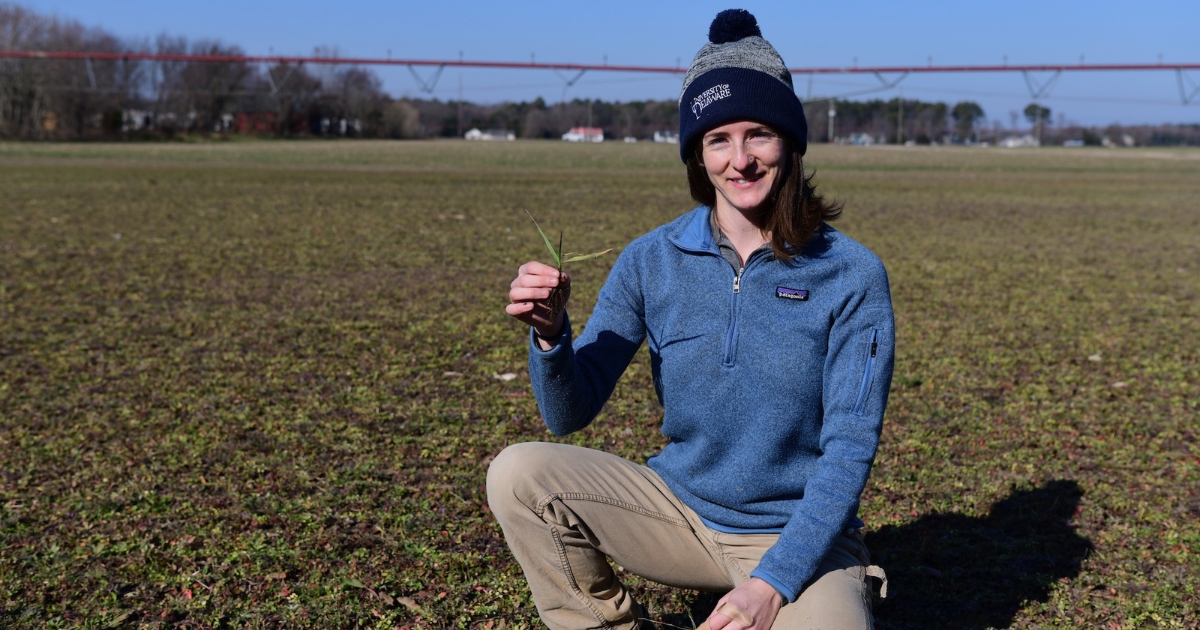
If you’re looking for Prof. Huddell, you’ll find her in a research plot on the UD Newark Farm, where she’s setting up pilot experiments, or taking soil samples at the UD Carvel Research and Education Center in Georgetown.
In addition to building momentum for her research, Huddell is busy crafting agroecology and sustainable agriculture coursework for budding University of Delaware scientists. In Spring 2024, Huddell teaches Introduction to Crop Science (PLSC 151), where undergraduate students study plant structure and processes in the production and management of commercial crops. And, in a future UD course catalog near you, look for Huddell’s upper level courses in sustainable agriculture, where students will dive deep into the intersection of ecosystem ecology, biogeochemistry and agronomy.
Whatever the course, Huddell always finds opportunities to get the students out of the classroom and into the field.
“When I was a student, the way that I learned best was to get out into the field to measure; that’s how you reinforce the concepts in the class,” emphasized Huddell. “Problem-solving is a great way to learn. I want to incorporate problem-based learning or hands-on measurements of soil and environmental processes into my courses.”
As she navigates year one at UD, Huddell is absorbing all that she can around the University and the state. She has enjoyed hearing about her colleagues’ work across the College of Agriculture and Natural Resources, learning about the agricultural industry across Delaware, and speaking to prospective students.
As a student herself, Huddell experienced a winding path to the field of plant and soil sciences. As an undergraduate economics major, the then American University student focused on international studies. As she deepened her knowledge, Huddell found herself gravitating to agriculture for its role in environmental sustainability and food security. Diving into the natural sciences and biogeochemistry, Huddell became engrossed in the role and life-sustaining importance of the nitrogen cycle.
“I was able to tie in social aspects in terms of producing food for people as well as reducing our impact on the planet,” said Huddell. “What I like about working in agriculture is we are constantly managing agricultural systems. There is a huge potential for impact by figuring out how we can manage these systems optimally.”
When Huddell was looking for her academic home, she sought a research university where she could straddle the lines between applied and basic research in the ecology and agronomy disciplines.
“Our Department of Plant and Soil Sciences has a wealth of experts that bridged that gap and represent a lot of depth in those disciplines,” stressed Huddell. “So UD was an ideal fit.”