



Category: Research
Global environmental advocate
September 06, 2022 Written by Dante LaPenta | Photo by Monica Moriak
The American Geophysical Union (AGU) named University of Delaware faculty member Rodrigo Vargas the 2022 recipient of the Piers J. Sellers Global Environmental Change Mid-Career Award. The annual honor recognizes outstanding contributions in research, educational or societal impacts in the area of global environmental change, especially through interdisciplinary approaches.
“This award is such an honor for many reasons. Global environmental change is an area in which I am heavily invested,” said Vargas, professor of ecosystem ecology and environmental change in the Department of Plant and Soil Sciences. “I am humbled because of the previous recipients of this award, who have inspired me throughout my career.”
Vargas is the first Hispanic researcher to be recognized for this honor.
“With this recognition comes great responsibility to be a role model for minorities in science,” emphasized Vargas.
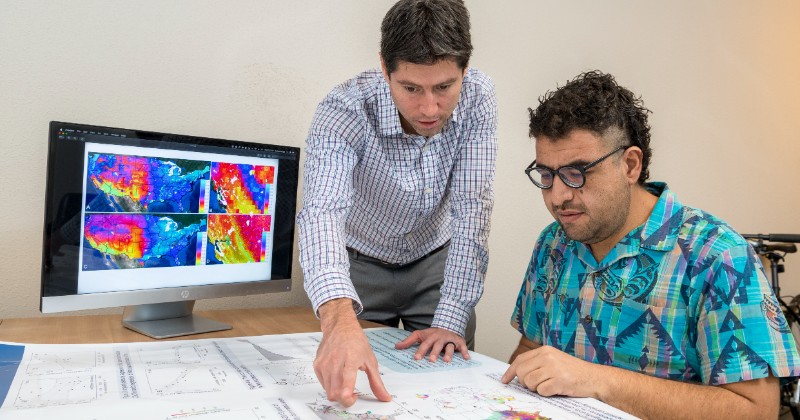
The UD faculty member is a renowned researcher, studying soil-plant-atmosphere interactions to understand how ecosystems ‘breathe’ and the global carbon cycle. He analyzes the controls and implications of carbon and water fluxes in ecosystems around the world to better understand how they will respond to changing climate and extreme events like major storms or drought.
Scott Collins, distinguished professor and the Loren Potter Chair of Plant Ecology at the University of New Mexico, nominated Vargas.
“Rodrigo has made numerous important contributions to our understanding of the global carbon cycle,” said Collins. “He has made fundamental contributions to the use of environmental sensor networks and sensor technology, which has made him a national and international leader in studying the impacts of climate change on ecosystem carbon budgets,”
Through his Ph.D. advisor Michael Allen at the University of California, Riverside, Vargas was introduced to and began working with Collins on a climate change experiment. The study analyzed how precipitation variability changed carbon dynamics in a desert grassland. Vargas seized the opportunity to take part in Collins’ experiment as part of the Sevilleta Long Term Ecological Research (LTER).
“Working with Scott gave me an opportunity to learn about long-term ecological experiments,” explained Vargas. “He opened doors for me and remained a mentor since then.”
This American Geophysical Union award is the latest, high-level honor for the Department of Plant and Soil Sciences researcher. As a faculty member, he’s earned UD’s Mid-Career Faculty Excellence in Scholarship Award, UD‘s Latino/Hispanic Heritage Impact Award and a Mexican Carbon Program National Award. Vargas is one of two UD faculty members named as an Earth Leadership Program Fellow; the other recipient is former UD president Nancy Targett. Clarivate, a global analytics company, recognized Vargas on its 2021 global list of Highly Cited Researchers, ranking in the top one percent by citations over the past decade.
About the American Geophysical Union award
The award is named to honor the work and life of Piers J. Sellers, an accomplished astronaut, AGU fellow and member of the Global Environmental Change Section who pioneered vegetation and carbon modeling. AGU supports a global community of individuals and organizations interested in advancing discovery in Earth and space sciences and its benefit for humanity and the environment.