



Current Graduate Students
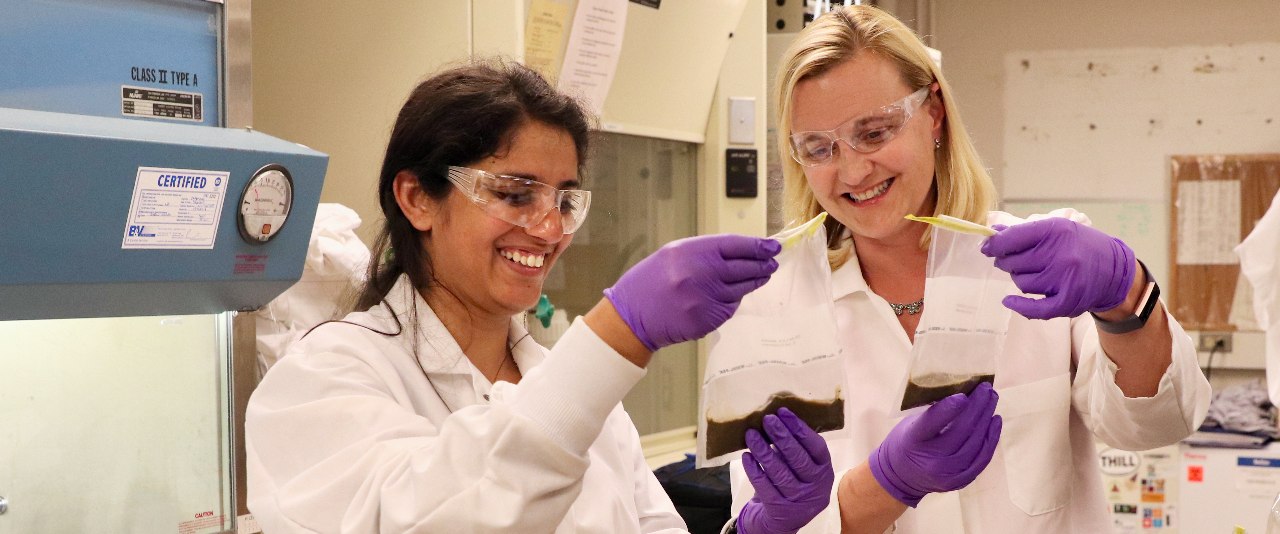
Committed graduate student success
For questions on a specific program, the graduate program director in each department can serve as a contact for further information.
- Animal and Food Sciences: Dr. Tanya Gressley
- Applied Economics and Statistics
- MS Statistics: Dr. Wei Qian
- MS Applied Statistics: Dr. Tom Ilvento
- MS Agricultural and Resource Economics: Dr. Leah Palm-Forster
- Entomology and Wildlife Ecology: Dr. Deb Delaney
- Plant and Soil Sciences: Dr. Jeffry Fuhrmann
Quick links
Graduate programs by department


-
Downed Milton pecan tree determined to be 109 years old
October 22, 2026 | Ryan Mavity | Cape GazetteResearchers from the University of Delaware and the U.S. Forest Service determined a pecan tree that formerly stood at the corner of Union Street Extended and Route 16 in Milton was about 109 years old when it was cut down in January. -
Fighting food waste
October 15, 2026 | Written by Katie PeikesUniversity of Delaware researchers use black soldier fly larvae to keep food waste out of landfills and turn scraps into compost and potential livestock feed. -
Kickstarting Mid-Atlantic Kernza
October 09, 2026 | Written by Katie PeikesKernza, the world’s first commercially available perennial grain, has been picking up steam in regenerative agriculture, a conservation approach focused on improving soil and ecosystem health. UD scientists teamed up with scientists from the U.S. Department of Agriculture’s Agricultural Research Service and the Massachusetts Institute of Technology to study and compare Kernza’s roots with the roots of common crops. -
Communicating plant stress
October 06, 2026 | Written by Katie Peikes | Photo illustration by Jeffrey C. Chase | Photos and video courtesy of Jung-Youn LeeUniversity of Delaware plant scientists have uncovered new knowledge that tiny nanopores called plasmodesmata send alert signals from cell to cell, generating a huge burst of hydrogen peroxide when a plant is wounded. The team recently published their findings in the journal The Plant Cell. The role of this burst of hydrogen peroxide is a key finding that could prove useful in engineering more climate-resilient crops.

Thabu Mugala
Thabu Mugala is a Ph.D. candidate in Entomology and Wildlife Ecology, where she studies sustainable pest management using natural enemies such as parasitic nematodes and ground beetles to control agricultural pests like slugs in conservation ag systems in Dr. Michael Crossley's lab. Her work is driven by a passion for developing environmentally friendly solutions that support farmers while reducing reliance on chemical pesticides.
Before beginning her doctoral studies, Thabu gained her master's degree in Entomology at Stellenbosch University in South Africa, where she investigated the ecology and biocontrol options of the potato leaf miner, and a bachelor's degree in agriculture engineering and Natural Resource Management at EARTH University in Costa Rica, where she studied entomopathogenic fungi and Bt-biopesticides efficacy for fall armyworm control.
While in her PhD program, Thabu has contributed towards peer-reviewed publications, with 3 more in preparation and presented her work at more than 30 conferences, symposiums, extension and outreach events and workshops across the US. Through her Ph.D. research, Thabu has been recognized with multiple distinctions, including three first-place placements, four second-place finishes and three audience-choice honors in student presentations and poster competitions and further contributed to securing her research funding.
Across her work, she is committed not only to advancing sustainable agriculture but also to mentoring students and engaging broader communities in conversations about science and food systems. She aims to build a career that bridges research, extension, and global collaboration in integrated pest management.

Harkirat Mashiana
Coming from Punjab, India, Mashiana grew up with agriculture all around; it was only natural that it became her passion. That love for plants and science led her to pursue my master's in plant science at the University of Delaware. She credits her advisor, Dr. Meng, for guiding her research and shaped the way she thinks, works, and communicates as a scientist. With his support, Mashiana also had the opportunity to present her research at the American Society for Horticultural Science (ASHS) Conference, where she won two awards for my presentations, and was also recognized at our college's Three Minute Thesis competition.
Outside the lab, Mashiana servies as president of the Indian Graduate Student Association, she gives gave her a chance to give back to her community. She enjoys every bit of her graduate program, including the research, coursework, writing, and presenting. Her labmates made her research journey smoother; wonderful friends made along the way made UD feel like home. And through it all, her family back in India cheers her on from thousands of miles away. Mashiana is extremely grateful to all these wonderful people; she isexcited to continue this journey as a Ph.D. student under Dr. Meng's mentorship.
| Year | Awardee | Department |
| 2026 | Harkirat Mashiana | Plant & Soil Sciences |
| 2026 | Thabu Mugala | Entomology & Wildlife Ecology |
| 2025 | Carl Nelson-Poteet | Applied Economics & Statistics |
| 2025 | Alexis Omar | Animal & Food Sciences |
| 2024 | Franklin Linam | Plant & Soil Sciences |
| 2024 | Anna Wockenfuss | Plant & Soil Sciences |
| 2023 | Spencer Moller | Plant & Soil Sciences |
| 2023 | Amanda Crandall | Entomology & Wildlife Ecology |
| 2022 | Polina Dineva | Applied Economics & Statistics |
| 2022 | Imogene Cancellare | Entomology & Wildlife Ecology |
| 2021 | Ryan Moore | Plant & Soil Sciences |
| 2021 | Emma Ruggerio | Plant & Soil Sciences |
| 2020 | Shani Craighead | Animal & Food Sciences |
| 2020 | Sergio Caberera-Cruz | Entomology & Wildlife Ecology |
| 2019 | Alyssa Lutgen | Water Science & Policy |
| 2019 | Tyler D. Sowers | Plant & Soil Sciences |
| 2018 | Hannah Clipp | Entomology & Wildlife Ecology |
| 2018 | Desiree Narango | Entomology & Wildlife Ecology |
| 2017 | Grace Savoy-Burke | Entomology & Wildlife Ecology |
| 2017 | Adrienne E. H. Shearer | Animal & Food Sciences |
| 2016 | Amanda Roberson | Plant & Soil Sciences |
| 2016 | Solny Adalsteinsson | Entomology & Wildlife Ecology |
| 2015 | Melissa Savin | Plant & Soil Sciences |
| 2015 | Sarah Markland | Animal & Food Sciences |
| 2014 | Allison Rogers | Animal & Food Sciences |
| 2014 | Rebecca Kern | Entomology & Wildlife Ecology |
| 2013 | Jacquelyn Marchese | Entomology & Wildlife Ecology |
| 2013 | Michelle Windle | Animal & Food Sciences |
| 2012 | Jixian Zhai | Plant & Soil Sciences |
| 2012 | Kirsten Hirneisen | Animal & Food Sciences |
| 2012 | Rachael Vaicunas | Bioresources Engineering |
| 2011 | Sudarshan Dutta | Plant & Soil Sciences & BREG |
| 2011 | Jacob Fooks | Food & Resource Economics |
| 2010 | Meredith Biedrzycki | Plant & Soil Sciences |
| 2010 | Laura Nemec | Animal & Food Sciences |
| 2010 | Zachary Ladin | Entomology & Wildlife Ecology |
| 2009 | Ellen Lake | Entomology & Wildlife Ecology |
| 2009 | Sarah Goodwin | Entomology & Wildlife Ecology |
| 2008 | Hudaa Neetoo | Animal & Food Sciences |
| 2008 | Bridget Collins | Entomology & Wildlife Ecology |
| 2007 | Kristian Paul | Plant & Soil Sciences |
| 2007 | Anthony Gonzon | Entomology & Wildlife Ecology |
| 1997 | Sharon Keeler | Plant & Soil Sciences |
| 1994 | Michael Stapleton | Plant & Soil Sciences |
| 1993 | Sandy Cloud | Animal & Food Sciences |
-
Downed Milton pecan tree determined to be 109 years old
October 22, 2026 | Ryan Mavity | Cape GazetteResearchers from the University of Delaware and the U.S. Forest Service determined a pecan tree that formerly stood at the corner of Union Street Extended and Route 16 in Milton was about 109 years old when it was cut down in January. -
Fighting food waste
October 15, 2026 | Written by Katie PeikesUniversity of Delaware researchers use black soldier fly larvae to keep food waste out of landfills and turn scraps into compost and potential livestock feed. -
Kickstarting Mid-Atlantic Kernza
October 09, 2026 | Written by Katie PeikesKernza, the world’s first commercially available perennial grain, has been picking up steam in regenerative agriculture, a conservation approach focused on improving soil and ecosystem health. UD scientists teamed up with scientists from the U.S. Department of Agriculture’s Agricultural Research Service and the Massachusetts Institute of Technology to study and compare Kernza’s roots with the roots of common crops.
A video of Transforming Lives with Scholarships: Shem Msabila, Marcia & Jim Borel: youtube.com/watch?v=FvfcsQJw8Sw
Shem Msabila, ANR24, from Tanzania, Africa never even imagined the possibility of researching plants in the United States. He had heard “no” too many times to have hope in pursuing research that will make a difference in his home country. But funding from Marcia and Jim Borel helped Shem experience more that he could have ever dreamed.