



Category: Cooperative Extension
Financing the Future of Agriculture: Delaware Agriculture shares feedback with the Federal Reserve Bank
September 14, 2026 Article and photos by Michele Walfred
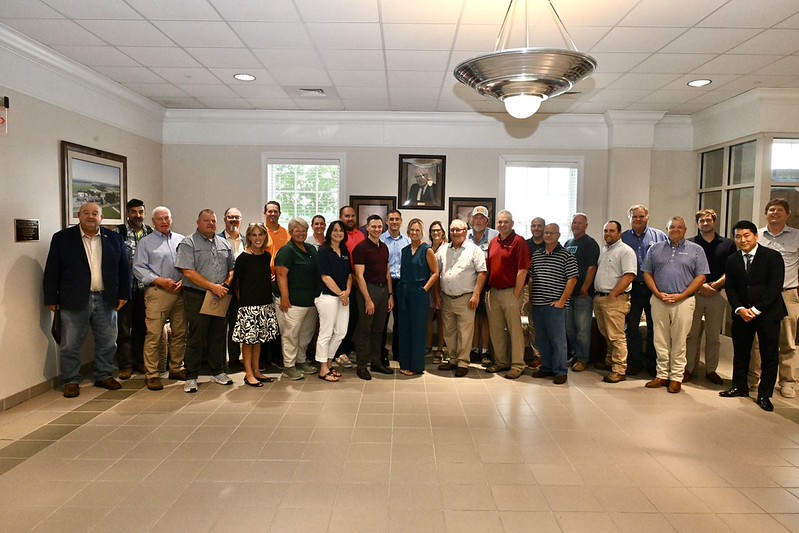
In early September, individuals representing a cross-section of Delaware agriculture accepted invitations to a candid conversation with the Federal Reserve Bank. The attendees included produce and grain growers, poultry and dairy farmers, ag lenders, suppliers, commercial poultry integrators, and owners of agritourism venues. The event was hosted by the University of Delaware Elbert N. and Ann V. Carvel Research and Education Center in Georgetown.
During the hour-and-a-half conversation, the group of 25 was encouraged to speak frankly. While the exchanges were polite, frustration flowed freely.
Nate Kauffman paid close attention. A senior vice president and Omaha Branch Executive for the Federal Reserve Bank, Kauffman wanted to augment the data his agency relays to monetary policymakers in Washington, D.C., with real voices — authentic accounts of how current fiscal policies affect local farmers and how these farmers and businesses plan for their future amid uncertainty.
Kauffman reached out to Nate Bruce, farm business management specialist with UD Cooperative Extension, to plan a conversation with individuals representing Delaware agriculture.
“The Federal Reserve sets the monetary policy of the United States and therefore needs to understand how the economy is doing,” Bruce said.
Bruce recently heard Kauffman’s keynote speech at a National Risk Management Conference and knew Kauffman’s center conducted extensive economic analysis of the agriculture industry. Bruce was keen to include Delaware’s voices.
“The round table discussion was great for the Federal Reserve to understand the financial health of Delaware agriculture,” Bruce said. “It was an honor to have him speak here with our producers.”
Kauffman wanted to know the specifics of how his audience conducted their agricultural operations under current monetary policies, and what factors were considered when making decisions or planning for the future.
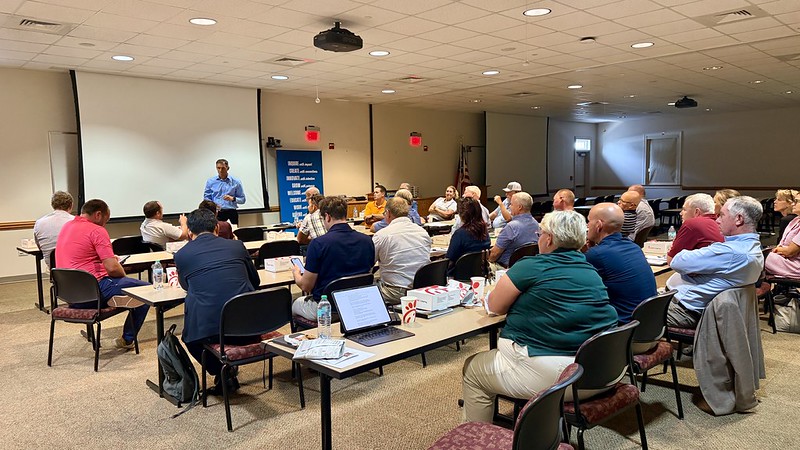
Kauffman’s branch is one of 12 regional Federal Reserve branches in the U.S. The Kansas City branch is the most agriculture-centric in the nation. An economist by training, Kauffman said the listening tours help round out the data they provide to inform policymakers who shape fiscal policy.
‘We want to give policy makers the best information possible; topics can surface in discussion that do not surface in data,” Kauffman told the gathering. “When we talk about agriculture at a national level, it is important that we are inclusive.”
Kauffman heard frustration among the common themes that emerged.
The drying up of credit and local banks placing cash flow over farm equity as a requirement to lend, and the high interest rates overall. Suppliers noted that customers are spending less, and when they do, they use credit cards but balk at paying credit card fees — additional costs that farm markets and suppliers are now forced to pass on.
The uncertainty of labor availability and labor costs.
Of great concern were the skyrocketing prices of utilities such as electricity and diesel, and fertilizers, which deeply impact cash flow. As a result, farmers often delay investments in new infrastructure, innovations, poultry houses and equipment. Instead, they are opting to maintain and repair what is already in place.
The shrinking of available farm land and the high price farm acres command in the First State.
According to the 2022 USDA National Agriculture Statistic Services, 31% of Delaware’s 522,834 acres of farmland is leased to private farmers.
Typically, a tenant farmer will lease year-to-year. Landowners are increasingly tempted by the high prices offered by commercial and residential development. Tenant farmers face few guarantees they can continue to farm the land they know, and makes extended planning nearly impossible.
Everyone in the room had a vested interest in how to keep their land in agriculture.
Delaware grain farmers receive a premium for grain due to their proximity and close relationship with Delmarva’s poultry growers, but there is not enough land to fill the need, especially for corn, which must be imported at a much higher cost.
The lack of a U.S. Farm Bill, currently stalled in Congress, was noted.
Dave Marvel felt sharing his perspective was valuable. Marvel farms in Kent County and grows small grains, corn, soybeans, wheat and barley, sweet corn for processing and watermelons.
“This was valuable for us as farmers and agriculturists in the area to realize that the Federal Reserve is interested in hearing from us and that our needs might not be the same as everyone else’s needs,” Marvel said. “Even though the Reserve impacts everybody, right now, with the economy of farming, it was definitely important to share how finance and interest rates affect our future.”