



Category: Entomology and Wildlife Ecology

Conservation in Tanzania
March 19, 2026 Written by Katie Peikes | Photos courtesy of Michael Toy and Aidan Short
Aidan Short remembers visiting the Philadelphia Zoo as a child. He could sit for hours, watching the rhinoceroses and the zebras run by. In particular, Short was captivated by Tony, a Southern White Rhinoceros who he basically grew up with.
As Short’s love for rhinos grew, so did his passion to protect the animal and thwart poaching efforts. Many rhino species are on the verge of extinction.
“They’re such an iconic African species,” said Short, a University of Delaware Class of 2027 wildlife ecology and conservation major. “We will not have the megafauna (large mammals) we have now if we don’t do something about it.”
Short dreams of working in large mammal conservation across Eastern Africa some day. So, imagine the raw emotions he felt being just a few feet away from several rhinos going about their way of life in northern Tanzania’s Ngorongoro Crater.
“I stood there and cried watching this one rhino just stand up and sit down,” Short said. “My dreams became so much more real.”
Short’s experience was part of the UD College of Agriculture and Natural Resources Winter Session study abroad program in Tanzania. Eighteen Blue Hens were immersed in a four-week guided safari where they observed rhinos, lions, elephants, cheetahs, and many other animals up close in their natural habitats. During the study abroad program, they learned and saw firsthand how wildlife and people can thrive alongside each other.
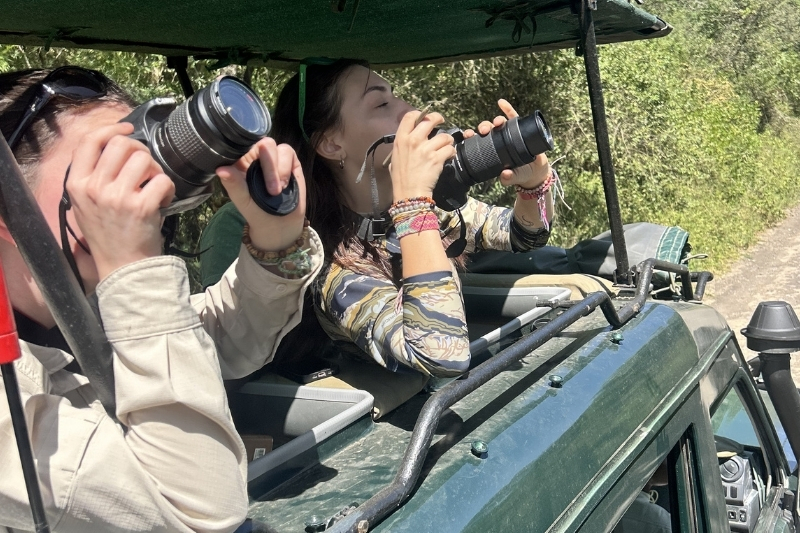

Observing wildlife on a safari
The intrepid Blue Hens spent time on an educational safari, where they closely observed animals and animal behavior in various national parks and reserves: Arusha National Park, Serengeti National Park, Tarangire National Park, and more.
Jake Bowman, professor of wildlife ecology and the associate dean of research at CANR, who led the Tanzania program, prepared his students on what they should look for and the safety protocols they needed to follow, such as being quiet and still around predators.
“The first leopard we saw was just your normal leopard in a tree,” Bowman said. “But the second one we saw had killed a wildebeest calf and it had it up in the tree late in the evening.”
The group went back first thing the next morning, and saw the leopard feeding on the wildebeest calf.
“We were right there,” said Michael Toy, a UD Class of 2026 accounting and finance double major. “There were a bunch of cars surrounding the leopard, keeping a safe distance. But we were close enough that we could totally see it.”
“You could hear her tongue rasping across the meat,” said Bowman, adding that he used that moment to talk quietly with students about leopards’ teeth.
Stella Pettit, a UD Class of 2027 wildlife ecology and conservation major, said that moment was one of her favorites. As was watching the calving season of the Great Wildebeest Migration. Wildebeests’ grazing helps nurture biodiversity and prevent wildfires. They are also important food for leopards and other predators.
“Wildebeests are so pivotal,” Pettit said. “They’re so important for the ecosystem because they migrate with the season.”
Bowman said this past Winter Session program showcased one of the larger diversity of mammals he has seen. Some of the standout moments he and a few students buzzed about included:
When a giraffe walked by their vehicles with birds on its neck as the sun set on the horizon;
A cheetah killing a Bohor reedbuck;
Baby elephants rolling around in mud;
Finding three Beesley’s lark, a rare species of lark with an estimated 200 or fewer left in the world;
A lioness stalking a zebra; and
A lioness chasing a waterbuck.
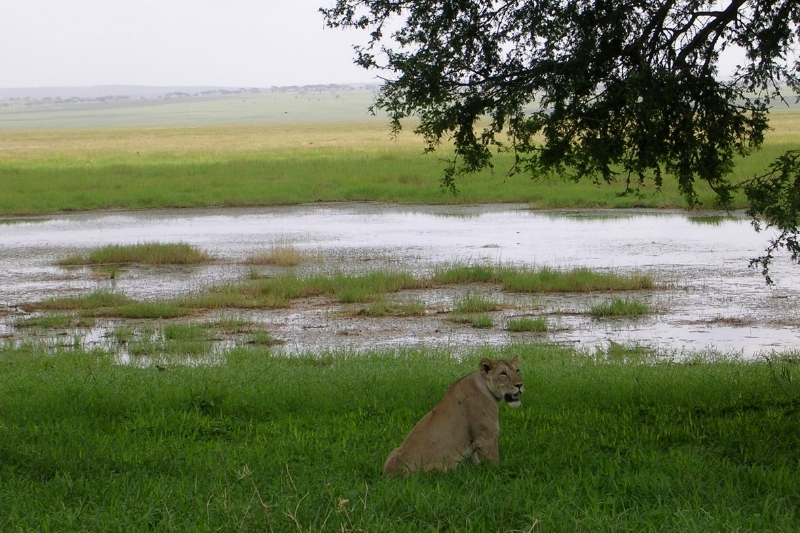
“We were in an open vehicle, and the lioness walked by us at two meters,” Bowman said. “She went for that water buck, and then she just sort of stopped, and when she stopped, she was right beside our truck. Everybody had to be super quiet and not move.”
Pettit said it was beautiful seeing all the wildlife up close. She was often emotional watching them roam around their natural habitat.
“There were so many moments like that that just felt larger than life,” Pettit said. “And it makes you feel really grateful to be alive.”

Engaging with Indigenous groups
One of the Tanzania program’s key objectives was to show students how people fit into the ecosystem. The students learned this through the courses Community-based Conservation (ENWC453) and Conservation of African Wildlife (ENWC452).
“We don't think enough about that here in the U.S. because most people are distant from wildlife. They're not living next door to them,” Bowman said. “Understanding what that means is important for any wildlife biologist to think about. How is this impacting people? And how does that impact whether I can conserve that species or not?”
To help students understand this, Bowman introduced them to members of two Indigenous tribes — a pastoral group of people called Maasai and hunter-gatherers called Hadza.
“We actually live with them when we are here,” Bowman said. “For the Hadza, we visit their land where they live in a protected area. With the Maasai, we visit the Ngorongoro Conservation Area, where they are the furthest away from civilization, most similar to the way you would’ve seen them 100 years ago.”
During the few days the group stayed with the Maasai, students got to watch them prepare a goat for dinner. Short ate a raw kidney, which he said tasted “gamey.”
With the Hadza, the UD students joined them to hunt kudus, a species of antelope.
“On the last night, we sat down by the fire with the Hadza,” Short said. “We all went around and spoke, and had some translators with us. The language we all understood was laughter.”
Short’s biggest takeaway from the study abroad was that people have a role to play in East Africa’s ecosystem, just as much as the various animals have their roles. For example, he said, the Maasai in their pastoralism coexist with herds of wildebeests.
Toy said his biggest takeaway from the Hadza and Maasai was to appreciate the small things.
“I learned how to not care about the material things, like we’re taught here. And to try to just live in the moment with what you have and find a way to be happy. They were all so happy all the time,” Short said.
As the students have returned to UD for the Spring 2026 semester, they are looking for ways to apply what they learned in Tanzania to their daily lives. Pettit, who is the president of the UD student chapter of the Wildlife Society, wants the society to build a more curious and hopeful community.
“I want to bridge agriculture and community-based conservation with indigenous traditional ecological knowledge and wildlife conservation,” Pettit said.
Pettit said overall, the Tanzania study abroad program has given her more of a purpose to pursue in wildlife conservation.
“I had a sense of oneness,” she said. “I had a sense of connection with the earth, and I had a sense of connection with my fellow students.”
