



Category: Plant and Soil Sciences
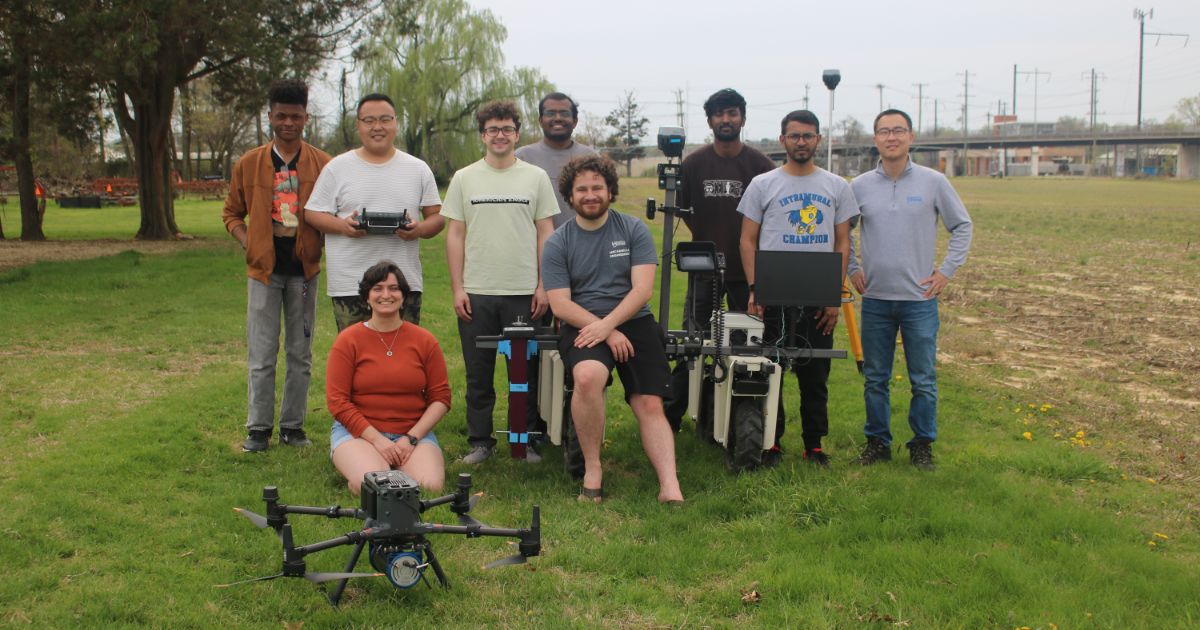
University of Delaware wins impact award at 2025 Farm Robotics Challenge
May 13, 2025 Written by Katie Peikes | Photo courtesy of Yin Bao
A team of University of Delaware students won a prize in a competition to design a technological solution to tackle agricultural challenges farmers face.
The UD Salty Blue Hens were awarded a Judges Choice Impact Award — a $2,500 prize sponsored by Google.org — in the 2025 Farm Robotics Challenge’s award ceremony May 8. The team built a robot and drone system automating soil salinity and moisture analysis. The technology uses a drone with a gamma-ray sensor to map soil variability in terms of radioactive isotopes and then directs a ground robot to strategically deploy a soil probe across the field. The goal is to monitor the impact of saltwater intrusion on soil productivity while reducing the need for manual labor, increasing the efficiency of soil mapping, and supporting precision agriculture (a type of agriculture that uses various technologies in farming) for smaller and mid-sized coastal farms.
The team’s faculty advisor, Yin Bao, an assistant professor with joint appointments in Plant and Soil Sciences and Mechanical Engineering, said the competition draws in students from across various disciplines to collaborate in identifying and solving problems farmers face.
“The students learned how to contribute their own knowledge and skills in an interdisciplinary team,” Bao said. “The students also gained new knowledge and experience in agronomy, robotics, or remote sensing and really appreciate the positive impact of technology on improving farmers' ability to make informed decisions on management practices and alleviate labor shortages.”
Jarrod Miller, a UD associate professor and extension specialist in agronomy, is an agricultural partner to the team.
“I was impressed with how quickly the team learned how to tackle the science behind saltwater intrusion and crop responses,” Miller said. “I believe they could take on a range of agricultural issues.”
More than 20 college teams from across the country and internationally competed this year. The 2025 Farm Robotics Challenge is hosted by the University of California Agriculture and Natural Resources and the AI Institute for Next Generation Food Systems with support from technology partner Farm-ng.