



Category: Animal and Food Sciences
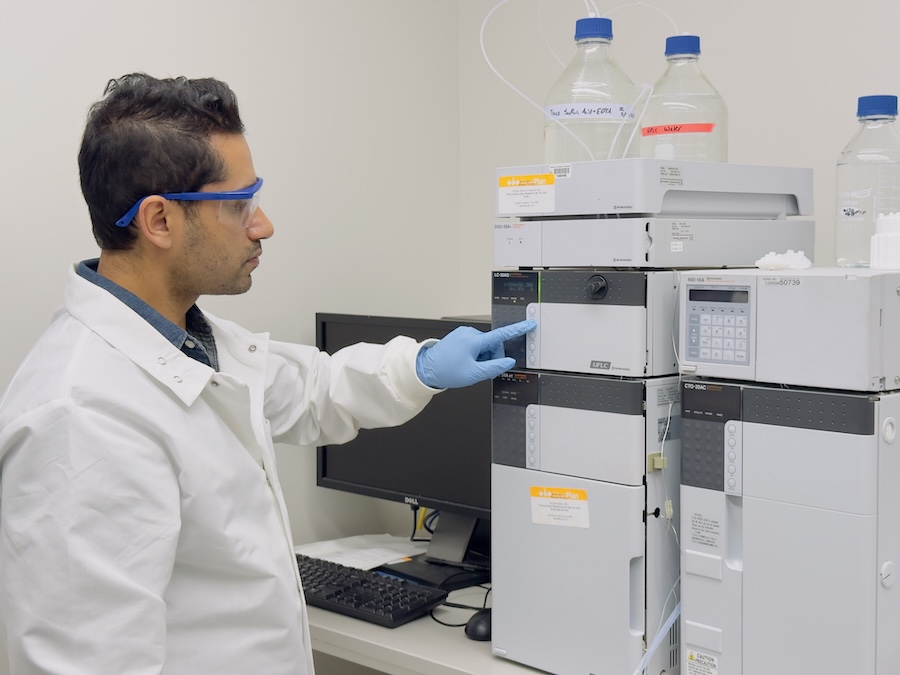
Meet our new faculty: Muhammed Shafeekh Muyyarikkandy
November 07, 2024 Story by Katie Peikes | Photo courtesy of Shafeekh Muyyarikkandy
While Muhammed Shafeekh Muyyarikkandy was pursuing his Ph.D. in animal science with a microbiology concentration, he spent time researching if healthy bacteria called probiotics could control infections of salmonella, a bad bacteria, in a variety of foods and animals including chicken eggs, fresh produce, live chicken, and mice.
He supplied each chicken egg either with the probiotics, the salmonella, or both, to watch the good bacteria and the bad bacteria at work. But what he saw was not at all what he expected.
“Whenever I used probiotics, the chicken embryo grew bigger,” Muyyarikkandy said. “Initially, I was not trying to see that. There were no other studies showing the probiotics would make the chicken embryo grow bigger. Typically probiotics are used to improve diets and protect from illness.”
The unexpected result set Muyyarikkandy on a path to pursue further training in metabolism and the mechanisms that led to that embryo growth. He wanted to gain a full picture of One Health, an approach recognizing the health of people, animals, and the environment are all interconnected.
“Many people just focus on either microbiology or bioinformatics of the host, but you sometimes miss the whole picture,” Muyyarikkandy said. “So once you understand the whole picture, there is a good chance you can solve problems such as diseases and outbreaks.”
Today, Muyyarikkandy, a University of Delaware assistant professor of interdisciplinary food animal product quality and food safety, uses One Health to study disease transmission between animals and humans, and the interaction between diseases and the animal or human host. He also researches how to mitigate antibiotic resistance. He’ll teach Current Topics in One Health (ANFS 448/648).
Bacteria can mutate to defend itself against the very medications meant to destroy it. But Muyyarikkand said natural substances from plants can counteract the fight those bacteria put up.
“There is a saying that bacteria already has resistance against an antibiotic, which has yet to be discovered,” said Muyyarikkandy, a new faculty member in the Department of Animal and Food Sciences. “It is in their DNA. The bacteria evolve fast.”
But, while bacteria evolve quickly to be able to resist the very antibiotics meant to kill it, developing antibiotics to destroy bacteria takes time. That’s where common compounds such as cinnamon and other spices come in.
“Many spices have a lot of antimicrobial compounds,” Muyyarikkandy said. “Normal bacteria in our body are not affected by these compounds because they’ve adapted to them. Newer, pathogenic bacteria are not adapted to these compounds, which means they may be killed.”
Historically, many farms have used antibiotics to keep livestock from getting sick before they enter the U.S. food supply. They’ve also used antibiotics to help animals grow and develop. But the U.S. Food and Drug Administration has been trying to crack down on this.
“If you keep supplementing antibiotics in the field, eventually all the bad bacteria in the food production system will become resistant to antibiotics," Muyyarikkandy said, “and when an animal gets an infection nobody will be able to treat you with antibiotics and you'll be out of choice.”
So Muyyarikkandy is trying to find an alternative solution to available antibiotics out there for animals. Cinnamon, for example, can help slow down bacteria’s ability to develop resistance because it can work cooperatively with other compounds to be strong enough to reduce bad bacteria.
New to UD as of August, Muyyarikkandy has been busy setting up his lab and gearing up for research. In his first year as a Blue Hen, he looks forward to building collaborations within the Department of Animal and Food Sciences and with other departments as well.