



Keeping chickens healthy
Photos by Evan Krape | Photo illustration by Jeffrey C. Chase April 20, 2026
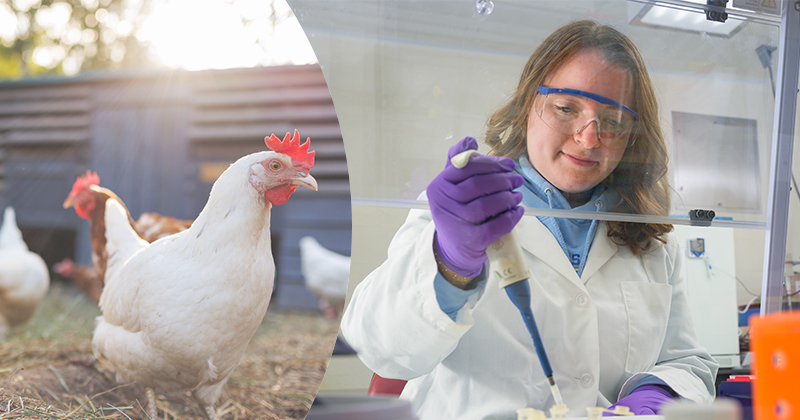
UD lab and research experience prepares graduating senior Casey Epstein for animal biosciences career
Many college students hope to land a job in their chosen career field as soon as they graduate. For Casey Epstein, an animal biosciences major at the University of Delaware, her first day of work can’t come soon enough.
The UD senior, who had enough credits to graduate in three years rather than the typical four-year path, will be a flock service technician at Dutchland Farms in Lancaster, Pennsylvania. She landed the position last summer after interning at the egg marketing and production company.
“I’m the liaison between the company and the farmers,” Epstein said. “I’ll be out on the farm almost every day, which I’m super excited for.”
The job entails visiting farms that distribute their eggs to Dutchland Farms. Epstein will make sure chickens are healthy, meet state agricultural standards and ensure the farms are free from salmonella.
Before UD, the suburban Philadelphia native knew nothing about poultry. Epstein grew to love chickens through working for UD’s Charles C. Allen Jr. Biotechnology Laboratory and her Dutchland Farms internship. She experienced both the diagnostic side and the production side of the animal industry.
Seeking out lab experience
When Epstein began her college career, she thought maybe one day she would be a veterinarian.
In high school, she worked at a small animal veterinary clinic, but she quickly figured out there were other career pathways in which she could work with animals.
“The University of Delaware does a really good job of exposing you to those things you don’t necessarily think about in agriculture,” said the UD College of Agriculture and Natural Resources student.
What Epstein hadn’t given much thought to was poultry. And something clicked during a tour of Allen Lab, UD’s nationally recognized Biosafety Level-3 lab that studies severe poultry pathogens.
Shortly after that tour, Epstein was talking with Noel Wolhar, the associate director of recruitment for CANR. She told Wolhar that her dream job would be working in Allen Lab, so Wolhar introduced her to Brian Ladman, Allen Lab’s director and director of the UD Poultry Healthy System.
Soon, Epstein landed a job assisting with a variety of poultry research projects there. Since the end of the Fall 2024 semester, Epstein has worked on a variety of research projects for the nationally recognized Biosafety Level-3 lab — feed additive studies, a bronchitis study, and tests on whether strains of avian influenza can survive in eggs.
Epstein has also been helping with research to determine if bird flu can survive in fermented beef products like pepperoni. She even helps with testing tissue and swab samples sent to Allen Lab to determine if chickens have respiratory diseases.
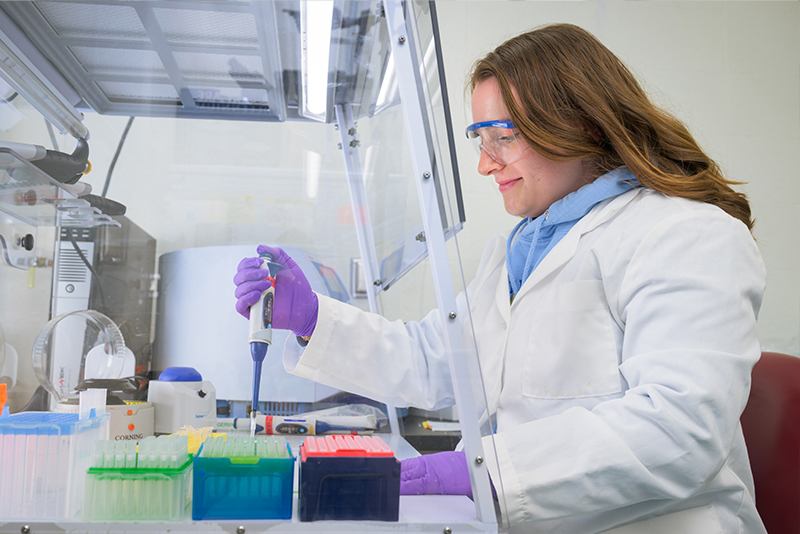
Marcy Murphy, an associate scientist at Allen Lab who supervised Epstein’s work, said the animal biosciences major brought a huge value to the lab. Epstein recovers genetic material from swabs to run PCR tests (a lab technique to detect infectious diseases), and inoculates viruses into chicken eggs to see if what is detected by PCR is still alive.
Murphy said Epstein is especially valuable in the scientists’ avian influenza work. Epstein helped to organize supplies needed for studies including collecting red blood cells from chickens for one study. She also helps with the collection and processing of samples once the studies start.
“She’s very dependable. She’s confident,” Murphy said. “She asks the right questions.”
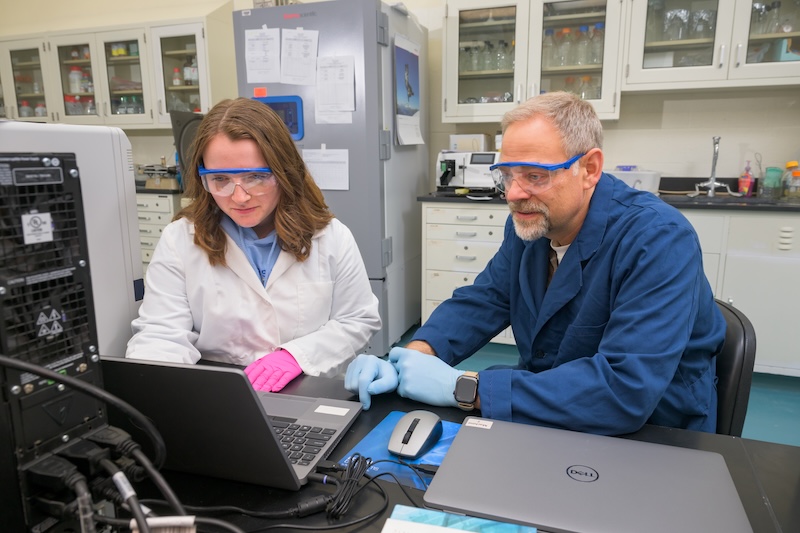
Ladman said Epstein meshed well with his group, bringing in a fresh perspective and eagerness to learn everything about poultry health. Many students come to the Department of Animal and Food Sciences focused on pre-veterinary medicine. Ladman said they often overlook poultry as a career path.
“When speaking to more than 100 students in ANFS 111 [Animal and Food Science Exploration], perhaps two will contact me about working in the lab,” Ladman said. “I tell them it is an important yet odd task at hand, keeping animals alive and healthy so we feed the nation and the world. You can't have a chicken sandwich war without healthy chickens.”
Ladman’s job is to try to reach students who may not want to be a vet, like Epstein, or do not get into vet school on the first attempt, and help them realize what else they can do in the animal health space.
Learning poultry production
Epstein’s work at Allen Lab made her curious about the production side of the poultry industry.
This past summer, Epstein interned at egg marketing and production company Dutchland Farms in Pennsylvania. She learned how to care for and manage young hens called pullets, that have not yet started laying eggs. She got to see another side of working with chickens, a side often unpredictable compared to being in a lab-controlled environment.
“I loved getting to think about poultry in a new way,” Epstein said.
Though the poultry production and diagnostics sides are very different, Epstein has bridged the two. She recalls sitting in on a meeting between a Dutchland Farms production manager and a representative from another company visiting them. The representative asked her if she knew anything about the function of the bursa, a lymphoid organ, in chickens.
And she did. Epstein recalled Murphy’s master’s thesis about the bursa. The bursa produces B cells which support immune function in chickens.
Both the manager and representative were impressed with her knowledge, making Epstein thankful she had learned that from Marcy.
“UD and Allen Lab staff prepared me to be a more informed and more educated flock service technician,” Epstein said. “The Allen Lab staff are really going to have a big impact on me when I step out and work in the industry.”
When Epstein graduates UD, she will also bring a One Health Certificate to her new job. One Health considers human, animal and environmental health as interconnected. She hopes her ability to associate all three will make her a better flock service technician.
Ladman is excited for Epstein as she launches her career in poultry production. He said training students is an important part of Allen Lab’s mission, but rarely does he see a student go into the poultry industry.
“Casey stands to take all she has learned in the diagnostic and research space and apply it to her industry job,” Ladman said. “I hope this experience and our investment in Casey makes her a better service technician.”
Contact Us
Have a UDaily story idea?
Contact us at ocm@udel.edu
Members of the press
Contact us at mediarelations@udel.edu or visit the Media Relations website