

Shining a light on colloid science
Photos by Evan Krape July 31, 2026
Scientists and engineers gather to discuss impact of colloid science in our lives
Paper conservator Crystal Maitland peers over a watercolor depicting a man in a rowboat along a sandy shoreline, while a larger ship is visible farther out to sea. The work, which is under consideration as a project for next year’s incoming cohort of paper conservation graduate students in the Winterthur/University of Delaware Program in Art Conservation (WUDPAC), has unusual damage along the painting’s perimeter and portions of its surface.
“It’s animal glue, protein-based collagen that is only cleanable in water-based treatments,” Maitland told scientists and engineers touring her Winterthur laboratory. The tour was part of a special workshop held during the 2026 American Chemical Society’s 100th anniversary Colloid and Surface Science symposium, hosted by the University of Delaware.
Developing a treatment plan to preserve such an artifact can take hours, according to Maitland, senior conservator of paper at Winterthur and affiliated assistant professor at UD. Enzymes might digest the glue down, she said, but it will require controlling moisture to prevent damaging the work itself.
“This is where having the ability to cut and apply a gel where needed, without fear of residues left behind, is advantageous,” she said.
One option — specialized colloidal systems with James Bond-level technology — can be quite effective.

Colloids are mixtures in which tiny particles of one substance are suspended within another. You’ve encountered them if you’ve ever spread butter on a warm roll, painted a room or brushed your teeth.
In art conservation, colloidal systems like hydrogels and microemulsions act as controlled carriers for cleaning agents, including enzymes or solvents, offering advantages for preserving works of art on paper, historical paintings, sculptures, wood and more.
During a panel discussion, conservation experts from academia, industry and museums shared some of the challenges they are facing with current cultural preservation approaches and the opportunities they see for colloid scientists and engineers to help advance their work.
In many cases, conservators only get one chance to do things right. Though re-treatability is always a goal, true reversibility is rare: there are no do-overs. This is why a major consideration in any plan is how the treatment will hold up 20, 30 or even 100 years down the line.
Residues are a big problem that might not appear right away, making a conservator’s upfront choices important. Supply chain issues and material availability also are creating challenges.
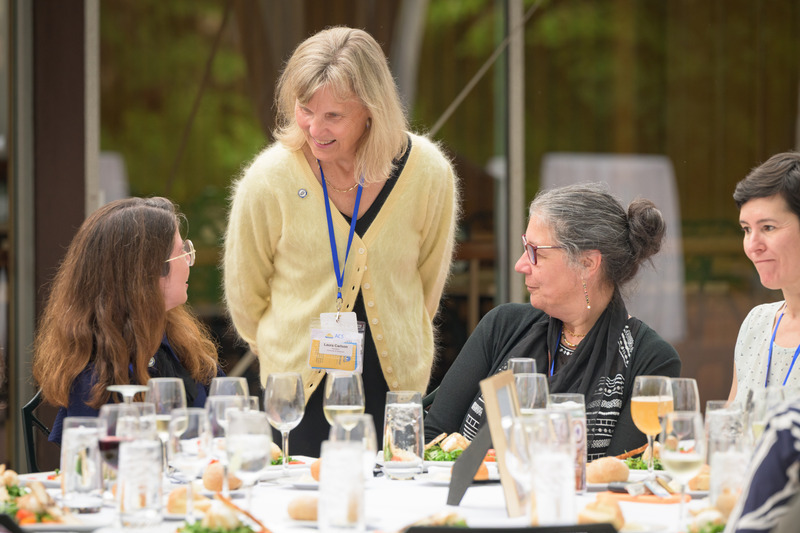
One expert pointed to the need for access to a wide range of expertise to ask specific questions or to tailor a gel for specific artwork, making collaboration key. At UD, the WUDPAC partnership makes this easier, providing access to faculty and students working in key areas. Workshops and meetings like the ACS colloids symposium can help spread the word about new scientific and engineering advances, others said. And while industry collaborations have the potential to lead to new techniques, the panelists acknowledged that getting connected can be challenging.
“Most industry doesn’t know you exist,” said Melinda Keefe, R&D/TS&D director of America’s architectural coatings at Dow. “Be creative in how you tell your story and ask industry for help.”
Norman Wagner, Unidel Robert L. Pigford Chair in Chemical Engineering, wondered whether conservators consider it possible — or even prudent — to use machine learning and automation to standardize cleaning and repair of cultural works. The approach might offer systematic results across the field, experts said, but it does have pitfalls.
“Conservators will always rely on hands and eyes because every piece of artwork is different. Even different areas of an artwork can respond differently” to treatment approaches, said Teresa Duncan, conservation scientist at the National Gallery of Art in Washington, D.C.
Trends and future directions
Back on UD’s Newark Campus, other symposium sessions covered work underway around many unseen ways that colloid and surface science improve our daily lives, from changing the way pharmaceuticals, foods and agricultural formulations are developed to advancing high-tech ceramics, metals and other materials for everything from automobiles to aeronautics to battery technology.

“The next time you buy a product, whether it is a high-tech automobile, a high-performance fabric or paint, even a creamier ice cream or chocolate, chances are good that colloid interface science had a hand in that improvement,” said Wagner.
There also is a chance that UD research played a role.
UD’s leading-edge research contributions
UD has a long history of leadership in advancing colloid and surface science research, from innovative studies on the International Space Station with potential to evolve new materials for next-generation electronics, to solutions for pesky protein problems in the manufacture of biopharmaceuticals to the UD-developed inventions like shear thickening fluid, a smart material that changes from a liquid to solid when struck or agitated forcefully, and mastery of molecule mechanics related to the formulation of diabetes and obesity medications.
UD is home to many future leaders in this fascinating field, too. Chemical and biomolecular engineer Catherine Fromen is exploring pharmaceutical applications for colloids, which can play a critical role in how proteins or nanoparticles in solutions interact with each other and with air at interfaces, all of which are critical to how medicines are formulated, packaged and injected.
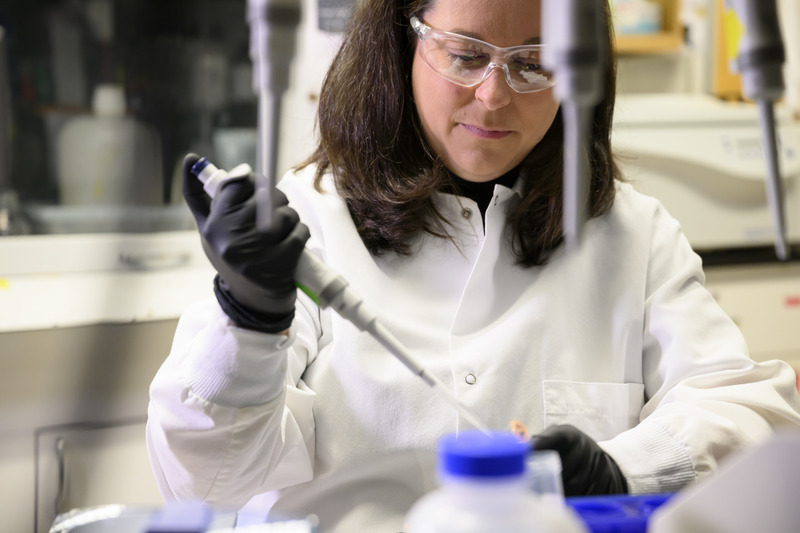
Mechanical engineer Chelsea Davis is investigating responsive adhesives that get stickier the harder you push on them. With similar bonding forces as common office tape, these pressure-tunable adhesives offer “pick and place” fabrication advantages for multi-step manufacturing processes involved in making microchips, among other things.
Meanwhile, chemical and biomolecular engineer Alexandra Bayles is using fluid mechanics to shape materials using controlled flows, developing new devices to sculpt soft materials in ways that enhance their performance, work with the potential to improve additive manufacturing, among other things. And biophysicist Ed Lyman is exploring how deep-sea animals survive under pressure, which could inform understanding of human health.
“I commend our faculty who are leading the way in this expanding field, and who have established and are continuing to build UD Engineering as a place that prepares future leaders in surface science and colloid research,” said Pamela M. Norris, dean of the College of Engineering.
Historical connections
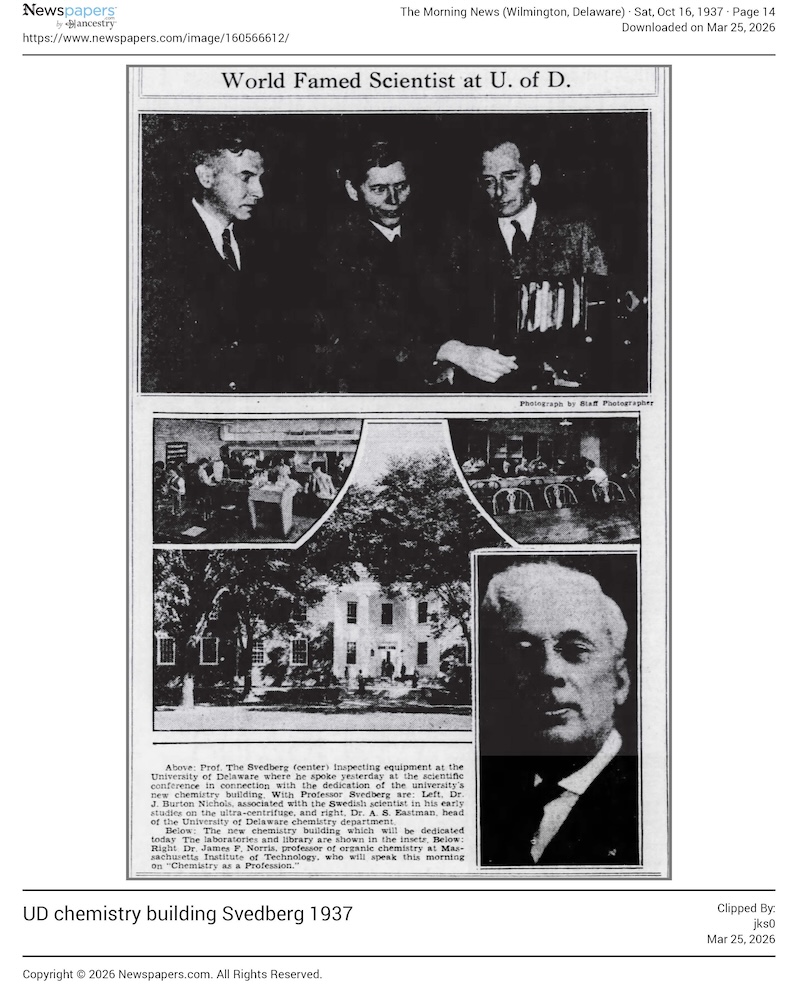
According to Abraham Lenhoff, Allan P. Colburn Professor of Chemical Engineering, it is fitting that the ACS Colloid and Surface Science’s 100th anniversary symposium be held at UD. After all, it was Swedish scientist Theodor Svedberg’s development in the 1920s of the ultracentrifuge, which enabled scientists to separate colloids and solutions such as blood and proteins for the first time, that framed the ACS technical division’s inaugural meeting a century ago — and Svedberg had a UD connection.
Svedberg delivered a keynote address in 1937 at the dedication of UD’s new chemistry building, Brown Laboratory, situated just across The Green from Gore Hall, where attendees gathered for the 2026 symposium. Today, the ultracentrifuge he developed is considered a workhorse for studying disease, drug development and biotechnology in laboratories at UD and beyond.
Lenhoff co-organized the ACS symposium at UD alongside Wagner and Eric Furst, William H. Severns Jr. Distinguished Chair of Chemical Engineering.
Contact Us
Have a UDaily story idea?
Contact us at ocm@udel.edu
Members of the press
Contact us at mediarelations@udel.edu or visit the Media Relations website