


UD Magazine

Humans are remarkably bad at feeling good.
Which is awkward, considering how hard we work at it. We exhaust ourselves chasing the usual suspects: new house, bigger job, more perfect body or [insert culturally sanctioned obsession here]. But too often, even after reaching the goal, we’re left unfulfilled and scrolling TikTok for the latest happiness hack. Scientists call it “miswanting.” We pursue the wrong things—and greatly overestimate their emotional payoff.
But Blue Hens can help.
Long before Ivy institutions taught viral classes on the topic, the University of Delaware was quietly setting the curve. Professor Emeritus Steve Goodwin launched “The Art of Happiness” course 15 years ago to offer UD students a wellbeing blueprint, and it’s been filling seats—and waitlists—ever since.
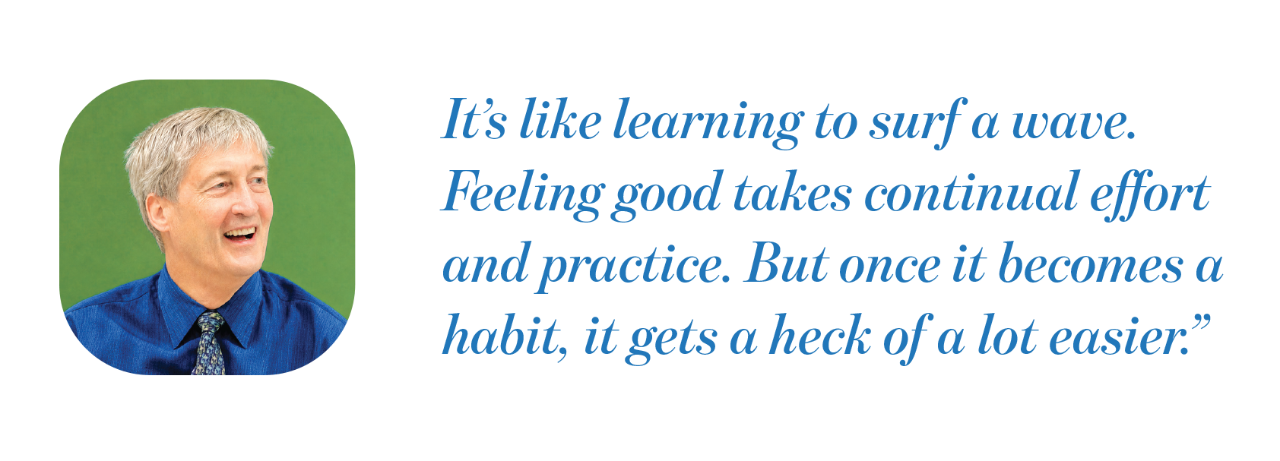
“It’s like learning to surf a wave,” says Goodwin, author of A Practical Guide to Improving One’s Happiness. “Feeling good takes continual effort and practice. But once it becomes a habit, it gets a heck of a lot easier.”
Today, several UD professors are applying rigorous scientific study to the topic. (Yes, even something this subjective, emotional and elusive can be put under the microscope.) And they all offer the same hopeful verdict: Happiness—however you define it—is not some predetermined genetic state, at least not completely. There are practices that will almost certainly change your emotional temperature for the better.
And UD? It’s an incubator for these very habits. Students arrive on campus to master biochemistry formulas or cybersecurity code—and, somewhere along the way, start decoding something even more useful: how to feel their best. It’s the University’s sneakiest curriculum, and Blue Hens graduate with a lesson no syllabus can fully capture, a working knowledge of what makes life meaningful.
Read on for our crash course on living well. There is no textbook required, and only one homework assignment to complete: Make the joy stick.
People need people. For all its scholarly muscle, the scientific community keeps arriving at that same stubborn conclusion.
“I’m often asked for the secret to happiness, and it’s not really a secret at all,” says Assistant Professor Amit Kumar, who studies the psychology of the emotion. “Our connections are what matter most. That’s what all the data points to. That’s the clearest answer.”
Friends, loved ones, baristas at Main Street cafes who know your order before you say it—these are not extras in the movie of your life; they are the entire reason for the script. And UD?
That’s where the cast comes together.

This was the mid-70s, and dorm room turntables were spinning protest anthems: Dylan growling through “Hurricane,” CSNY mourning Kent State and Marvin Gaye asking his immortal question: What’s going on? But from just outside Morris Library came an entirely different sound. Four undergraduates with bowties and a pitch pipe, as if summoned from a bygone era, closed their textbooks for the evening and harmonized beneath a campus lamppost.
“It gets in your blood,” says Kevin Hartnett, AS76. “I got infected by this thing—and it was a blast.”
Between astronomy classes, Hartnett decided to form a barbershop quartet. Thanks to a high school production of The Music Man, he had experience performing in one, and as a member (and eventual president) of UD’s Concert Choir, he had a network. He set to work recruiting fellow science and engineering majors intrigued by the old-school genre: Dan Oman, EG76; Jay Sames, EG77; and Ed Hampson, who eventually moved and was replaced by Ed Miller, TKTK. The Log-Rhythms—a play on the mathematical logarithms tool—were born.
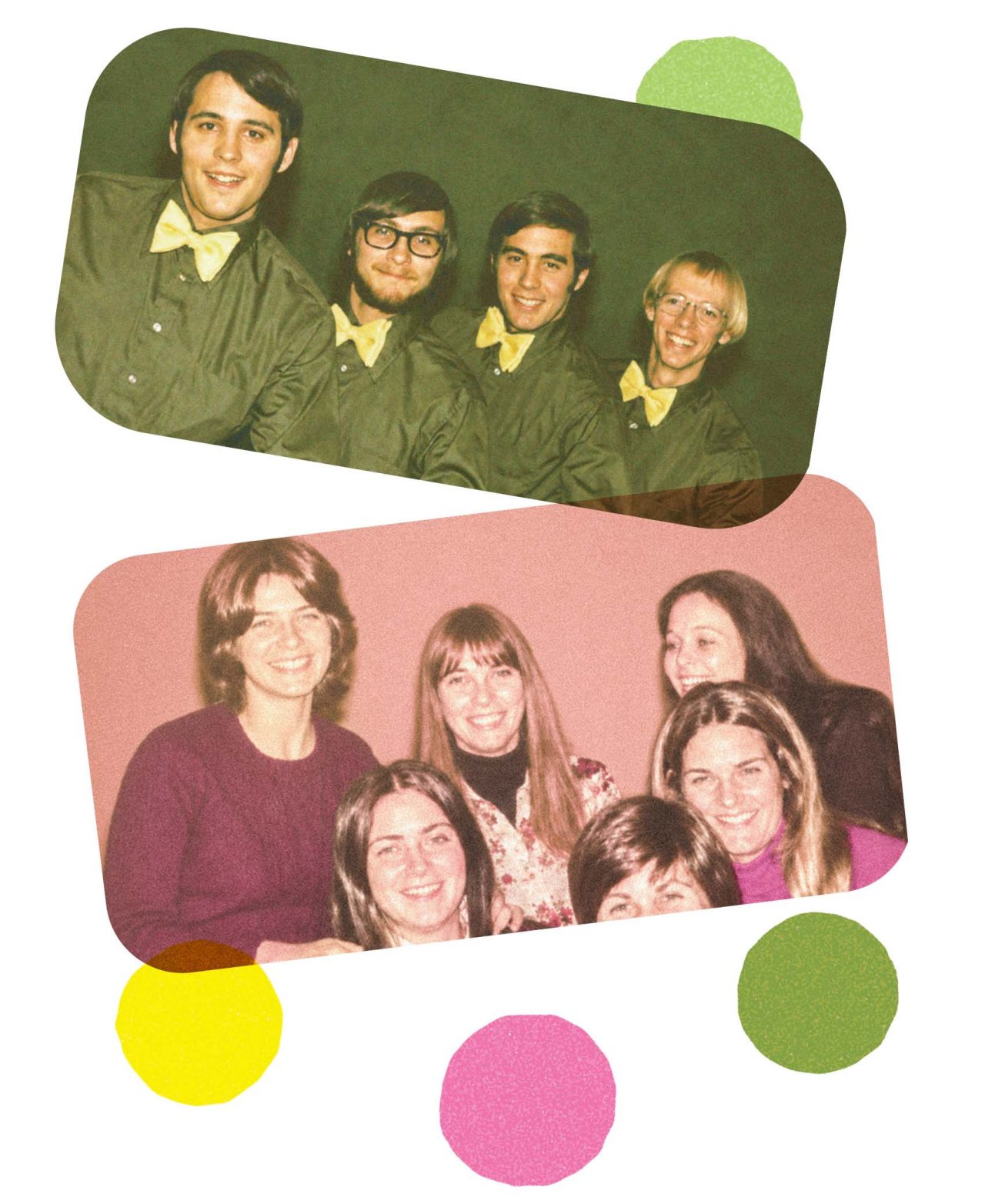
TOP: The Log-Rhythms, left to right: Jay R. Sames, EG77; C. Edward Miller, Jr., AS77; Daniel E. Oman, EG76; Kevin Kartnett, AS76.
BOTTOM: The girls of Harrington D, clockwise from left: Melissa A. Brumbach, HS76; Patricia L. Kline, EHD76; unknown; Bernadette Fismer, AS76; Debra J. Masters, HS77; Catherine E. Taraschi, EHD76.
Almost immediately, the group knew it was onto something bigger than music. A barbershop quartet isn’t merely four people singing in unison. The lead carries the melody, the bass gives a song depth, the tenor hits the high notes and the baritone fills in the essential spaces between. The parts are fine on their own, pleasant even, but together they become something memorable. That’s not a bad metaphor for college, where students arrive as solo acts and leave with the people who put them in tune.
“The university experience we had with our friends was irreplaceable,” says Oman. “We knew we had something unique at the time.”
The guys spent a couple of hours per week in a practice room of the Amy E. du Pont Music Building, rehearsing songs like “Baby Face” and “By the Time I Get to Phoenix.” They also took their act to the odd lamppost or shuttle bus where, in true barbershop quartet fashion, they hammed it up with synchronized gestures and a little slapstick. The Log-Rhythms garnered such a reputation, they were invited to perform at Student Center Day in the Perkins building, a campus activity night where “people burst into applause as soon as we started our first song,” Oman says. “That’s probably my fondest memory.”
Most often, the Log-Rhythms performed just outside the Harrington D residence hall, where seven of the women in their friend group lived. When serenaded, the ladies sometimes tossed coins, flowers and candy at the singers’ feet. Hartnett even composed an original tune, “The Girls of Harrington D,” with lyrics extolling the women’s beauty: “My score would not have been so bad had she not been so smartly clad; oh, blame my distraction on upperclass fashion from the girls of Harrington D…”
“There were a lot of bad things going on at the time—the aftershocks of the war, inflation out of control,” says Debra Masters, HS77, one of the quartet’s muses. “It was wonderful to just hang with our gang of friends and have fun—I’m so grateful for that opportunity. And, yes, it was nice how special they made us feel.”
Because Oman and Masters were going steady, Oman couldn’t resist committing a small act of lyrical rebellion, changing the lines of the old sweetheart standard,“Peg o’ My Heart,” to “Deb of My Heart”—and irritating the other Log-Rhythms in the process. But poetic liberties aside, the singers and their most adoring fans became a tight-knit social circle, attending football games and dances together. In their spare time, the girls of Harrington D sewed bow ties for the quartet, ensuring they had proper matching stagewear.
“When you sing, you produce something that’s outside of you, but it enriches you on the inside,” Hartnett says. “And the fact that you’re not doing this alone—you’re doing this thing in concert with others and for others—that’s a character-building and friendship-building experience.”

Watch and Listen: The Girls of Harrington D.: https://capture.udel.edu/media/1_4c5gmaq2/
Life after graduation, predictably, scattered the band. Oman moved to Wisconsin for work and graduate school. Hartnett landed at NASA’s Goddard Space Flight Center, where his career eventually took him to the Hubble Space Telescope program. The others moved through their own adult orbits—jobs, children, distance, time. Save for some Blue Hen weddings, the Log-Rhythms stopped performing as a group. But the bonds have outlived the bowties.
Oman eventually married his girl from Harrington D (“He still serenades me, but I think he’s mostly trying to annoy me,” Masters laughs), and the couple have two Blue Hen daughters—Alicia Oman, AS05, who minored in vocal performance, naturally, and Stephanie Oman, AS08, who joined her own campus a cappella group.
Meanwhile, while reflecting on his 50th Commencement anniversary this year, Hartnett came upon the sheet music for “The Girls of Harrington D.” He polished the old tune, added new verses and arranged to have it recorded by singers connected to the Barbershop Harmony Society, a national organization dedicated to preserving the barbershop form. Partly because original member Jay Sames has passed away, the LogRythms can no longer perform the song themselves, but Hartnett would like the piece (and the moment in time it captures) to have one more life.
As for those currently in the midst of their own moment—that tender, formative, blink-and-you’ll-miss-it college experience—the Blue Hen offers one piece of wisdom.
“Your classwork is important, yes, and you need it to land the right job and get the next leg up,” he says. “But the relationships you build will always transcend the books. As you move through your four undergraduate years, remember that.”
It is, perhaps, the central takeaway from a life of harmony.

He's been keeping University spaces spic-and-span for 20 years, but his job description goes far beyond mopping.
Jesse Coppedge is more than a custodial technician—for Blue Hens across campus, he's a purveyor of fist bumps, fatherly advice and silly dance moves that never fail to elicit a luagh on a hard day.
It's the reason he's been invited to dissertation defenses and post-Commencement celebration dinners; it's the reason students recognize him 15 years after graduation. “The kids miss their families, and you can see it on their faces,” Coppedge says. “So I encourage them like they’re my own.”
At UD, Blue Hens find their closest friends and, in many cases, soulmates. But just as important are the interactions they have with everyday acquaintances. Not the people who will someday serve in their bridal party, necessarily, but the custodians, dining hall workers and shuttle drivers whose steady presence holds deep meaning.

A growing body of research suggests these so-called “weak ties” are essential for happiness. They provide the benefits of low-stakes connection—warmth, support—without the emotional upkeep required in an intimate relationship.
Recent studies have found interactions of this sort can boost feelings of self-worth and belonging. In short: They make people feel seen—and that’s a responsibility Coppedge never takes for granted. “I hope students know one thing,” he says. “They are never alone.”
Do good, get good.
That’s not karmic comeuppance; it’s science. An established body of research makes clear: Acts of kindness don’t merely benefit the recipient—they reduce stress, improve confidence and strengthen identity for the person doing the act. Kindness can also change the world. Not in a schlocky, motivational poster sort of way, either. It’s a phenomenon called “prosocial contagion.” People who witness generous, helpful behavior are likely to act in a similar fashion.
Since the University’s founding more than 250 years ago, Blue Hens have contributed in meaningful ways to that good-vibe ripple, prioritizing service, community building and the quiet, unglamorous work of showing up for others.
Turns out, that’s a pretty solid life hack.
For proof that service is a two-way street, look no further than Andrew Wilson, ANR03M.
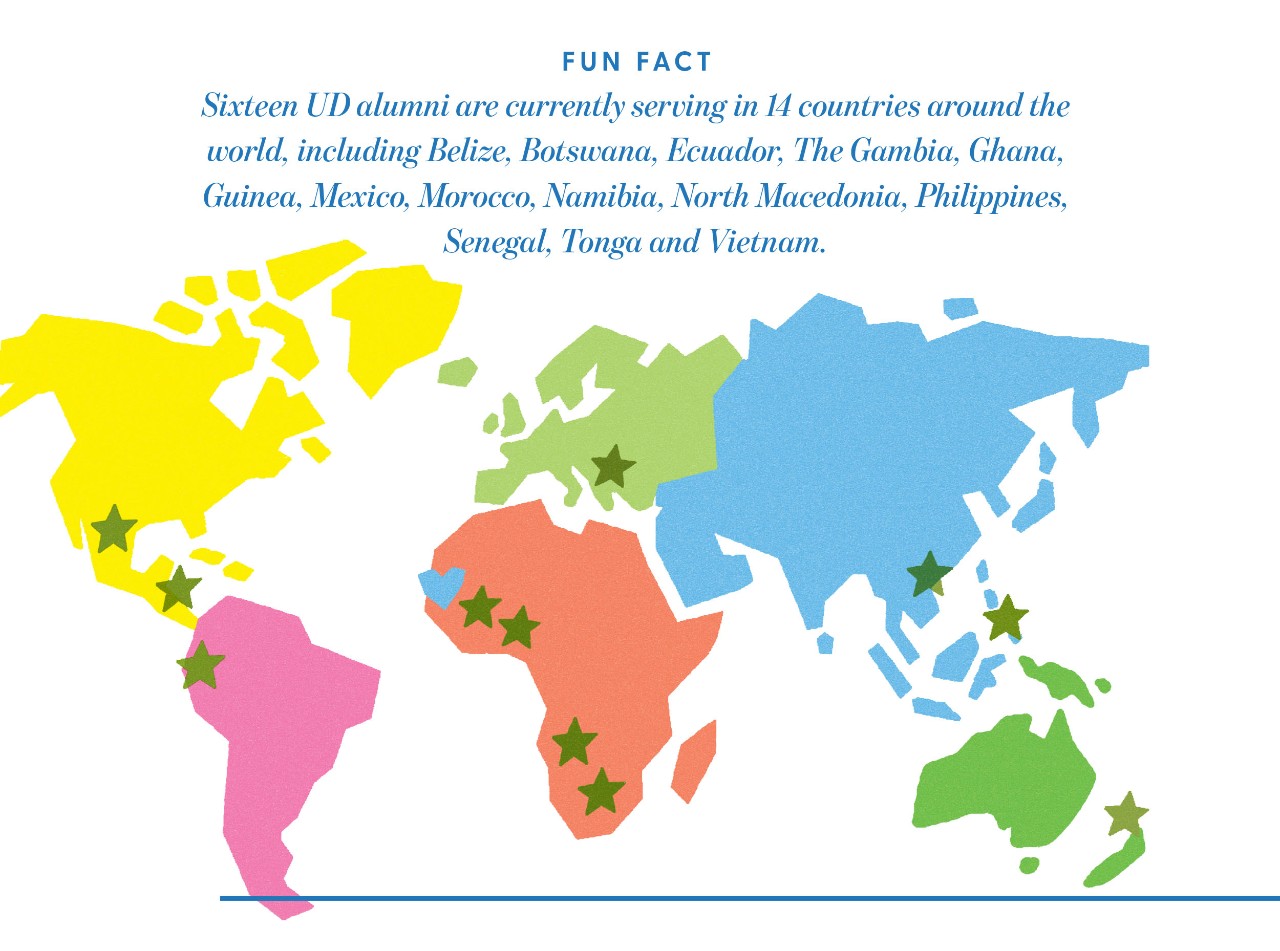
As a young man, he volunteered with the Peace Corps, doing sustainable agricultural work in rural Senegal.
Ask what the experience gave him, and he’ll tick off an impressive list: learned three languages, developed a deeper sense of empathy, became a sharper problem-solver.
All of these takeaways increased his happiness, Wilson says, but the real joy came from the people. In Africa, the Blue Hen met the love of his life, Dioumy, and the couple recently celebrated their 25th wedding anniversary.

When their first daughter was born, they named her after Wilson’s Senegalese host mother, with whom he’s stayed close. (The admiration is mutual: A member of the Senegalese family later named her daughter after Dioumy.)
Today, Wilson has parlayed his Peace Corp experience into a career with the organization, recruiting new volunteers, improving outreach and helping a new generation enjoy the same life-expanding benefits. In his professional opinion: “This experience shapes who you are as an individual, and Blue Hens—with their grit and curiosity—100% make great candidates.”
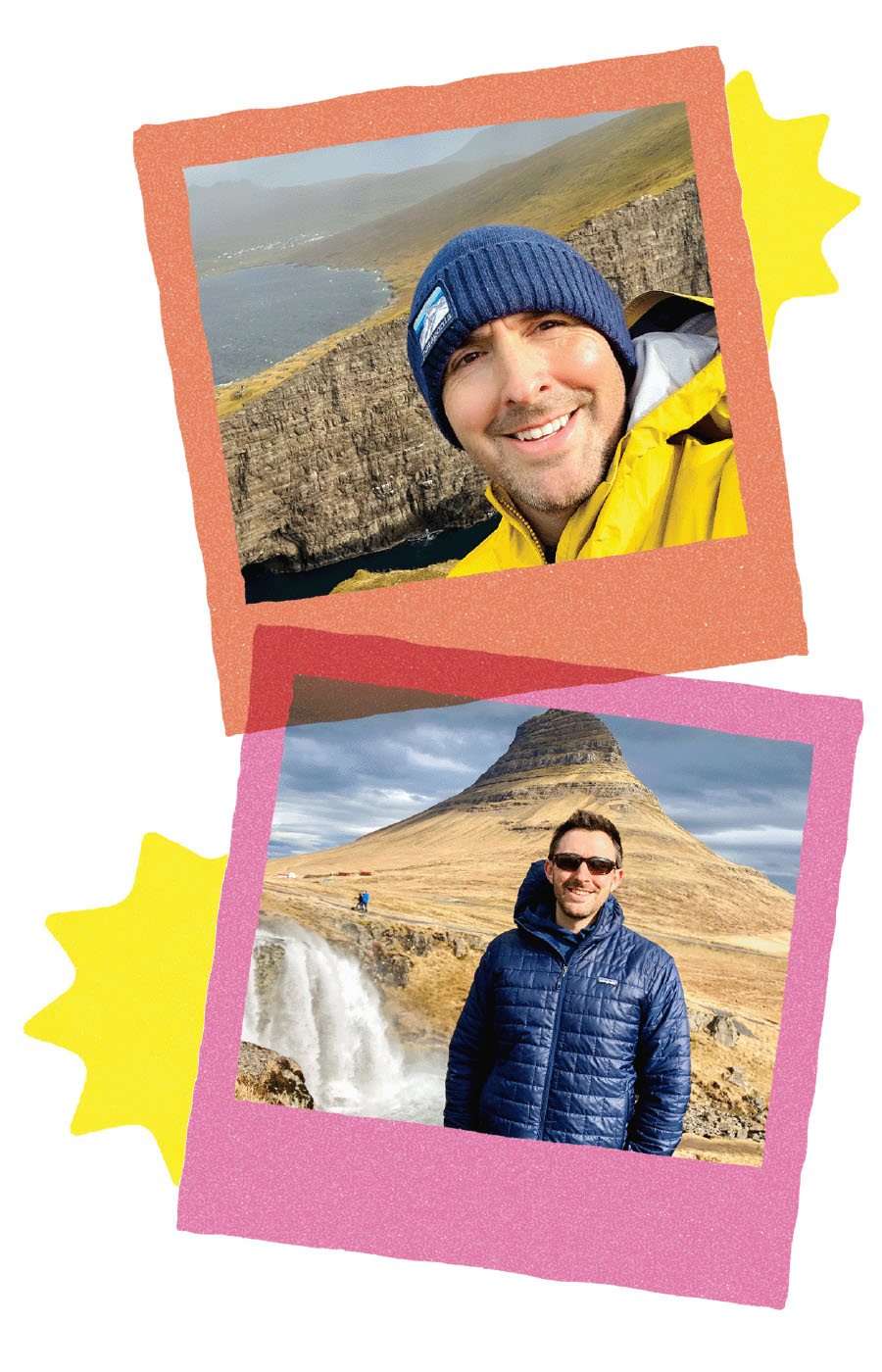
We’re not saying that a Blue Hen hoodie from the UD Bookstore can’t bring you happiness (plenty of anecdotal evidence suggests it will!), but in terms of lasting joy, the science is clear: Prioritize experiences over things. Not only will that dinner or trip or post-Commencement splash in the UD fountain lift your mood in the moment, it will provide what researchers call long-term “storytelling utility.” In other words, rehashing adventures—or misadventures—is its own reliable source of dopamine. And at UD? There’s no shortage of material.

He’s come face to face with an African bush elephant in Botswana, feasted (reluctantly) on a slab of reindeer tongue in Sweden, and perched on black volcanic rock at the base of the iconic Skogafoss waterfall in Iceland—a cascade so thunderous it features in both Viking lore and Game of Thrones.
Michael Bennett, BE00, has explored more than 50 countries, collecting both passport stamps and life-affirming experiences. Here, he shares advice for getting more out of your next trip—or Tuesday night:
HUMBLE. Go into a new space or encounter thinking it will be lame, and it will be. Instead, assume the world has something to teach you.
ENGAGED. Get curious. Ask questions. Spark up a conversation with the stranger behind you. Curiosity is the cheapest upgrade available.
RESILIENT. New experiences bring friction. Good. Instead of bolting, notice what that discomfort is trying to show you.
OPEN-MINDED. Drop the script. The best moments aren’t always on the itinerary.

Adulthood is for working, paying taxes and mowing the lawn. That’s the prevailing script in a productivity-obsessed society. Respectable humans give up playing tag and make-believe around the same time their braces come off. End of story.
Or is it?
“The instinct for play gets beaten out of us as we age,” says Roberta Golinkoff, a developmental psychologist and UD’s resident play expert. “And this comes with measurable costs to our health.”
While play is notoriously difficult to define, researchers have identified conditions that qualify an activity: You have to derive pleasure from it, you have to engage voluntarily and not out of obligation, and you have to find yourself in a so-called “flow state” while participating. In other words, if you lose all sense of time while engaged, it’s likely you’re in play mode. (Pursuits that fit the bill run the gamut from throwing a football to listening to music to chasing giant balls of cheese downhill—a real English tradition representing one of the most chaotic forms of adult play in the world.)
According to numerous studies, flow states can reduce chronic stress, restore the nervous system, even improve emotional resiliency. If done with others, playing can also boost social connection, preventing isolation and potentially increasing longevity.
If you’re struggling to make time for play as a grownup, Stacey Furtado, AS08, senior director of internal communications for Hasbro, offers a reminder: “That kid from your childhood is still inside you somewhere.” Below, her best tips for getting back in the game:
FIND YOUR COMMUNITY: Copping to a niche interest—fantasy novels, board games, collectibles, fan conventions—can feel vulnerable. So, connect with likeminded folks. Join a local meetup or online platform like Discord, and feel part of something bigger than yourself.
EXPAND YOUR WORLD: Just because you’ve outgrown a childhood medium doesn’t mean you’ve outgrown the interest—and you don’t have to. Board games have gone digital, toy aisles have expanded into entire fandom ecosystems, and familiar brands have updated for a mature, tax-paying set. (See: A Monopoly-themed steakhouse opening this year.) Follow what you love, and you may be surprised to learn it’s evolved, too.
TAKE A BREAK: When a to-do list is long, making time for play can be an anxiety-inducing proposition—especially if emails and notifications are piling up. So block them out… literally. Invest in a brick or other app-blocking device, and put playtime on your calendar like any other commitment.
DON'T OVER THINK IT: If it’s been a while since you’ve hosted a game night or engaged in cosplay, you may feel overwhelmed or under-equipped. Remember: There are no wrong answers. The most important thing, according to Furtado: “Just start.”
Sometimes feeling good feels like a chore. In an era marked by global conflict, political division, existential crises and garden-variety stressors (Laundry! Expense reports! The cost of gas!), who has the bandwidth for mood boosting? Is happiness even a worthy goal? At what point should we stop chasing inner peace — and start making peace with inner angst?
For answers, UD Magazine reached out to Jeffrey Spielberg, associate professor in the Department of Psychological and Brain Sciences. Spoiler alert: Uncomfortable emotions have their place, too.

THE PURSUIT OF (UN)HAPPINESS
As counterintuitive as it sounds, feeling bad is key to feeling your best. If you look at negative emotions not as something to bury or escape, but as data worth analyzing, they can help guide you toward a better, more fulfilled future. Distress is a signal that something may need to shift: a job, a relationship, a habit, a perspective. So difficult feelings are not obstacles to a good life, but catalysts for building one.
“They’re a feedback system,” Spielberg says. “They tell us when something is off — and motivate us to do something about it.”
KNOW THYSELF
As anyone who’s ever scrolled through TikTok can tell you: There’s no shortage of advice — breathwork, meditation, walking barefoot through a field of ethically sourced lavender blossoms. But all of these tools are extremely limited if you’re skipping the most important (and most overlooked) step.
“Think about your values,” Spielberg says. “If you want more fulfillment, identify what’s important to you. Then think about changes you can make so you’re living in accordance with them.”
If you’re a person who values, say, community involvement, then another breathing exercise won’t save you — at least not until you sign up for a PTA meeting or shift at the local food pantry.
THE TIPPING POINT
Negative emotions can be useful signals that point to misalignment. But sometimes, even when you’ve listened to the signal and made changes, hard days compound. The World Health Organization reported a 25% global increase in depression and anxiety during the first year of the pandemic, and rates have remained disconcertingly high — especially among adolescents and young adults.
Spielberg points to a messy convergence of factors: early puberty, economic trouble and the ubiquity of social media. Which means young people are hitting emotional vulnerability earlier, adult milestones later—and everyone else’s highlight reel constantly.
So how many bad feelings are too many? The line is not always easy to spot. But Spielberg puts it plainly: It’s never too early to seek professional help. You don’t have to wait until you’ve exhausted every other avenue. If you feel unhappy and you don’t know how to change that — if your distress is bigger than your usual coping skills — that’s a situation that deserves care.
At a certain point, the only self-improvement project that matters: Letting someone else in.
THE WELLBEING CENTER AT WARNER HALL
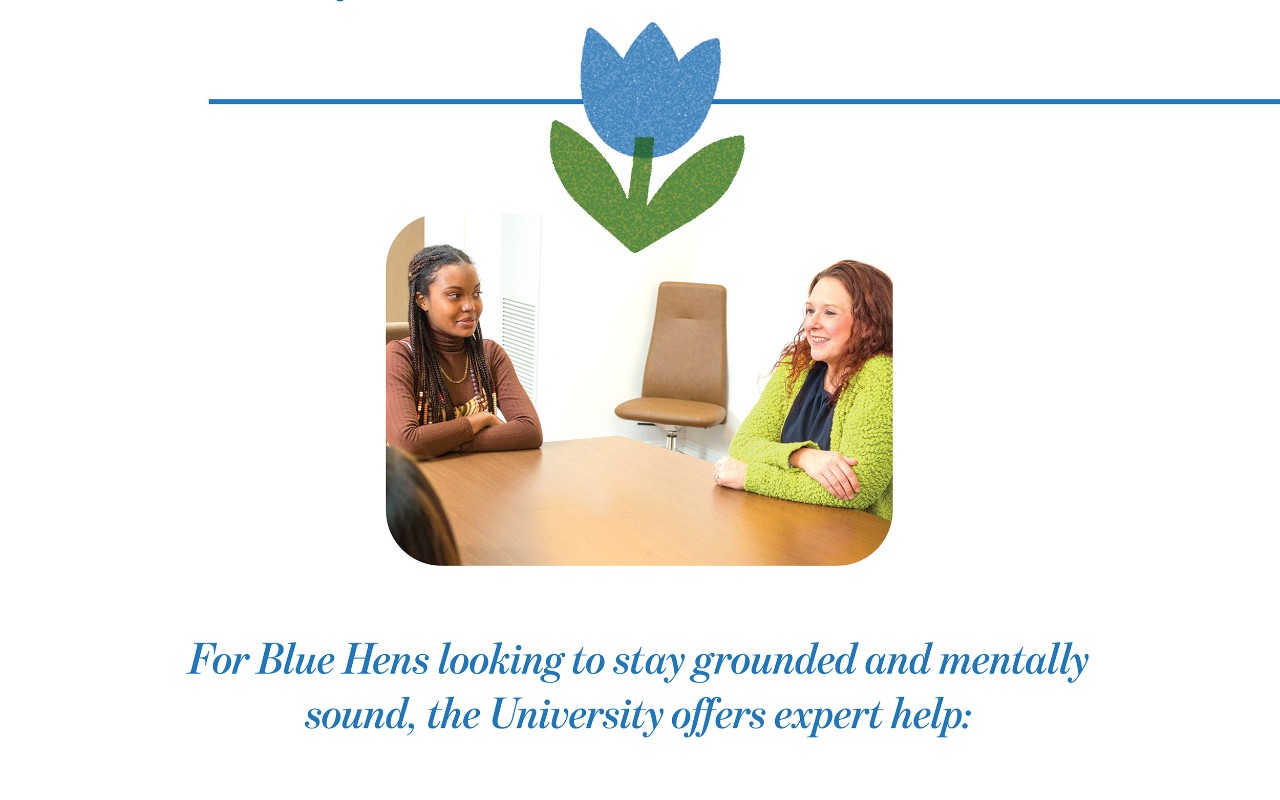
Located on The Green, this is home base for a wide array of mental health-promoting services, including educational programming meant to build strong habits, in-person counseling for groups or individuals, and an online platform called TimelyCare for on-demand support, 24/7. When students need longer-term or specialized help beyond the campus ecosystem, the center also navigates referrals and next steps.
STUDENT ADVOCACY AND SUPPORT
Not every mental-health challenge begins in the mind. Sometimes the stressor is practical: food insecurity, housing concerns, financial strain or a family emergency. This office helps students sort through those complications and engage with the right campus resource, whether that’s guidance for military-connected Blue Hens, support for survivors of sexual violence or help meeting basic necessities.
STUDENT HEALTH SERVICES AT LAUREL HALL
Providing clinical support for illness, injury, reproductive health and other medical needs, this unit rounds out UD’s “neighborhood of wellbeing” with care that addresses the body as well as the brain.