




Cold-blooded club
Photos by Jim White and courtesy of the Delaware Herpetology Club April 30, 2026
UD students form Delaware Herpetology Club to protect reptiles and amphibians
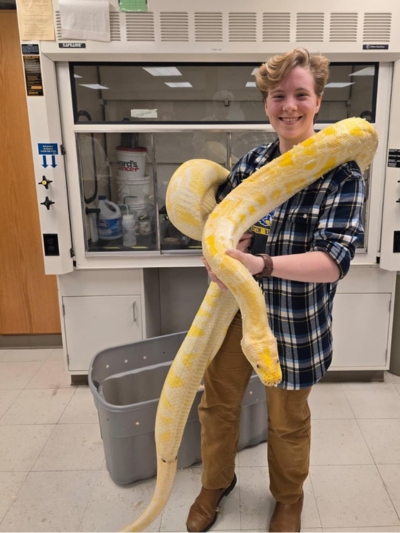
Reptiles and amphibians, collectively known as herptiles or herps, may not win any popularity contests, but they are essential to a healthy ecosystem. A group of students from the University of Delaware College of Agriculture and Natural Resources (CANR) founded the Delaware Herpetology Club to share their love of herps with the community. With more than 40% of amphibians worldwide threatened with extinction, along with 21% of reptiles, herps need all the help they can get.
“They’re an underdog of the animal world,” said Nat Moore, a junior wildlife ecology and conservation major serving as president of the club. “People don’t see them as inherently charismatic like they do with mammals. But just because some people think they’re gross or scary doesn’t make them any less deserving of conservation.”
In fact, more than half of herp species in our state are identified as species of greatest conservation need (SGCN) in the 2025-2035 Delaware Wildlife Action Plan. Habitat destruction and fragmentation, along with disease, pollution and climate change, contribute to population declines.
“Herps are a key part of the ecosystems around us, even right here in Delaware,” said Theo Kaiser, a junior wildlife ecology and conservation major and the club’s treasurer. “At White Clay Creek, you can see red-backed salamanders, an ‘indicator species’ for the health of the forest.”
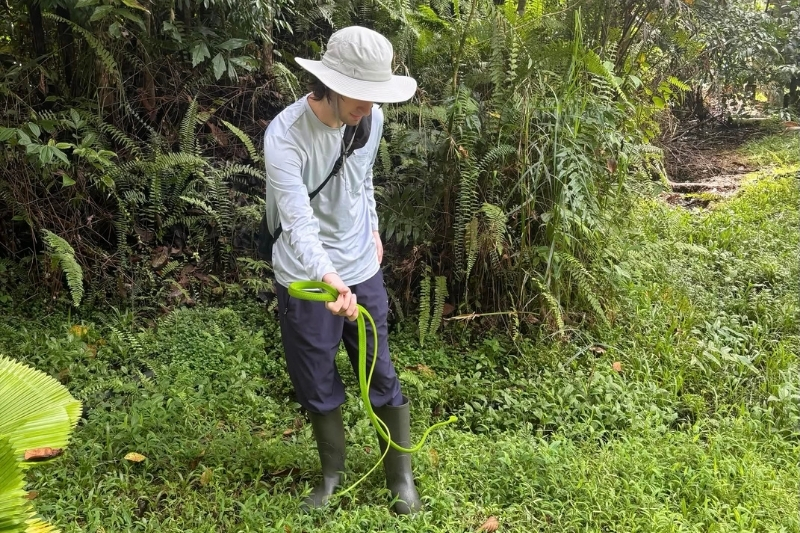
Although Delaware’s varied ecosystems have plenty to offer herpetologist hopefuls, one club member got his lucky break further afield. Norman Bucciero, Herpetology Club vice president and junior wildlife ecology and conservation major, was on a UD study abroad course in Borneo when he spotted an Oriental whipsnake.
“The snake was barely visible, nestled in between the leaves, its body looked identical to the surrounding foliage,” Bucciero said. “I only saw it out of the corner of my eye because it moved slightly.”
Spotting such a well-disguised snake is an achievement to be proud of. But Bucciero was not satisfied with simple observation. Sneaking up to the snake, he scooped it up before it slithered away.

“I gently picked up the snake and showed the people I was with just how incredible this animal is,” Bucciero recounted.
That inclination to share their appreciation and encourage others to care is what led Moore, Kaiser, Bucciero and Jake Speed, a UD junior who serves as club secretary, to found the club.
“We really wanted to provide a space where if people were interested in reptiles and amphibians, they could learn about them in addition to what our curriculum already teaches,” Moore said.

Vincenzo Ellis, assistant professor in the Department of Entomology and Wildlife Ecology, serves as faculty advisor.
“The student leadership of the Herpetology Club is a very dedicated group,” Ellis said. “They did all the heavy lifting to get their club established. I hope to see the club continue to grow and build on its successes.”
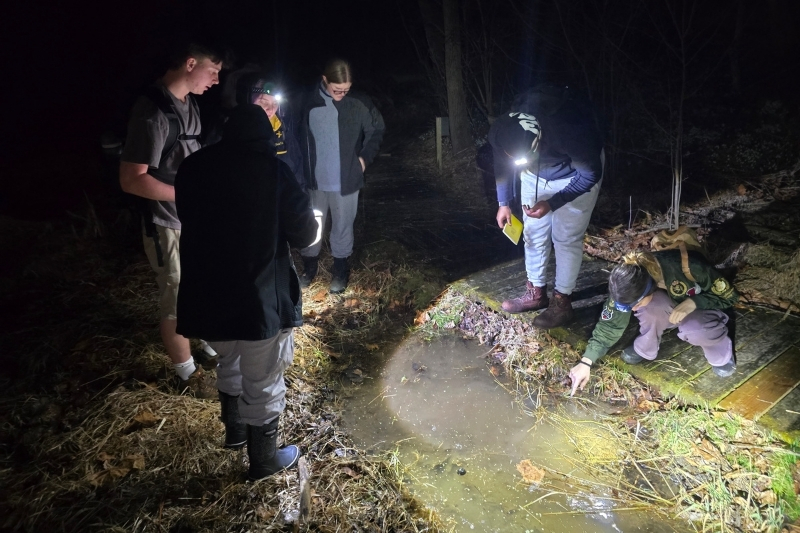
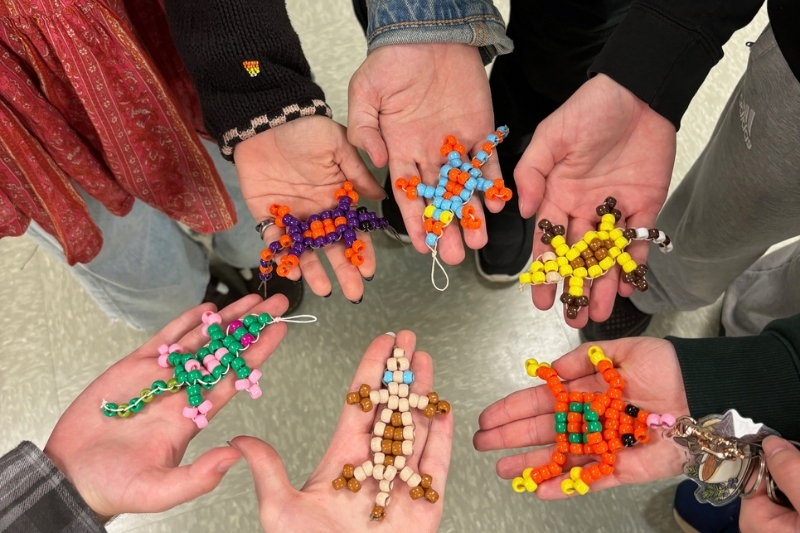
The Delaware Herpetology Club pairs education with activities such as crafting, frog call identification and field trips. During one particularly exciting meeting, members participated in a March Madness-style bracket of venomous snakes. After a presentation on venomous snakes, club members debated each bracket and voted by a show of hands.
“It is good practice to stand in front of a room and speak, and that's part of what being on the executive board provides,” said Moore. “I make sure everybody gets a chance to talk and be an active part of the club.”
Jake Speed, a junior wildlife ecology and conservation major and club secretary, is an advocate for venomous snakes.
“Venomous snakes deserve just as much protection as any other endangered species,” Speed said. “When left alone, snakes have no intention of attacking humans.”
This spring semester, several club members are enrolled in UD’s Herpetology course (ENWC 424). The popular class, which offers live animal labs, four field trips and an optional camping trip, is co-taught by lifelong Delawareans and CANR alumni Nate Nazdrowicz and Jim White.
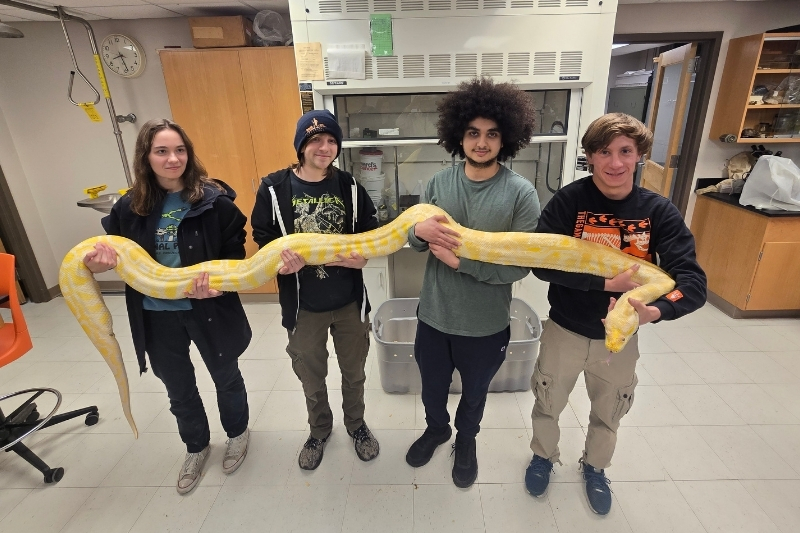
In the class, the students find mentorship and camaraderie. White and Nazdrowicz offer a glimpse of what a career in herpetology looks like. The duo is just as enthusiastic as the Herpetology Club.
The two met when Nazdrowicz was 9 years old. He spent the summer volunteering at Ashland Nature Center. White worked at the center, and he took Nazdrowicz under his wing.
“Jim noticed that I had an interest in herps,” Nazdrowicz said. “I helped him feed the animals and clean their enclosures.”
Then in 2000, White accepted a position as the herpetology instructor in CANR, and Nazdrowicz began his master’s degree at UD.
“I was the teaching assistant for Jim’s first herpetology course at UD, and we’ve basically been teaching it together ever since,” Nazdrowicz said. “When I started my Ph.D. at UD, I became a co-instructor.”

Their students could not ask for more knowledgeable instructors. Nazdrowicz is Delaware’s state herpetologist within the Department of Natural Resources and Environmental Control’s (DNREC) Division of Fish and Wildlife. White literally wrote the book on herps in the state. “Amphibians and Reptiles of Delmarva” is a comprehensive field guide by White and his wife, Amy Wendt White, also a UD graduate. White recently retired from his position as the associate director of Biodiversity Management at the Delaware Nature Society.
Together, Nazdrowicz and White have been involved in nearly every herpetological study in Delaware, including UD’s long-running research on the eastern box turtle.
UD’s herpetology course culminates in an optional camping trip, during which students benefit from Nazdrowicz and White’s decades of field experience.
At UD, students can expand their passion by gaining taxonomical knowledge, engaging in hands-on learning and acquiring field experience. With such passionate herpetologists in training, a brighter future for reptiles and amphibians is possible.
“We need to protect and restore habitats across the world,” said Moore, “otherwise even snakes with stable populations could face population declines in the future.”
Contact Us
Have a UDaily story idea?
Contact us at ocm@udel.edu
Members of the press
Contact us at mediarelations@udel.edu or visit the Media Relations website