




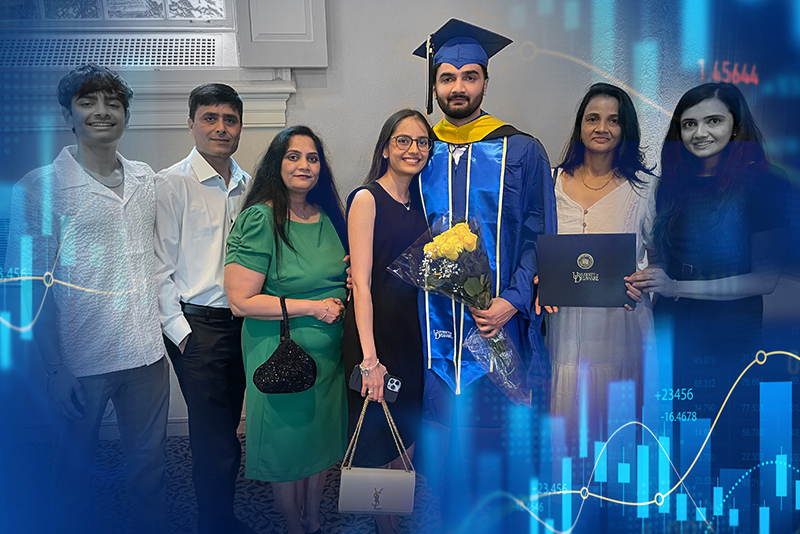
Data-driven success
Composite photo by Jeffrey C. Chase August 05, 2026
Data science student Urvesh Bhagat applies skills learned at UD to internship and full-time job
The role of a data analyst isn’t as straightforward as spotting trends. It requires determination and grit to sift through complex data and translate it into actionable insights that help organizations make informed, strategic decisions.
By navigating a career change, a move to a new country and the difficult job market, Urvesh Bhagat demonstrated that same necessary tenacity and proved that he had the fortitude to achieve career success after earning a master of science in data science degree from the University of Delaware in 2025.
As he was nearing graduation from an electrical engineering undergraduate program in his native India, Bhagat decided to change the trajectory of his career while working on a final-year project. He joined a programming team at a small tech company and helped build a smart energy meter using Arduino and Raspberry Pi, computing boards often used to develop smart devices.
“That experience was the first time I combined hardware with programming, and I really enjoyed the coding aspect — collecting data, processing it and making it useful. That’s when I realized I was more interested in the data and software side than pure electrical engineering,” said Bhagat, who completed his bachelor’s degree in 2021 and began seeking out data-centered opportunities.
While the transition from working with hardware to software was challenging at first, he was excited by the prospect of switching from hands-on problem-solving to something more abstract. Instead of circuits and signals, he was dealing with data pipelines, queries and algorithms.
“Over time, I started appreciating how powerful software is,” said Bhagat, who spent the first three years of his career gaining experience as a data analyst and data engineer at Accenture in India. “You can solve large-scale problems and make data-driven decisions that impact businesses directly.”
Driven by aspirations to advance his career and live out his childhood “American Dream,” Bhagat immigrated to the United States in 2024 and began searching for a master’s program close to his relatives in Piscataway, New Jersey. He found UD to be the perfect fit.
Looking back on his experiences in the program, one course in particular stood out to Bhagat: Big Data Technologies. Taught by Guido Geerts, professor of accounting at UD, the class emphasized practical assignments and projects that related theoretical concepts to real business problems, which helped prepare him to enter the real world of data science.
In the class, students built dashboards using the interactive data visualization software Power BI, worked on datasets similar to what companies use and solved problems that resembled actual business scenarios.
“It felt like working in a professional environment rather than just a classroom,” Bhagat said.
His passion for analytics didn’t go unnoticed by Geerts, who recalled that Bhagat approached any new subject that increased his skill level — such as data preparation — with curiosity and a genuine excitement to learn, often researching topics independently and returning to the classroom with engaging questions and insights.
“He had a lot of interest in the class and the skills he was learning, which is very enjoyable to see as a teacher,” said Geerts, who described Bhagat as one of his top students that semester.
While Bhagat excelled in the classroom, he faced a common struggle that often goes unseen for many international students: the emotional and mental adjustment of transitioning to life in a new country. Leaving a full life behind in India, Bhagat said that moving to the U.S. and building a new life for himself in Delaware was challenging.
“There’s pressure to succeed academically, find internships, manage finances and also deal with uncertainty about visas and job opportunities. It's a journey that requires a lot of resilience,” said Bhagat, noting how UD helped alleviate some of the financial pressures by offering opportunities for part-time campus jobs.
When Bhagat began searching for an internship in data analysis in early 2025, that resilience became an essential part of his success. Despite applying for new positions regularly, he struggled to proceed past the first round of interviews and, more frequently, wasn’t selected for preliminary screening.
“After about a month of constant rejections, I started feeling demotivated, but I kept applying consistently,” said Bhagat, who was thrilled when he received an invitation to interview for a loss forecasting internship at Sallie Mae, a college financial planning, loan and banking corporation based in Newark. After a few rounds of interviews and successfully demonstrating the Power BI skills he mastered at UD, Bhagat was offered the position, participating on both the loss forecasting and loss mitigation teams.
His manager was so impressed with his work that he was offered a full-time position as a senior associate of business analysis beginning the following summer. But Bhagat was eager to join the team as soon as possible. It motivated him to accelerate his academic plan and take additional courses during his final semester, leading him to graduate early in December 2025 and begin working at Sallie Mae in January.
“I think he’s an inspiration because the job market can be tough, especially for international students,” Geerts said. “By his example, current students can see that if you work hard, eventually success will follow.”
As someone who experienced the challenges of the job market firsthand, Bhagat offers current UD data science graduate students some advice before entering the industry.
“Don’t focus solely on developing coding skills,” said Bhagat, who currently uses artificial intelligence tools in the workplace. “Coding itself can become replaceable with AI. What really matters is understanding how machine-learning models work, knowing how to approach problems and being able to troubleshoot effectively.”
To adapt to the recent AI boom, Bhagat encourages students to learn how to properly implement AI tools as analysts and, when in doubt, to think strategically about their futures — as he plans to do for himself. As his position shifts toward analytics and microeconomics, Bhagat one day plans to segue more into the role of a risk scientist, which requires a human element AI can’t fully replicate.
Contact Us
Have a UDaily story idea?
Contact us at ocm@udel.edu
Members of the press
Contact us at mediarelations@udel.edu or visit the Media Relations website