




From performer to clinician
Photos courtesy of Natalie Atkinson June 17, 2026
A passion for singing led UD alumna to a career in pediatric voice care
For University of Delaware College of Health Sciences alumna Natalie Atkinson, a childhood love of singing has evolved into a career helping patients improve and protect their voices.
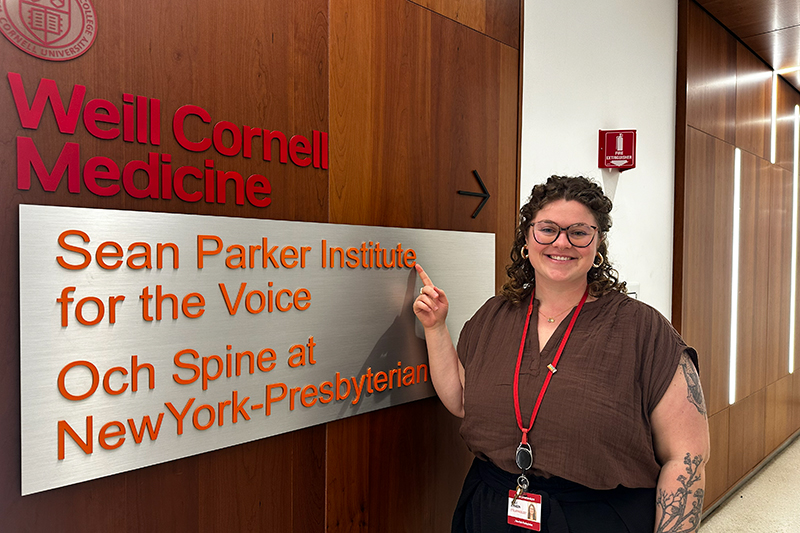
The 2025 graduate of UD’s Speech-Language Pathology (SLP) master’s program now works at the Sean Parker Institute for the Voice at Weill Cornell Medical College. Internationally recognized for treating professional performers and patients with complex voice disorders, the institute is considered a leader in voice care.
“It’s the coolest job ever,” said Atkinson, a speech-language pathologist and voice specialist, who works with children who have developed vocal fold nodules, often due to chronic vocal strain.
“Listening to so many voices, your ears get so strong, and you can hear what’s going on with the vocal cords without actually seeing them,” she said.
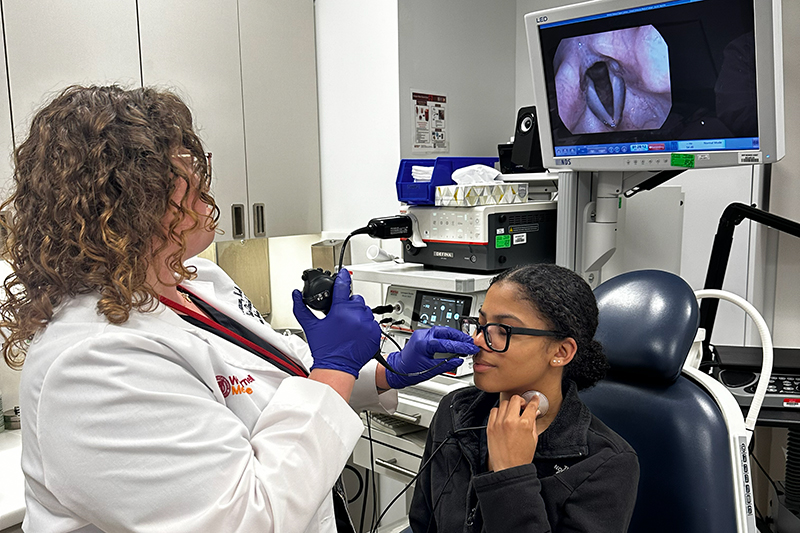
But she also gets close-up views of vocal cords, working with laryngologists to perform videostroboscopies to identify lumps, bumps or tension often found in professional singers.
A perfect pairing
As a child, Atkinson was always singing – in the shower, in the car, and later, on stage at Lincoln Center in Manhattan.
A Sussex County native, Atkinson earned her bachelor’s in voice performance from Westminster Choir College at Rider University and aspired to become a professional opera singer in Germany. The COVID-19 pandemic forced Atkinson to pivot. She enrolled in UD’s SLP MA Extended Track, where she discovered her passion for the science behind singing. The program was ranked among the nation’s top speech-language pathology programs by U.S. News & World Report.
“In those two years, I studied neurological communication disorders and classes like Speech Sound Disorders and Voice and Resonance Disorders and realized I could marry my passions and turn them into a career,” she said.
Her clinical interests deepened during an internship at Nemours Children’s Hospital, where she worked with young children.
“Working with children ages 0 to 5 taught me to find the simplest way to explain complex things,” she said. “It also taught me how to support parents who are trying to meet their kids where they’re at, even if it’s not where they hoped they’d be.”
At UD, she found a professional identity that blended performance and clinical science.
“I had big musical theatre kid energy, and UD’s SLP professors encouraged my individuality and inspired me to bring my own flair to my practice,” Atkinson said.
That approach was shaped, in part, by her own experiences navigating clinical care as a patient.

“They’d ask me questions, check off boxes, tell me something about me or my body that I didn’t understand, and leave,” she said. “Now, I spend so much time making sure patients know what’s going on and know they can ask questions.”
Her background in performance also influenced her clinical confidence.
“As a performer, I’ll say the right word and hit the right notes in front of hundreds of people, but being one-on-one with a patient is more daunting because they’ve placed their trust in you and need your help,” Atkinson said. “It’s taught me to be comfortable with vulnerability and given me confidence, even when I don’t know the answer.”
At UD, she also worked with people who stutter and learned lessons she carries into her practice.
“Working with that population taught me that you never know what mental load people are carrying,” she said. “It’s helped me create safe spaces for my patients and remind them not to be embarrassed when they’re trying their best.”
She also worked with Life Participation Groups, including Neuro Notes, a choir for people with Parkinson’s disease, through UD’s Speech-Language Hearing Clinic.
Another key differentiator is Healthcare Theatre, an interdisciplinary program that helps future health professionals develop their communication skills.
“That program is brilliant,” Atkinson said. “It was so helpful in teaching me how to navigate uncomfortable situations, and that practice made me feel less intimidated in the real world.
“UD’s SLP program is small but mighty,” Atkinson said. “The clinician I am today is a direct result of my time at UD and the professors who lifted me up.”

Contact Us
Have a UDaily story idea?
Contact us at ocm@udel.edu
Members of the press
Contact us at mediarelations@udel.edu or visit the Media Relations website