
Envisioning Animal Care
Photos courtesy of Haley Drysdale December 08, 2025
Animal science major Haley Drysdale enhances her degree with research, UD farm experiences and teaching assistantships
When Haley Drysdale was admitted to the University of Delaware as a pre-veterinary medicine major, she was excited to learn about the intricacies of caring for animals.
However, as she progressed through her freshman year, she realized that her interests aligned more with research than with practicing veterinary medicine. She quickly made the switch to animal science, a major that focuses more on research and industry skills.
“I was a part of my high school FFA chapter, and I had some opportunities to do some agriscience research projects, so I knew that research was always something that I wanted to get involved in,” Drysdale said. “That’s when I spoke to Dr. Hong Li, who was actually looking for a student to take over a project as part of the UD Envision program.”
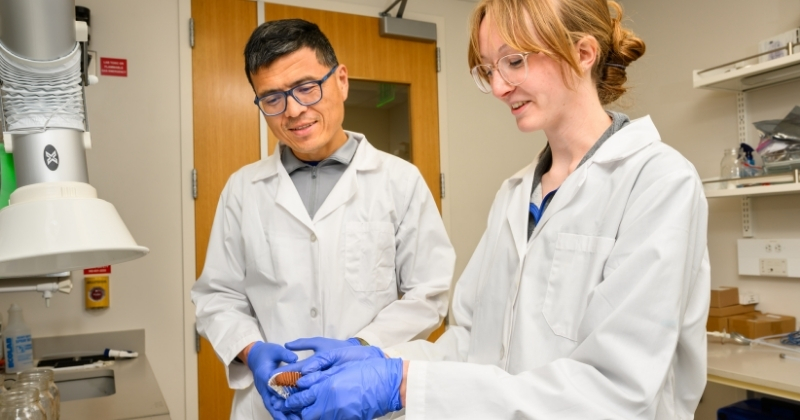
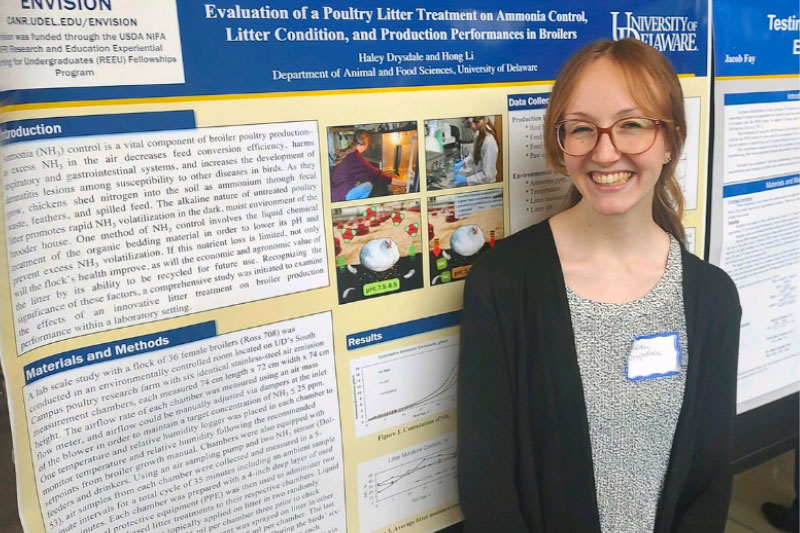
Drysdale worked with Li, associate professor of animal science, for ten weeks. She investigated how different litter amendments—substances added to the bedding in chicken houses—can impact the health of broiler chickens.
“Essentially, as chickens grow up, they shed their excess nitrogen, which can volatilize to ammonia and be detrimental to their respiratory tracts,” Drysdale said. “We used litter amendments that acidified the litter and reduced the ammonia from volatilizing to study the chicken growth and development under different litter treatments.”
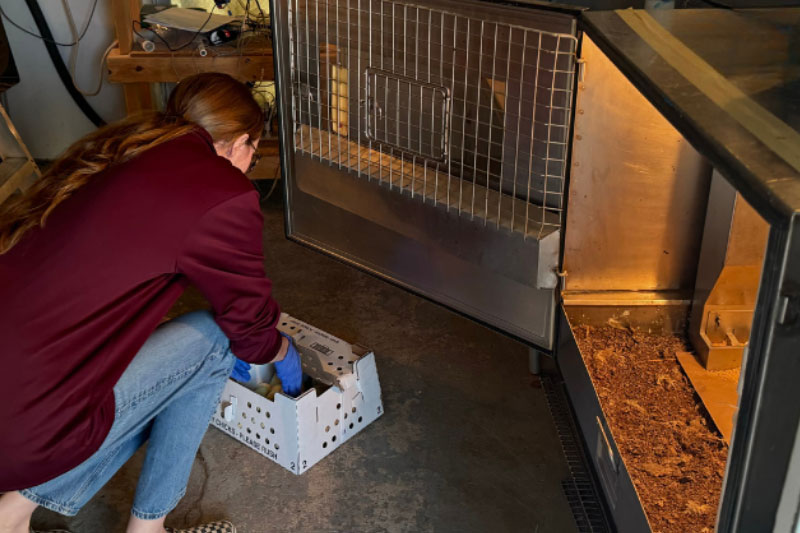
In addition to damaging their respiratory tracts, Li explained that these litter amendments can also help limit the amount of excess ammonia emitted into the air, soil and surrounding waters.
“It’s mainly detrimental to the chicken houses, if they’re exposed to high ammonia, they’re susceptible to some respiratory diseases,” Li said. “But also when the ammonia is emitted into the air, it could come back to the soil and the water, impacting the environment and could cause eutrophication.”
Through this experience within the Li Lab, Drysdale’s interest in research that began in high school FFA was reignited.
“I was caring for a little flock of broiler chicks every single day and coming in and processing data, collecting bedding samples to calculate their ammonia and all that fun stuff,” Drysdale said. “With the help of Dr. Li, I found my passion for research and it showed me that there are so many other opportunities in this industry.”
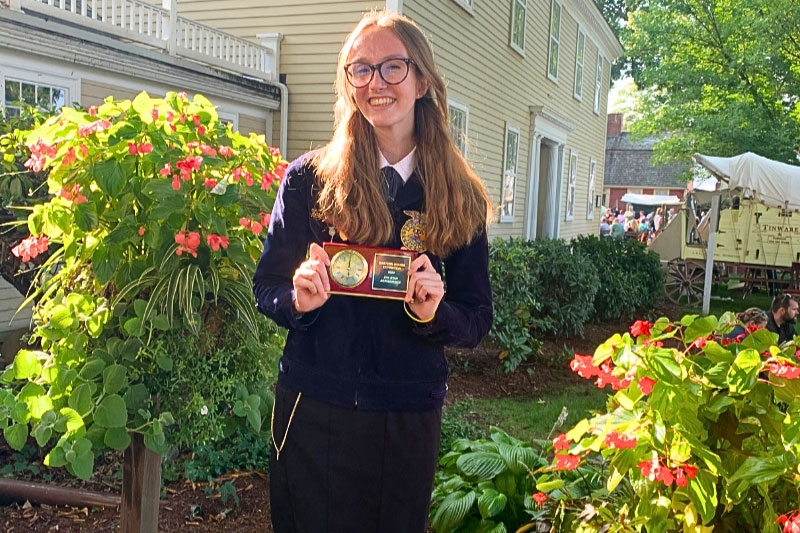
In addition to his lab space in Worrilow Hall, the Li Lab works with chickens on the UD Newark Farm, UD Carvel Research and Education Center in Georgetown and in locations in surrounding states.
Drysdale’s lab work has since extended to several farm trials testing different litter amendments in farms in and around Delaware.
Both Li and Drysdale emphasized the importance of CANR’s commitment to One Health, the idea that everything in the living world is interconnected, and finding ways to feed a growing human population while protecting the natural world at the same time. This drove Drysdale towards a One Health certificate.
“Haley really has a strong desire and interest in research that can solve real-world problems,” Li said. “That kind of interest is great for students in the animal science major, especially those who want to look at the greater environmental and human impact.”
In addition to caring for her flock of broiler chickens, Drysdale also works at UD’s Webb Farm as part of the feeding crew, caring for Angus beef cattle, horses, sheep and lambs.
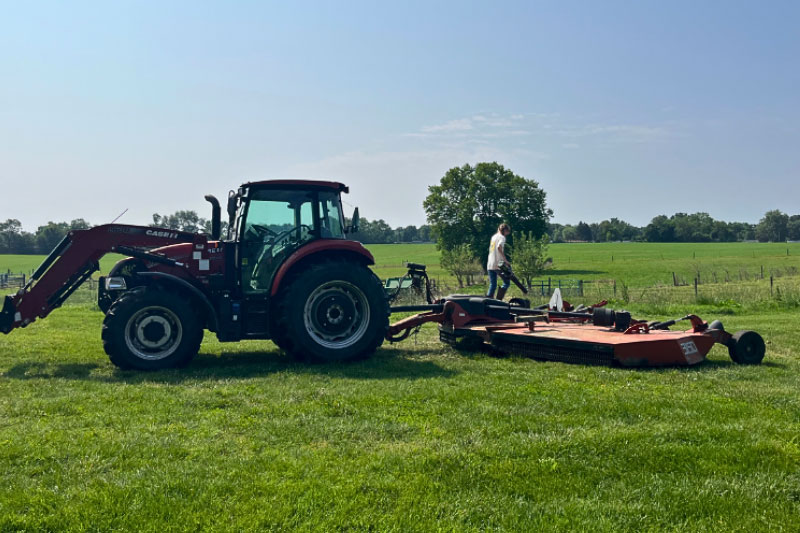
“I started on Webb Farm as a teaching assistant for the Animal and Food Science Exploration Lab (ANFS 111),” Drysdale said. “So, when Larry Armstrong, our farm manager, asked if I was interested in working on the farm part-time, I was super excited.”
Drysdale assists with frequent health checks, special projects, and any upkeep that needs to happen around the farm, such as mowing the lawn, weed whacking or trimming trees. One project she’s particularly excited about is helping to raise the sows for Swine Production (ANFS 418), a highly coveted capstone course that many UD students hope to take during their course at UD with faculty member Tara Gaab.
The course requires students to care for pregnant sows and their piglets once they’re born. The course is a culmination of many animal science courses, as students have to see the process through from start to finish, ensuring the health and safety of the sows and piglets.
As Drysdale, who is slated to graduate in the spring, decided to apply to UD’s M.S. in Animal Science (Thesis) program to continue her work with Hong Li.
“For someone like her, the master’s is just the first step to then getting a Ph.D.,” Li said. “But in addition to staying in academia, a lot of pharmaceutical companies, nutritional companies, or general animal and human health industries have a lot of demand for someone like Haley, with a strong research mind and also the complete skillset that she’ll have.”
Although her path at UD did not take her where she initially expected, Drysdale could not be happier with her experiences and is excited about what a future career in animal science will bring her.
“From the moment that I started working on Webb Farm and in the Li Lab, it just felt like such a community of people,” Drysdale said. “I feel so supported by the people with whom I come to work every single day. It’s really setting me up for a strong future in animal science.”
Contact Us
Have a UDaily story idea?
Contact us at ocm@udel.edu
Members of the press
Contact us at mediarelations@udel.edu or visit the Media Relations website