
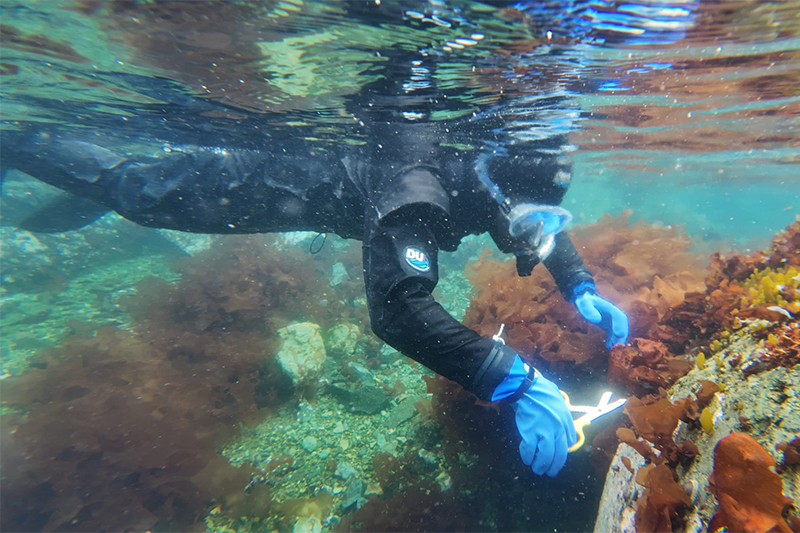
Diving into Delaware seagrass
Photos by Camila Rimoldi Ibañez and Wing Chan and courtesy of TreVaughn Ellis April 24, 2026
UD doctoral student TreVaughn Ellis dives deep to explore the underwater world
As he snorkeled around the West Antarctic Peninsula, University of Delaware doctoral student TreVaughn Ellis was a bit bummed that he couldn’t scuba dive. But having only gotten his drysuit certification a month before, Ellis was placated with an analogy: It’s like learning to ride a tricycle and then wanting to compete in the X Games.
Ellis traveled to Antarctica in January to sample and examine the microbiome of Antarctic brown algae as part of a research expedition aboard the Motor Vessel Ortelius.
All the collections he made were done using snorkeling methods with the assistance of advanced drysuit divers.
“Snorkeling in Antarctica was incredible. I was astonished at the color and vibrancy that existed underwater,” Ellis said. “The water was a different kind of cold, and while my face was the only part of my drysuit exposed, I immediately felt pins and needles as it froze and went numb after only a few minutes. Fighting the freeze, surge and dodging ice floats made the collections even more of an adventure.”
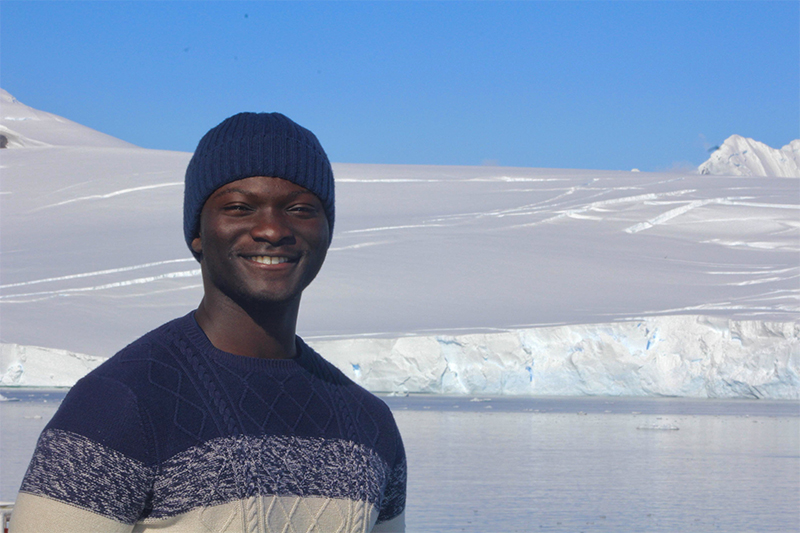
His research focused on characterizing the microbial symbiotes living on the surfaces of algae. The extreme conditions, such as long polar nights, extreme cold and limited nutrients, when combined with global warming, increasing water freshening events and changing water chemistry, suggest a highly specialized microbial suite adapted to the conditions.
“What I'm interested in exploring is to what extent the microbiome changes spatially, as I collected water and small tissue samples from across the coast of the West Antarctic Peninsula,” said Ellis.
UD diver
At UD’s College of Earth, Ocean and Environment, Ellis has continued to develop an interest in researching microbial seagrass communities under water. His research has focused on the microbiome, or the community of microorganisms, of seagrass species in the Delaware Bay and how they respond to different variables such as tidal stressors.
Microbes are key to keeping underwater plants healthy, and Ellis’ research at UD includes examining how microbes generate power underwater, conducting a census of Delaware submerged aquatic vegetation (SAV), and a lab-based study to see how SAV microbiomes are impacted by physical stressors such as boat activity and heat.
Until recently, there was only one problem with his desire to take a closer look at these seagrass beds on his own time: He didn’t have any diving gear.
Recently awarded the Zale Parry Scholarship from the American Academy of Underwater Sciences, Ellis was able to purchase the necessary equipment and take his research to the next level.

The Zale Parry Scholarship offers financial support to individuals seeking to advance their knowledge or to enter professional careers in ocean exploration and related fields. It is named after Zale Parry, a scuba pioneer, underwater photographer and actress.
“That scholarship gave me the means to actually build my kit and be able to get diving in Delaware,” said Ellis.
In addition to the monetary award, Ellis flew to Florida for the ceremony, which he said offered a valuable networking opportunity.
“In her letter, congratulating me on the scholarship, Zale Parry said the ceremony was the ‘Oscars for the diving community,’” said Ellis. “And it was like the Oscars for me because they rented my tuxedo, they paid for my flight, and the people who were there were literally history makers. By talking to them, I was able to get advice on purchasing the correct gear for the type of diving that I want to do.”
Ellis, who learned to dive in 2024 through the UCLA Diversity Project and earned credentials as a scientific diver, is interested in cold-water diving. Due to the extreme icy conditions and poor visibility divers must endure, this type of diving is less popular than its warm-water counterpart.
While it might not be as popular, Ellis said it is just as important.
“My research is here in Delaware, and it gets cold in our waters. Having the right equipment to stay under longer and be able to investigate some of these critical ecosystems is important,” said Ellis. “Our seagrass beds are disappearing, and there are a lot of things that need to be investigated when it comes to preserving those ecosystems. So, yeah, cold-water diving is for me.”
Biddle lab group
Ellis is a doctoral student in Jennifer Biddle's lab group. He first came to UD during a Research Experience for Undergraduates (REU) program in the summer of 2021, where he also worked with Biddle, the Mary A.S. Lighthipe Professor of Marine Studies.
He said Biddle was a big reason why he wanted to continue his studies at UD after graduating with a degree in biology from American University, in Washington, D.C.
“Jen is a great advisor, and she is someone that I knew I could trust or rely on,” said Ellis. “She was someone I could see myself learning a lot from, and Jen gave me the platform to do all of these different things. She’s awesome and wonderful, and I'm really lucky to have her as my advisor.”
For her part, Biddle said Ellis has been an incredible student, not only for UD but for the greater Lewes community.
“TreVaughn first stood out to me due to a recommendation letter that we received with his application to our National Science Foundation-funded REU program. It said he ‘was a professor's dream student’. I knew right then he was the intern I'd select,” said Biddle. “TreVaughn is not only a serious and talented student; he's also a member of the local beekeeper group, a greeter at the Lewes Farmer's Market and just completed Delaware Fire School to volunteer with the Lewes Fire Department.”
Ellis said it feels good to be headed in the right direction, and he encourages anyone who feels things aren’t quite clicking right away to stick with whatever goal they want to accomplish.
“Right now, I’m experiencing a lot of wins, but there are tons of losses I’ve endured too,” said Ellis. “The thing is not to be discouraged. That has been important throughout my academic journey. It started off rough — it was hard adjusting to being here, getting out of undergrad, and being in a new area. But after so much time and care from people, things are starting to work and I'm finding my way. I think that's an important thing to be honest about and to talk about because it doesn't always click right away.”
Contact Us
Have a UDaily story idea?
Contact us at ocm@udel.edu
Members of the press
Contact us at mediarelations@udel.edu or visit the Media Relations website