




Mud snails: youtube.com/watch?v=vU206GhfnWc
Mud snail census
Photos by Kathy F. Atkinson | Photo illustration by Jeffrey C. Chase | Video by Sam Kmiec August 20, 2026
University of Delaware senior studies benthic species with important ecosystem service
Editor’s note: Every year, hundreds of undergraduates at the University of Delaware pursue research under the guidance of a faculty mentor, especially during the summer months. Such experiences provided by UD — a nationally recognized research university — can be life-changing, introducing young scholars to a new field, perhaps even the path to a future career, as they uncover new knowledge. These spotlights offer a glimpse into their world.
University of Delaware senior Seth Buchanan sported sunglasses and a smile on a recent Wednesday as he headed to Cape Henlopen beach for fieldwork.
While waves crashed along the shoreline, Buchanan was near the fishing pier in search of Eastern mud snails, small marine animals found in coastal tide pools, marshes and inlets along the Delaware Bay and Atlantic Ocean. Around an inch long, the humble sea snails help shape intertidal communities as they chow down on dead and decaying marine material. They also aerate the soil as they burrow, bringing essential nutrients deeper into the soft sediment.
Several days a week, Buchanan collects mud snails from three Delaware locations — Cape Henlopen beach, the Great Marsh and Slaughter Beach — as part of his undergraduate summer research with Ed Hale, assistant professor of marine science and policy. He wants to know how prevalent Eastern mud snails are in these locations and whether they are carrying parasites.
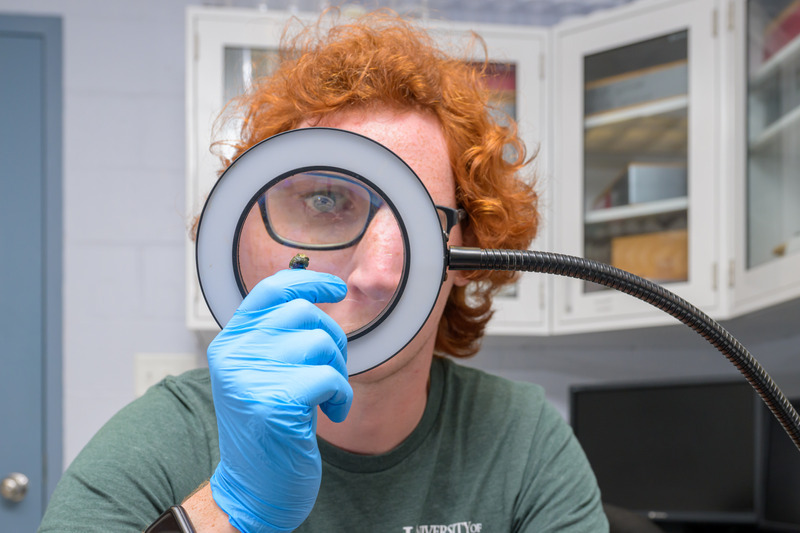
His initial hypothesis was that the snails may be more abundant in areas that are less accessible to the ocean, where human traffic can affect their habitats. So far, however, Cape Henlopen beach and the Great Marsh have provided roughly the same number of available specimens — sometimes as many as 40 to 50 snails in a 3-foot-by-3-foot square.
Back in the Hale lab on UD’s Lewes Campus, Buchanan rinses the snails off to remove any exterior debris. Then he examines each snail’s outer shell for a specific parasite egg, Pleurogonius malaclemys, which is known to affect the diamondback terrapin, a tidal turtle species considered in need of conservation in the Delaware Wildlife Action Plan. He also checks for parasites inside the snail.
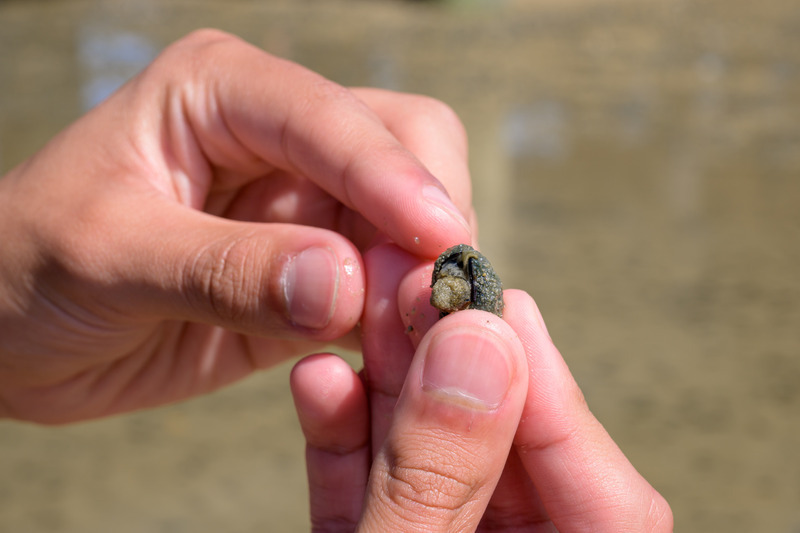
“Mud snails are considered an intermediate species,” said Buchanan, a marine biology major. “This means they get infected with parasites sooner than something larger like a fish or a bird. They don’t move fast, making them easier to collect and examine to learn about the overall health of the ecosystem.”
Each location offers something different in terms of habitat. Cape Henlopen beach is closest to the ocean, and the water there has the highest salinity, or saltiness. The marsh is muddy and smells of sulfur and salt air. Slaughter Beach is situated farther north in the Delaware Bay and the water’s edge is rife with pebbles, the result of turbid waters and currents that originate higher up in the watershed.
Collecting snails, along with data about air temperature, water temperature and water salinity, can help Buchanan piece together if, and perhaps why, the Eastern mud snail favors one habitat over another.

Generally, it’s not hard work. Fieldwork does have some hazards, though, like the time his boot got stuck so deeply in a marsh that retrieving it resulted in him leaving with mud caked up his arms and legs.
Still, Buchanan says those messy moments are worth it. His summer research will contribute to what is known about the distribution patterns of the Eastern mud snail along beaches within the Delaware Bay area.
Buchanan credits his undergraduate summer research with helping him build research skills, network and narrow his career interests, all of which will set him up to be workforce ready upon graduation. He’s also had the opportunity to learn new field research techniques, like trawling and seine fishing.
“The Hale lab is newly interested in researching diamondback terrapins, and I really enjoyed our trawling expedition to Port Mahon, where we collected terrapins and encountered other species, such as sting rays and sharks,” he said.
Following graduation, Buchanan hopes to pursue a career in the fisheries industry, and one day earn a master’s degree.
Contact Us
Have a UDaily story idea?
Contact us at ocm@udel.edu
Members of the press
Contact us at mediarelations@udel.edu or visit the Media Relations website