

Breaking barriers for multilingual learners
Illustration by Jeffrey C. Chase | Photo courtesy of Jon Kittle August 13, 2026
UD doctoral candidate Jon Kittle is working to transform support for multilingual learners
During a reading lesson, Mateo, an elementary multilingual learner (MLL) in a Delaware public school, read "sit" as "seat." Jon Kittle, his reading interventionist, walked him through the short vowel sound, but Mateo made the same "mistake" and grew frustrated. Kittle began to wonder if these “errors” were actually the result of Mateo applying what he knew from Spanish, where the letter “i” carries the sound of the English long “ē”.
When Kittle explained this difference, the tension in the boy's face eased as they discussed how Matteo was navigating his two languages. That moment reshaped Kittle's teaching and provided an early spark for his future research.
Now, as a doctoral candidate at the University of Delaware, Kittle is using his innovative research in literacy education to support K-3 reading specialists as they work with MLLs across the country, including in Delaware, where more than 11% of all K-12 students speak Spanish, Chinese, Haitian Creole or another language at home.
Kittle’s research positions MLLs’ home languages as a vital asset in their education rather than an obstacle. His dissertation examines what reading specialists understand about K-3 Spanish-speaking students’ home language and literacy skills and how they can leverage them to build English proficiency.
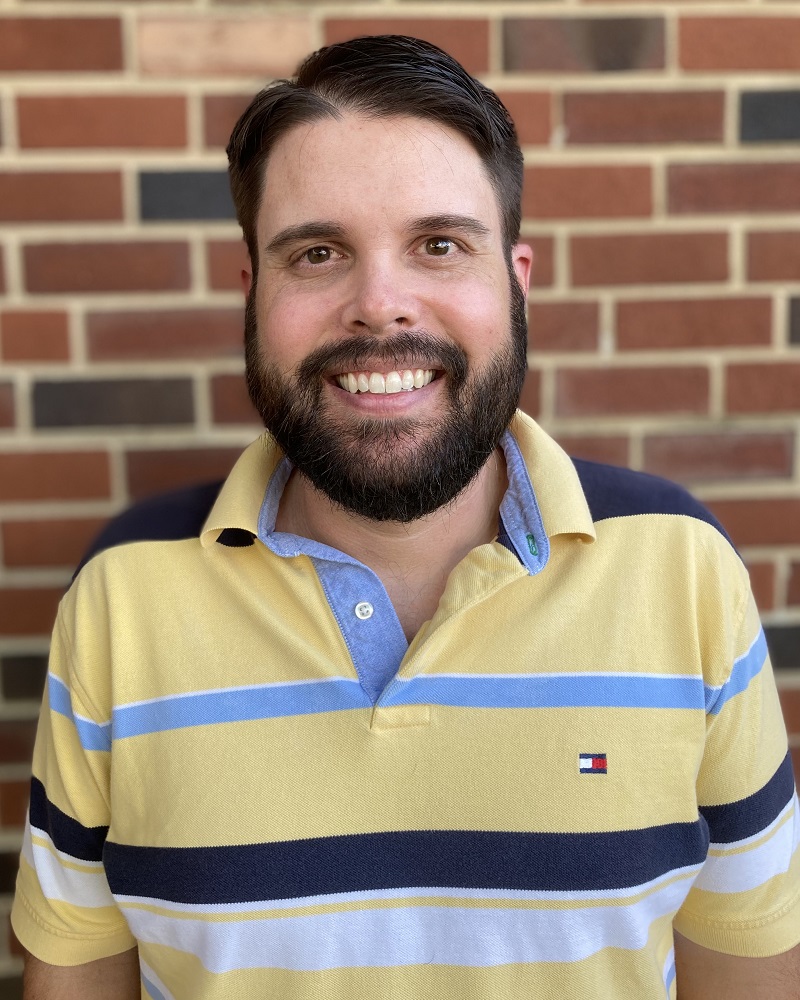
“Students’ home languages are not barriers — they’re powerful resources that can support the development of their skills in English,” said Kittle, a graduate of the M.A. in teaching English as a second language program and a current Ph.D. in education student in UD’s College of Education and Human Development (CEHD).
“This learning is probably happening through cross-linguistic transfer, which is how home language knowledge and skills can support the learning of a new language. For example, Spanish-speaking children might use their knowledge of Spanish letter sounds to help them understand letter sounds in English,” Kittle explained. “So my dissertation asks: ‘What do we know about transfer? And then, what do reading specialists know about transfer, and how are they applying it in their classrooms?”
His work — supported by a highly competitive National Academy of Education/Spencer Dissertation Fellowship — has the potential to shape not only reading instruction for MLLs in Delaware, but teacher preparation programs, professional development and education policy across the nation.
Early impact for Delaware teachers
Though Kittle’s dissertation study of reading specialists’ knowledge of cross-linguistic transfer is still underway, he’s already using his findings from an extensive review of existing research to help teachers maximize the use of MLLs’ home language in their classrooms.
With Christina Budde, assistant professor in CEHD’s School of Education (SOE), and his advisor, Steve Amendum, professor and director of the SOE, Kittle published an enhanced understanding of the Science of Reading for MLLs in January 2026, as well as an article on the Science of Reading for K-5 MLLs in September 2024.
These peer-reviewed articles examined the “Science of Reading” — the interdisciplinary body of scientific research on how children learn to read — through the lens of MLLs, highlighting the importance of home languages in their literacy development and effective strategies for the classroom.
In 2022, Delaware passed House Bill 304, which recognized advances in the Science of Reading. The bill mandated that public schools screen children in grades K-3 three times a year for reading difficulties and offer interventions aligned with the Science of Reading.
“Buidling on our prior work, the goal with the 2026 article was to outline two examples of how you can actually apply home language strategies in the classroom,” Kittle said. “One strategy was on using cognate instruction, and the second was a technique called ‘preview, view and review.’ I was really excited to have the opportunity to present these ideas at Delaware Department of Education’s annual Multilingual Learner Virtual Conference.”
Kittle presented these strategies to teachers, reading specialists and researchers in April 2026, demonstrating how to use “cognates,” words like “family” and “familia” that share similar forms and meanings in English and Spanish.
"I attended your sessions last year and this year at the conference, and I love them every time!,” said a Delaware K-3 MLL teacher in conversation with Budde. “I appreciate how practical the strategies are.”
This summer, Kittle is analyzing his interview responses from reading specialists across the country, learning more about what they know about transfer and how they may use that knowledge in their daily instruction. He hopes the work will ultimately identify how teacher preparation and professional development programs can strengthen reading specialists’ understanding of MLLs and their literacy development.
“Jon’s original research on how reading specialists are prepared to teach multilingual learners is unique and innovative,” Amendum said. “Most literacy researchers approach reading development and instruction from a monolingual English perspective, and many multilingual education researchers focus on language development. To my knowledge, there are few researchers working in this important space at the intersection of literacy education and multilingual learner education.”
Kittle received one of only 35 National Academy of Education/Spencer Dissertation fellowships across the nation from a pool of nearly 500 applicants, and he is the first UD student to do so.
UD’s many MLL programs complement this research, reinforcing the university’s leadership in innovative literacy education. CEHD offers an undergraduate degree in elementary and middle school teacher education with a concentration in MLL education, a master’s degree in teaching English as a second language and a master’s degree in literacy, with a special emphasis on preparing reading specialists.
Supported by a $2.6 million federal grant, UD’s statewide Project DELITE (Delaware English Learners’ Impact on Teacher Education) allows 60 teachers and 15 education paraprofessionals to take the UD courses necessary to attain certification as a Teacher of English Learners or a Bilingual Teacher and participate in a professional learning community.
To learn more about CEHD research in literacy and language, visit its research page.
Contact Us
Have a UDaily story idea?
Contact us at ocm@udel.edu
Members of the press
Contact us at mediarelations@udel.edu or visit the Media Relations website