



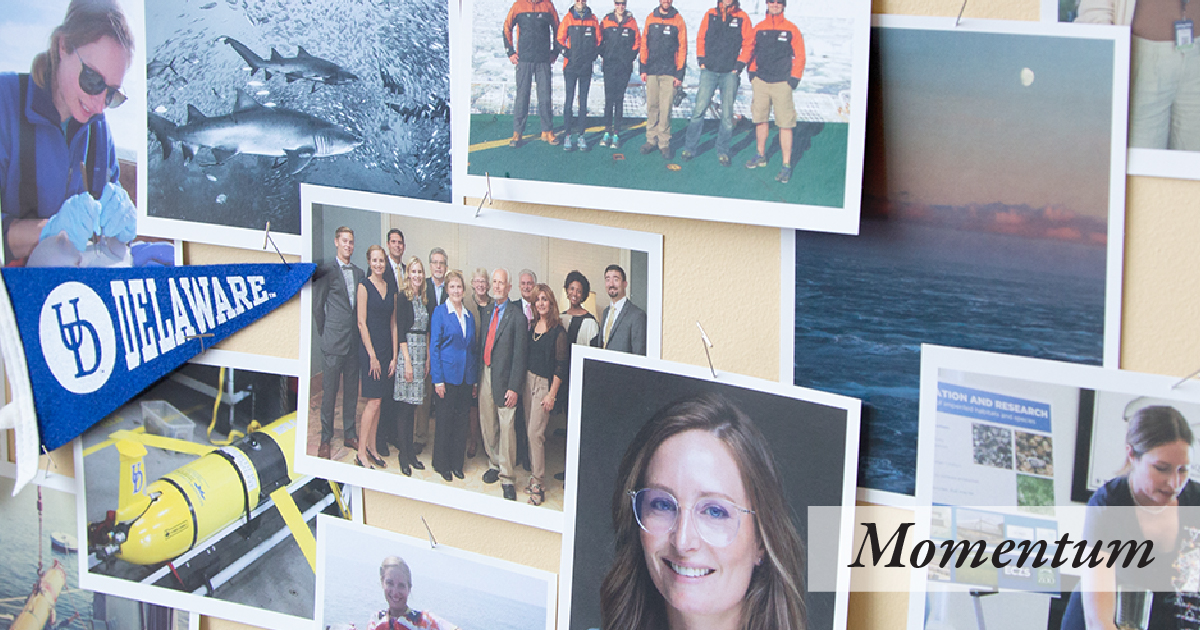
Philanthropy in Motion: Sharks, Robots and the Future of Science
For Danielle Haulsee, EOEPhD17, scholarships paved the way for her marine science research.
Momentum: Philanthropy in Motion is a collection of stories highlighting how philanthropy is driving progress and innovation all across our campus. It’s a celebration of those who believe in a better world – and who choose to invest in making it real.
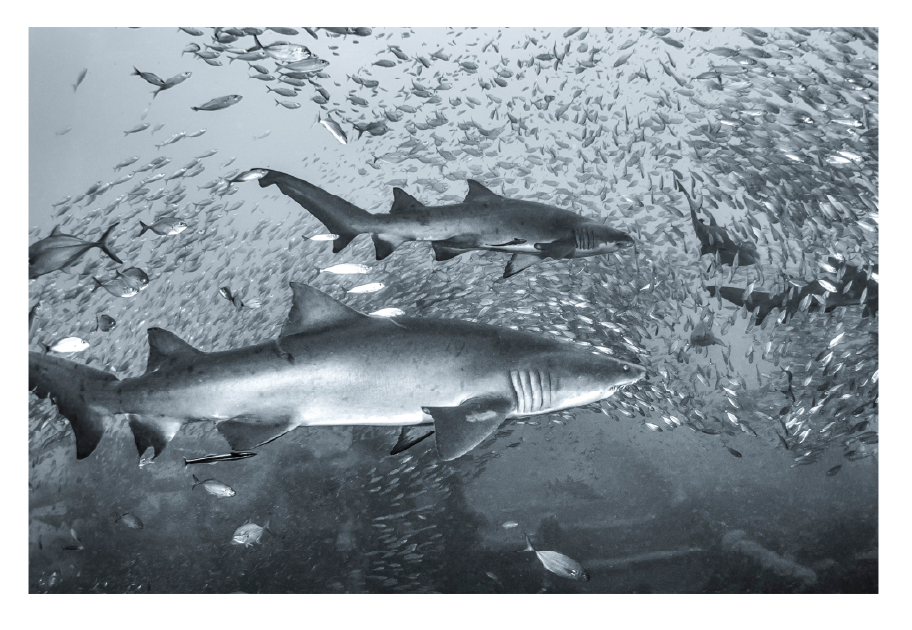
Sharks rarely sit still long enough for researchers to get to know them. They seldom show up for scheduled appointments, and they don’t often stop by the lab to answer questions. For the scientists who study them—or, for that matter, any other species of marine animal—getting out onto the water is a fundamental part of the job. Even so, searching for sharks in a vast ocean is difficult, expensive and often frustrating. Days can go by without a single sighting. But once in a while, the search pays off.
As a graduate student at the University of Delaware, Danielle Haulsee, EOEPhD17, came to understand this process better than most. As a researcher in Dr. Matt Oliver’s lab (Oliver is the Patricia and Charles Robertson Distinguished Professor of Marine Science and Policy), she spent long days (and nights) on the boat, operating complex robotics and monitoring sensitive detection systems for any signs of movement. Their aim was to understand the migratory patterns of sand tiger sharks along the United States’ eastern seaboard, generating data that would allow government agencies to protect certain areas from fisheries during specific times of year.
In practice, this meant pulling sharks from the water; implanting the animals with minimally invasive transmitter “tags”; and then setting up permanent “receiver stations” on the water that use acoustic telemetry to monitor when, or if, the transmitters came back within range. In the areas where sharks appeared, an underwater robot, or “glider,” was used to document the water conditions—temperature, salinity, oxygen-saturation, etc.—that the animals preferred. After years of research, Dr. Oliver’s lab published a first-of-its-kind paper on the “habitat selectivity” of sand tiger sharks.
“My story is about how the support of a few outstanding mentors, and the faith and support of the Robertsons, charted a path for me to hopefully be useful in building a better world.”
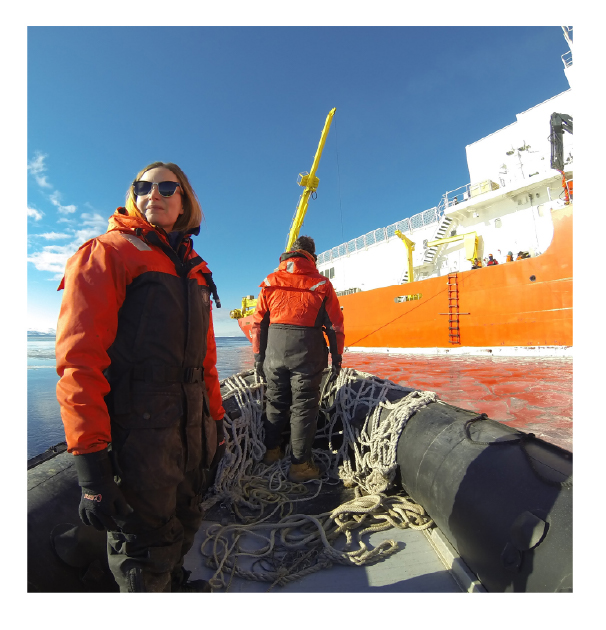
When asked to reflect on the groundbreaking implications of this research, Dr. Haulsee is characteristically modest. Even so, she has made a point to emphasize that this sort of opportunity shouldn’t be taken for granted. For graduate students hoping to hone their skills in field experiences like this, one can be hard to come by. The work often takes years to bear results, and the necessary equipment (like autonomous undersea robots) can be mind-bogglingly expensive. In fact, none of this would have been possible without the generosity of two individuals, Patricia and Charles Robertson.
Over the past decade, Patricia and Charles Robertson committed more than $12 million to support marine research and graduate education at UD. And of the many students who’ve benefitted from the Robertsons’ generosity over the years, Dr. Haulsee was the first. As Dr. Oliver explained at a December event held in their honor, the Robertsons’ support “is not just about funding. It's about belief: belief in the potential of young scientists, belief in the power of education and belief in the idea that together we can solve some of the greatest challenges facing our oceans—from climate change, to pollution, to endangered species, to sustainable food production.”
Today, Dr. Haulsee serves as Chief Science Officer at the Hubbs-SeaWorld Research Institute in San Diego. Running an entire science program keeps her more than busy, but when she was invited to give the keynote address at the event honoring the Robertsons, she didn’t hesitate. Speaking to an audience that included many of her former mentors, Haulsee concluded her lecture with a story from her early days as a graduate researcher. Invited to a dinner at the President’s residence, she was seated across from Patricia Robertson, AS72M, and they struck up a conversation about the team’s recent research expedition in the Delaware Bay. Patricia expressed her admiration for the research, noting that she wished this sort of opportunity had been available to her as a young student. In those days, women were rarely involved in hands-on field research, but she was glad that the world was changing. Since then, Haulsee explained, “I’ve been carrying Pat's words with me. There really is something to be said about the importance of students being able to see that anyone can contribute to these fields. I hope I can make a difference in inspiring the next generation of marine scientists.”
Why has this particular conversation stuck with Haulsee for all these years? “My whole education,” she reflected, “was supported by scholarships. At every level, not just graduate education, that support has been really instrumental for me getting to where I am.” And today, she continued, these opportunities are more important than ever: “A lot of people in the academic world are nervous about the stability of our funding. It’s an uncertain time, but the Robertsons’ generosity means that these opportunities still exist for UD students. I think it's more important than ever for people to step up if they care about this kind of work. The problems our research is trying to solve aren’t going away.”
In conversation, Danielle Haulsee, PhD17, and Jack Truschel AS20M, AS23PhD
To learn more about supporting the College of Earth, Ocean and Environment and graduate education at UD, click here.
Keywords
- Alumni News
- Alumni Voices
- Volunteers
- Alumni Profiles
- Students
- College of Arts and Sciences
- Delaware First Campaign
- College of Engineering
- Faculty News
- Campus News
- Lerner College of Business and Economics
- UDAA
- Biden School of Public Policy & Administration
- Planned Giving
- College of Education and Human Development
- College of Earth, Ocean and Environment
- Athletics
- Parent and Family Giving
- College of Health Sciences
- Blue Hen Strong Fund
- College of Agriculture and Natural Resources
- Horn Entrepreneurship
- I Heart UD Giving Day
- Virtual Engagement and Resources
- Biopharma
- Affinity Club
- Honors College
- Scholarships
- Alumni Wall of Fame
- STAR Campus
- Black Alumni Organization
- Reunions
- Biden Institute
- Careers
- UD MakerNetwork
- Momentum
- Delaware Diamond Society
- Delaware Fund