




Philanthropy in Motion: Paying it Forward
Inspired by mentorship, a new scholarship is opening doors for students.
Momentum: Philanthropy in Motion is a collection of stories highlighting how philanthropy is driving progress and innovation all across our campus. It’s a celebration of those who believe in a better world – and who choose to invest in making it real.
Have you ever remembered seeing something only to find out it wasn’t there? When we see a close-up image, our brains can construct a potential world beyond it, though we’re not aware we’re doing so. Helene Intraub, professor in the Department of Psychological and Brain Sciences, first observed this about 35 years ago. It was a turning point in her career and has been an integral part of her research since.
A few years after discovering the boundary extension phenomenon, Intraub was demonstrating it to a class of UD students. She showed a photo of spaghetti on the tines of a fork, and a short time later, the students “remembered” seeing the full fork and a bowl of pasta. Jennifer Mangels, AS90, was fascinated, and approached Intraub about getting involved in the research.
That work became the basis for Mangels’s honors thesis and a joint-authored publication that was part of a new line of research in Intraub’s lab.
“It’s very much a part of my research story, and having this really excited, really clearly brilliant young student saying, ‘I love this, I want to do this!’ was wonderful,” Intraub said. “I feel very proud of that work. I’m so glad she was there. A very rewarding part of being a professor is the students who just want to learn and find their path.”
Now a professor of psychology and the interim dean of the Weissman School of Arts and Sciences at Baruch College, Mangels credits her successful career in academia to her professors at UD.
In 1986, she came to Newark unsure of what she wanted to major in. She enjoyed psychology, but, other than becoming a therapist, what were her career options? When she got involved in faculty research, a world of possibilities opened up.
“It captured my imagination and the faculty were very supportive,” Mangels said. “Now, I can appreciate the effect that it had on me. I still know that the mentorship that I received from the faculty was the critical pivot point. I don’t know exactly what I would have done otherwise.”
UD certainly holds a special place in Mangels’s heart, and she’s always been happy to give back to her alma mater. In October 2024, an email from UD caught her attention: “There’s still time to establish the Mangels Scholarship.”
She had always wanted to establish a scholarship for psychology students and was in a financial position to do so. In another twist of fate, she already knew UD’s interim chair of the Department of Psychological and Brain Sciences, Rob West; the two worked together as postdoctoral researchers at the Rotman Research Institute and kept in touch over the years.
It was like all the stars had aligned.
“That email just struck me,” Mangels said. “I’ve always been grateful for the scholarship support that I’ve received along my way. Providing some sort of financial support was always something that’s been on my mind to do when I could. And when I received the email, I was like, ‘Okay, the time is now.’”
West noted that Mangels’s experience of majoring in psychology but being unsure of a career path is common. And like Mangels, getting involved in research and internships exposes today’s psychology majors to countless possibilities.
In fact, West views the out-of-classroom opportunities that the department offers as one of the factors that set it apart from other universities. When students work with world-class faculty on research projects, they develop critical skills that help them excel in careers in research, marketing, human resources, law and other fields.
But financial constraints can present academic barriers, forcing students to forgo those additional opportunities in favor of working paid jobs. For countless students, scholarships are a lifeline and an incredible investment.
“Any scholarship or support funds that we have help students engage in those other elements of the program,” West said. “The ability to do things beyond the structure of the classroom gives them that opportunity to find what they’re good at, what they enjoy. Jennifer was able to do research and it prompted a career in academia.”
The Jennifer A. Mangels ’90 Scholarship is the first in the department, which has more than 1,200 undergraduates. This past fall, two students were awarded the scholarship.
One of those students, senior Hannah Marmor (pictured above), expected she’d need to get a second job to cover her tuition. Marmor was already heavily involved in extracurriculars, so her schedule was going to be packed. When she was offered a second job, she faced a difficult choice: turn it down to remain involved in her activities but worry about finances, or take the job and cut down on extracurriculars, which have helped her develop invaluable leadership and communication skills that can’t be learned in the classroom alone. The Mangels Scholarship offer arrived shortly thereafter and Marmor could breathe a sigh of relief.
“It felt too good to be true, honestly,” Marmor said. “I got the email, and I was like, ‘This is fake. There’s no way.’ This gives me the opportunity to not be working a million jobs and to be involved in things that I actually enjoy. I’m very grateful. It’s taking the weight off of my parents and me.”
Fittingly, the psychology faculty have played an integral role in Marmor’s UD experience, just like they did for Mangels. During a difficult junior year, Marmor’s professors helped her navigate issues and offered extra support. That compassion is something Marmor will carry forward in her career as a mental health professional — just like Mangels has paid forward the mentorship she received at UD by helping countless students and junior faculty in her career as a professor.
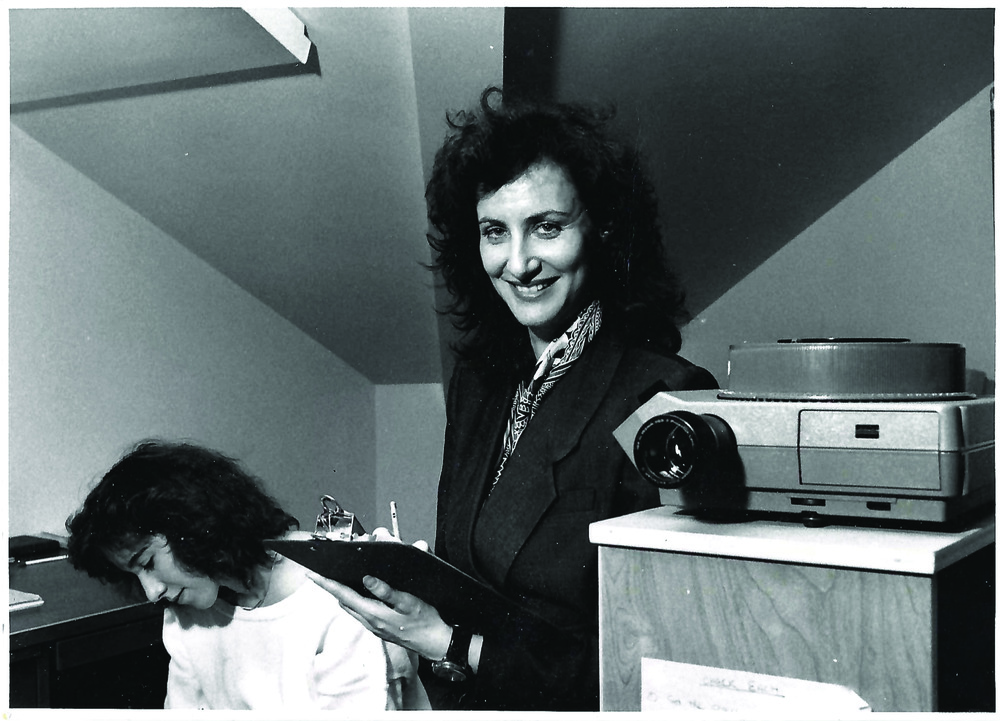
Early in Mangels’s career, the UD honors program invited her to speak to current students about her academic journey and research. The photo of the fork full of spaghetti was in her presentation, and, decades later, the memory still brings a smile to Intraub’s face.
More than the research and impressive careers it sparked for Mangels and Intraub, that fork is a reminder of what strong support systems make possible.
"Jennifer's success is because she grabbed onto something, used every part of it, found her direction and wanted to help other people," Intraub said.
Inspired to pay it forward? Learn more about establishing your own scholarship and expanding access for students here.
Keywords
- Alumni News
- Alumni Voices
- Volunteers
- Alumni Profiles
- Students
- College of Arts and Sciences
- Delaware First Campaign
- College of Engineering
- Faculty News
- Campus News
- Lerner College of Business and Economics
- UDAA
- Biden School of Public Policy & Administration
- College of Earth, Ocean and Environment
- Planned Giving
- College of Education and Human Development
- Athletics
- Parent and Family Giving
- College of Health Sciences
- Blue Hen Strong Fund
- College of Agriculture and Natural Resources
- Horn Entrepreneurship
- I Heart UD Giving Day
- Virtual Engagement and Resources
- Biopharma
- Affinity Club
- Honors College
- Scholarships
- Alumni Wall of Fame
- STAR Campus
- Black Alumni Organization
- Reunions
- Biden Institute
- Careers
- UD MakerNetwork
- Momentum
- Delaware Diamond Society
- Delaware Fund