


Category: Philanthropy
Beyond the Frame: An Art Donation’s Lasting Impact
Sandy Denney, EHD67, AS69M, was a retired middle school art teacher who passed away in 2019. She bequeathed three pieces of art prints to the University of Delaware’s Museum and Special Collections that unfortunately didn’t fit the parameters of UD’s acquisitions policy. The pieces were not received in marketable condition, so development staff worked with the personal representative for Denney’s estate to find an acceptable usage to honor her legacy and meet her philanthropic intentions as closely as possible.
Because of Denney’s passion for art history, it was determined that impacting the experience of future art conservators would have been meaningful, so her framed art found a new home within the Winterthur/University of Delaware Program in Art Conservation (WUDPAC). There, this art would be used for hands-on training and education projects for the program’s graduate fellows.
The pieces were accepted by the conservation lab faculty at Winterthur in 2020 and remained untouched for another five years, waiting for the right student to examine, analyze and treat them.
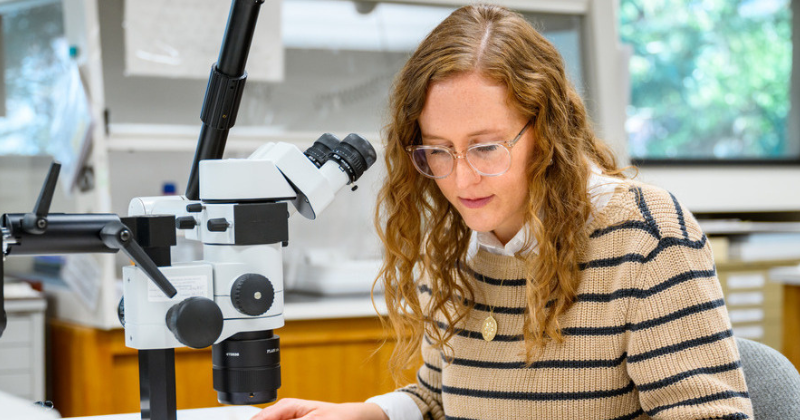
Graduate fellow Emma Reuther, AS27M, was that person. Hailing from Dallas, Texas, with a degree in biology and chemistry from Texas A&M University, Reuther was drawn to WUDPAC because of the excellent reputation of the program, faculty and mentorship — and also because of the international opportunities for internships. Crystal Maitland, senior conservator of paper at Winterthur, inspected Denney’s three donated pieces, and found the perfect fit for Reuther: “Anschutz Talking on Anatomy,” a copper plate etching with black printing ink by American artist John Sloan.
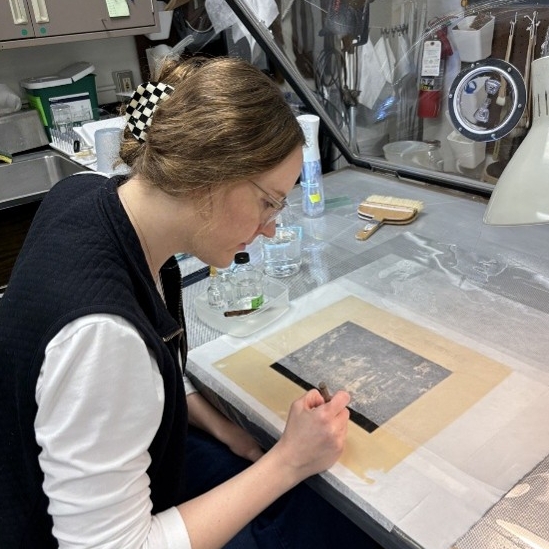
Alongside a thorough examination of the paper and ink used and analysis of the print’s condition, she set out to research the artist and to learn more about the subject to help establish a timeline. The piece was more historically significant than originally thought. For instance, prints from the same etching are found in collections including the Metropolitan Museum of Art and the Whitney Museum of American Art.
As time went on, Reuther’s appreciation of the artist and his print’s backstory grew. By the conclusion of the spring 2026 semester, she had successfully transformed the discolored and yellowed print into a more vibrant version of itself.
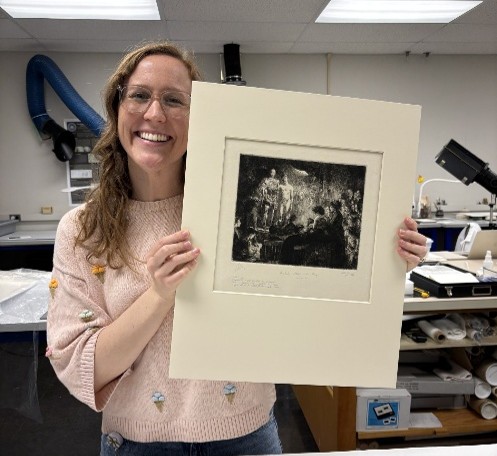
“For an art conservation student, trying a new technique for the first time on a real art object can be nerve-wracking,” Reuther shared. “But it’s an essential part of the process — you have to eventually perform the treatment. Wrapped up into this one print, I was able to gain a huge variety of skills: learning new techniques for tape removal, pushing the stain reduction further and further until the mat burn nearly disappeared and practicing a new fill technique to stabilize and reintegrate the corner losses. It was all immensely useful. I learned to push myself, to sit in the discomfort of feeling nervous and ultimately to trust in my own capability.”
WUDPAC is widely recognized as one of the leading programs of its kind. When Debbie Hess Norris, the program’s Unidel Henry Francis duPont Chair and professor of photograph conservation, travels to conferences, she reunites with UD art conservation graduates who now work all over the world.
“Graduates of the program serve museums, libraries, archives, historic sites and private practice around the world,” Norris said. “They advance research and scholarship, educate future conservators, contribute to emergency response and recovery efforts and care for collections that range from internationally significant works of art to the family heirlooms and community collections that connect people with their history and one another.
“Our graduates have cared for some of the world’s most significant cultural treasures, from the Declaration of Independence, the Emancipation Proclamation, the Star-Spangled Banner, the Liberty Bell and the Treaty of Paris to the Dead Sea Scrolls, John Glenn’s Friendship 7 space capsule and the world’s first photograph,” she continued. “Their work encompasses masterpieces by artists ranging from Rembrandt, Gilbert Stuart and Paul Cézanne to Ansel Adams, Andy Warhol, Faith Ringgold and Jean-Michel Basquiat, as well as beloved icons of popular culture such as Julia Child’s kitchen, C-3PO from the Star Wars franchise and Grace Kelly’s wedding dress. Faculty and alumni also respond to natural disasters and other emergencies, helping communities protect and recover at-risk collections from Cuba to Iraq. Through this work, they strengthen cultural understanding and ensure that meaningful stories remain accessible for future generations.”
The University of Delaware is grateful to Denney for the donation from her estate that now provides students like Reuther future opportunities to practice what they learn in the classroom.
“I think if the donor were alive, she would be happy to see how much life this print has re-gained, from contextual research tied to Sloan’s personal diaries, to the improvement in overall tone and reduction of staining,” Reuther said. “I would absolutely thank her for allowing me to work on this print and letting it be a crucial and beneficial stepping stone on my path to becoming a conservator.”
If you are interested in learning how a gift from your estate can impact the Blue Hen community, please contact Megan Cantalupo at 302-831-3822 or visit www.giftplanning.udel.edu.
Keywords
- Planned Giving
- College of Earth, Ocean and Environment
- Alumni Profiles
- Alumni News
- Alumni Voices
- Volunteers
- Students
- College of Arts and Sciences
- Delaware First Campaign
- College of Engineering
- Faculty News
- Campus News
- Lerner College of Business and Economics
- UDAA
- Biden School of Public Policy & Administration
- College of Education and Human Development
- Athletics
- Parent and Family Giving
- College of Health Sciences
- Blue Hen Strong Fund
- College of Agriculture and Natural Resources
- Horn Entrepreneurship
- I Heart UD Giving Day
- Virtual Engagement and Resources
- Biopharma
- Affinity Club
- Honors College
- Scholarships
- Alumni Wall of Fame
- STAR Campus
- Black Alumni Organization
- Reunions
- Biden Institute
- Careers
- UD MakerNetwork
- Momentum
- Delaware Diamond Society
- Delaware Fund