
Communicating plant stress
Photo illustration by Jeffrey C. Chase | Photos and video courtesy of Jung-Youn Lee October 06, 2026
UD researchers evaluate cell-to-cell signals that help plants mount defenses
When a person falls and gets a cut or a scrape, they often use hydrogen peroxide to clean the wound. This molecular compound is also produced within our cells, helping our immune system build its defenses against bad bacteria or other pathogens.
Hydrogen peroxide is produced inside plants, too, where it acts as a messenger, telling cells to beef up a plant’s defense when it is stressed, wounded or under attack.
“Hydrogen peroxide is involved in almost every internal and external challenge plants go through,” said Jung-Youn Lee, University of Delaware professor of plant molecular and cellular biology. “It’s involved in many different signaling mechanisms, but its function is localized, which means it doesn’t flood a plant’s cells.”
UD plant scientists have uncovered new knowledge that tiny nanopores called plasmodesmata send alert signals from cell to cell, generating a huge burst of hydrogen peroxide when a plant is wounded. The team recently published their findings in the journal The Plant Cell, with Niraj Kumar Vishwakarma, a postdoctoral researcher, serving as the lead author. The role of this burst of hydrogen peroxide is a key finding that could prove useful in engineering more climate-resilient crops.
“Climate-resilient crops can be developed by understanding how plasmodesmata handle biotic stressors, like bacteria and fungi, versus abiotic stressors, like weather, drought and wounding signals at a subcellular level,” Vishwakarma said. “Researchers might be able to fine-tune intercellular transport, keeping plant vascular networks open and productive even under harsh environmental conditions.”
Signaling stress
In 2016, Lee identified how plants handle stress from other living things, such as animals or other plants, versus stress from non-living things like air, water and soil. Lee learned signaling is possible because of multiple pathways from plasmodesmata — tiny bridges between cells — that move the signal forward.
“If a plant gets bitten by an insect, its cells are signaling, ‘I just got bit! Be prepared to defend!’” Lee said.
Then, there are the messenger molecules themselves that travel through plasmodesmata to alert cells of something bad: Hydrogen peroxide. Plants are stationary and some can produce toxins when threatened, to deter an animal from eating it. Hydrogen peroxide sends signals to plants in circumstances like that.
Plant cell communication: https://capture.udel.edu/media/1_5jkmu6ix/
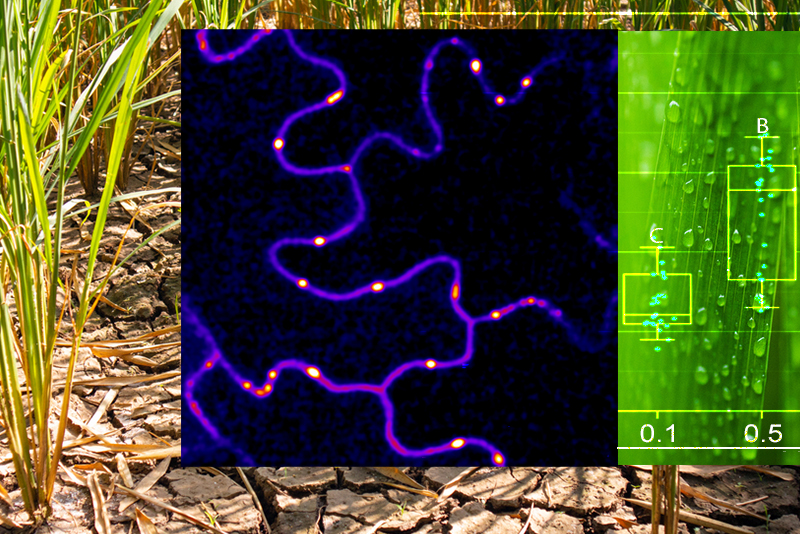
To learn more about how hydrogen peroxide responds and moves through plasmodesmata, a team of researchers from UD’s Department of Plant and Soil Sciences adapted a reporting tool called HyPer7, genetically engineering it to detect hydrogen peroxide within the cells and plasmodesmata of Australian wild tobacco and mouse-ear cress. HyPer7 binds to plasmodesmata. When hydrogen peroxide was present, HyPer7 would light up like a flashlight under a microscope.
Jeffrey Caplan, an associate professor and the director of the UD Bioimaging Center, has used this kind of a reporting tool for chloroplasts — the part of the plant cell that turns sunlight, water and carbon dioxide into plant food. He said it was much more difficult to use HyPer7 for plasmodesmata.
The research team thought plasmodesmata was going to mimic the response to hydrogen peroxide inside plant cells, cytoplasm and the plasma membrane, but something surprising happened.
“We thought the signaling events must all be happening at the same time when a plant is wounded,” Caplan said. “However, we saw the response near the wound first and then the plasmodesmata farther away responded afterwards. They weren’t simultaneous.”
Meanwhile, plasmodesmata in distant and undamaged tissue responded on their own delayed schedule, behaving like checkpoints to receive a body-wide alert and helping each part of the plant decide how to respond.
“It was much more sensitive and faster in the response compared to its most adjacent locations within the cell — the cytosol and the plasma membrane,” Caplan said.
Cytosol, water-based fluid inside of the cell that helps a living person or plant function, is not a particularly friendly environment for hydrogen peroxide, Caplan said.
“There are a lot of things in that kind of cytosolic soup that try to destroy the hydrogen peroxide,” Caplan said. “They basically try to scavenge it, get rid of it. You don’t see the same changes because proteins within the cytosol are trying to remove it as best as it can.”
Vishwakarma said this research is the first showing real-time reactions for unstable oxygen molecules measured at plasmodesmata. The communications channels display sensitive cellular chemical reactions and serve as early detection sites of plant stress at the cell’s surface.
It’s unclear why that delayed response happens. The researchers hope to dive deeper into that in the future.
The findings matter, Lee said, because if they know plasmodesmata can process the hydrogen peroxide burst, they could potentially genetically manipulate plasmodesmata so that it can more quickly respond to plant stressors, like drought, so a plant could overcome it more easily.
“This adds to the portfolio of things we can use to engineer plants to better equip them or help them survive against all these changing extreme environments,” Lee said. “We have more tools now than before.”
Niraj Kumar Vishwakarma, Md Abdur Razzak, Vishnu Mishra, Timothy Chaya, Jeffrey L Caplan, Jung-Youn Lee, Plasmodesmata display dynamic local and systemic redox responses during plant stress, The Plant Cell, Volume 38, Issue 7, July 2026, koag192, https://doi.org/10.1093/plcell/koag192. The research was funded by the National Science Foundation.
Contact Us
Have a UDaily story idea?
Contact us at ocm@udel.edu
Members of the press
Contact us at mediarelations@udel.edu or visit the Media Relations website