





Leaving gravity behind
Photos courtesy of Tyler Van Buren and NASA | Video courtesy of Tyler Van Buren May 27, 2026
A UD experiment returns from space with new data on how particles influence turbulence
After traveling hundreds of miles above Earth and spending months aboard the International Space Station, a University of Delaware experiment has returned to campus, bringing new data on how turbulence behaves in microgravity.
The project, led by assistant professor of mechanical engineering Tyler Van Buren, is designed to study how particles influence turbulent flows. From dust in the air to sand in coastal zones and bubbles at the sea surface, particles can change how flows behave.
Van Buren compares it to an energetic crowd moving around while carrying objects.
“The crowd would behave differently if they were holding large exercise balls versus heavy boulders,” he said. “In turbulence, the fluid motion can similarly carry particles. We’re interested in how the particle weight changes the turbulence.”
On Earth, particles are constantly influenced by gravity. In space, that force is greatly reduced, giving researchers a chance to isolate how suspended particles themselves affect turbulent motion.
The work began in spring 2022, when a group of undergraduate students led by Van Buren began designing the device, supported by a grant from NASA’s Established Program to Stimulate Competitive Research (EPSCoR). Then-graduate students Frank Tricouros and Tony Liang, who earned doctoral degrees in mechanical engineering from UD in 2025 and 2023, respectively, played key leadership roles in developing and refining the design.
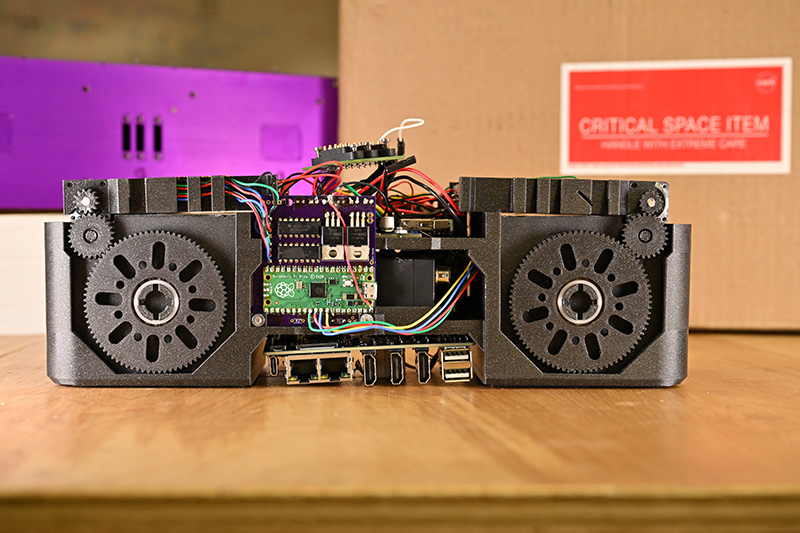
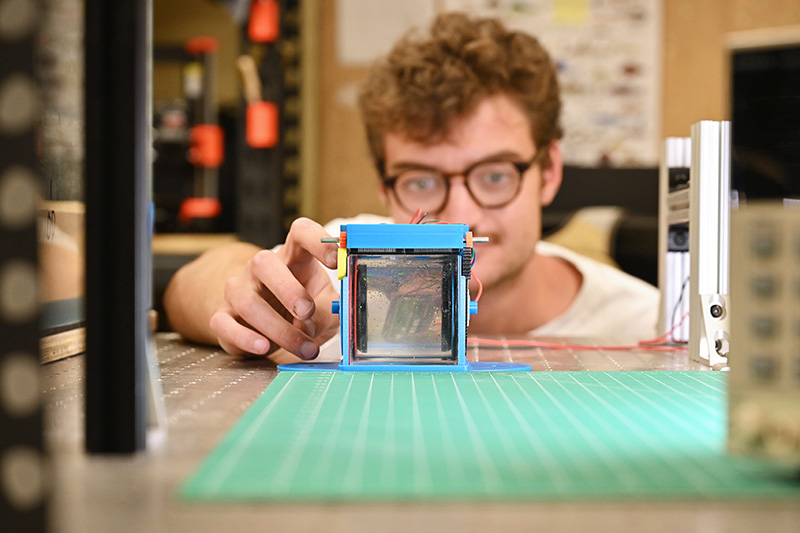
The team built a compact, self-contained system packed with fluid chambers, particles, lasers, cameras and onboard computing — all confined to a volume roughly the size of two coffee mugs. The device had to operate autonomously in orbit, collecting video data.
First, it had to get to space.
Catching a ride to space
As part of his senior engineering capstone, biomedical engineering student Brenden Swanik joined Van Buren’s lab and began tackling how the device would get into orbit. For Swanik, who graduated from UD in 2023, that challenge also became his entry point into the space industry.
“I had no idea where to start,” he recalled. “You can’t just order a rocket.”
He began reaching out to “mission management” companies that handle launching equipment into space. Eventually, he connected with Nanoracks, now Voyager Technologies, which became the service provider for the UD experiment — and his employer after graduation.
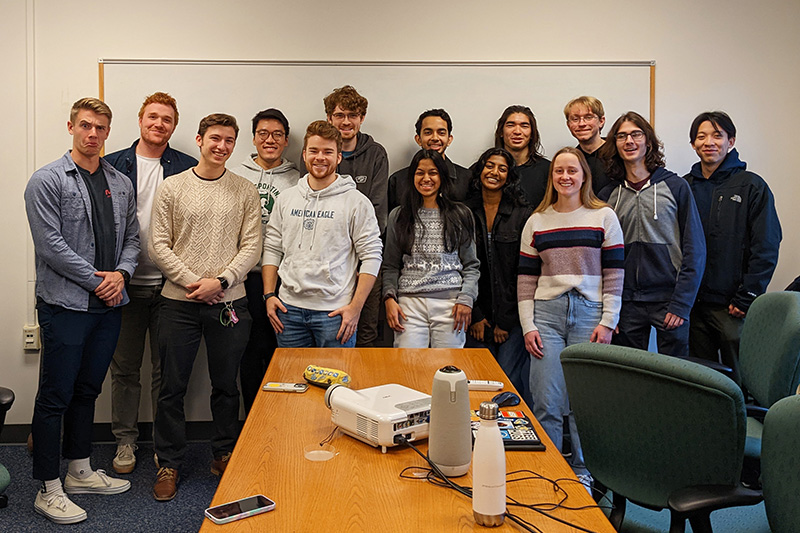
Swanik went on to focus on satellite missions but stayed closely tied to the UD project as it moved through approval and launch.
The device underwent an extremely rigorous safety review to ensure it met standards for equipment operating on the crewed space station.
“Even a single wire is measured down to a hundredth of a millimeter,” said Swanik.
After passing review, the experiment still needed a ride to the space station. Voyager secured a spot aboard the Japan Aerospace Exploration Agency’s HTV-X1 spacecraft, which launched Oct. 26, 2025.
“It was nice to finally see it go up,” Van Buren said. “You don’t think the launch day will ever come, and then suddenly it does.”
Frank Tricouros demonstrates assembly of the team’s device.: https://capture.udel.edu/media/1_id8e19k6/
Surviving the trip
Before reaching orbit, the device traveled from Delaware to Texas to Japan, then endured the extreme forces of rocket launch.
“Those are all instances where things could break, even something as simple as a wire coming loose on a solder joint,” said Van Buren.
After the experiment was installed aboard the space station, the question remained: Would it work as intended? Because of limited bandwidth, the video could not be streamed back to Earth. Instead, the UD team relied on indirect signals that the system was operating as planned.
Distinct spikes in power indicated that the system was cycling through its programmed stages. At one point, it shut down after drawing too much power, likely because it had filled its onboard storage.
That gave the team confidence that the experiment ran as expected, but they still had to wait months to see whether the recordings contained usable data. Eventually, the experiment got a ride back to Earth, survived reentry, was processed by NASA and got mailed back to UD, arriving on campus in April 2026.
Opening the box
In the lab, the team is beginning to extract and analyze the data. Their first steps are to download and process the videos, which were compressed using a custom algorithm developed by Galen Nare, who received bachelor’s degrees in electrical engineering and computer science from UD in 2024.
From there, the researchers will use image-processing techniques to track particles and reconstruct the flow of the fluid frame by frame, building a detailed picture of how turbulence evolves in microgravity.

The team is particularly interested in how turbulence behaves with heavier versus lighter particles. They will compare both cases while turbulence is active and after it is turned off, tracking how energy dissipates over time and comparing the results with those from Earth-based experiments.
The findings could improve understanding of processes from coastal erosion, where waves carry sand, to construction sites, where dust is kicked into the air. The work could also have implications for future space missions, where fluids may behave differently under reduced gravity conditions on the Moon or Mars.
“We still have to go through every video, so there are challenges ahead,” said Van Buren. “I feel tentative optimism. But regardless, I’m proud of the team. Designing something that runs autonomously, survives a rocket launch and works in space isn't easy — and UD students pulled it off.”

Contact Us
Have a UDaily story idea?
Contact us at ocm@udel.edu
Members of the press
Contact us at mediarelations@udel.edu or visit the Media Relations website