
Global Crops and Drought
Illustration by Jeffrey C. Chase July 30, 2026
UD’s Kyle Davis helps develop a framework to assess the resilience and sensitivity of crops to drought
As temperature and rainfall fluctuations continue to influence global crop production, UD research has identified where crops are most vulnerable to environmental stressors.
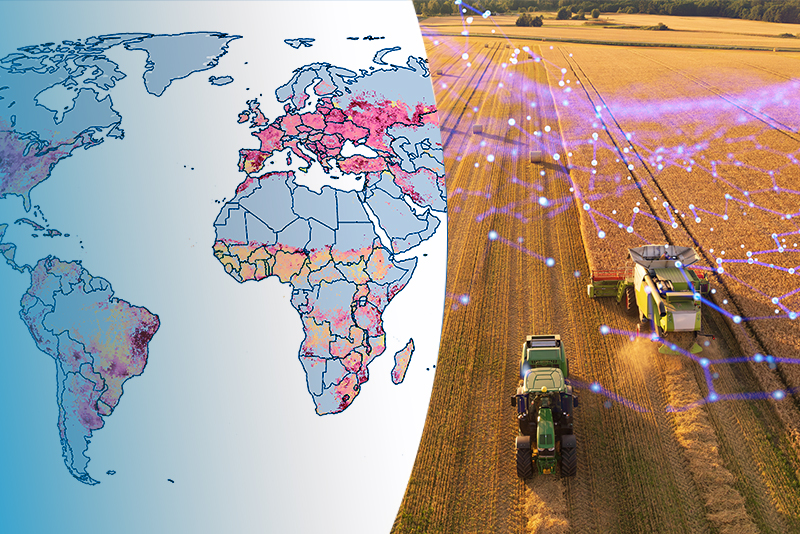
A new study from the University of Delaware’s Kyle Davis examined production losses for 17 major crops accounting for three-quarters of the world’s food production and found that portions of the Midwestern United States, eastern Brazil, eastern Spain, and central and northern India were among the areas most sensitive to droughts. He also found that rainfed crops are more sensitive to climatic conditions than irrigated crops, which can still receive water through sprinklers, canals or hoses, helping yields remain stable, or even increase, during a drought.
The research was published in Nature Communications, in a paper titled, “Addressing Global Hotspots of Drought-Related Crop Production Losses.” Marta Tuninetti, assistant professor in the Department of Environment, Land and Infrastructure Engineering at Politecnico di Torino in Turin, Italy, served as co-lead author.
Davis said that hotspots emerge when climate conditions vary, and when crops are not ideally suited for their location.
“If you have a crop that tends to be more sensitive to changes in temperature and precipitation, and its production is concentrated in a particular place, then that crop will dominate what you see in terms of overall drought sensitivity,” said Davis.
Identifying these hotspots offer policymakers an opportunity to prioritize interventions or adaptations in those regions and help target the specific crops that likely require the most attention, he added.
For instance, a country, intergovernmental organization or development agency can use these findings to test solutions and to understand, at a broad scale, which strategies might offer the greatest benefit. This could include expanding irrigation without stressing water resources, identifying areas where crop yields tend to be low but climate sensitivity is high, or switching to crops better adapted to or hardier against drought.
“In that way, they can quickly determine whether the additional effort and funding needed to pursue an intervention that is tailored and receptive to the needs of a particular people and place is likely to produce large benefits,” Davis said.
His research quantified global patterns of rain-fed and irrigated crop-specific drought sensitivity and drought-associated production losses for 17 major crops, including rice, corn, wheat, and soybeans.
Davis, an associate professor with joint appointments in UD’s Department of Geography and Spatial Sciences and the Department of Plant and Soil Sciences and a resident faculty in UD’s Data Science Institute, said the goal was to develop a set of metrics to assess the resilience or sensitivity of different crops to droughts.
“For all of the decades of research on drought and agriculture, we still don’t have a good understanding of which crops are most sensitive to drought — and where — across the world’s croplands,” he said.“We wanted to develop metrics for a large number of crops and do so in a spatially detailed way so that you can know in any particular place to what extent specific crops are affected by dry or hot conditions.”
Contact Us
Have a UDaily story idea?
Contact us at ocm@udel.edu
Members of the press
Contact us at mediarelations@udel.edu or visit the Media Relations website