




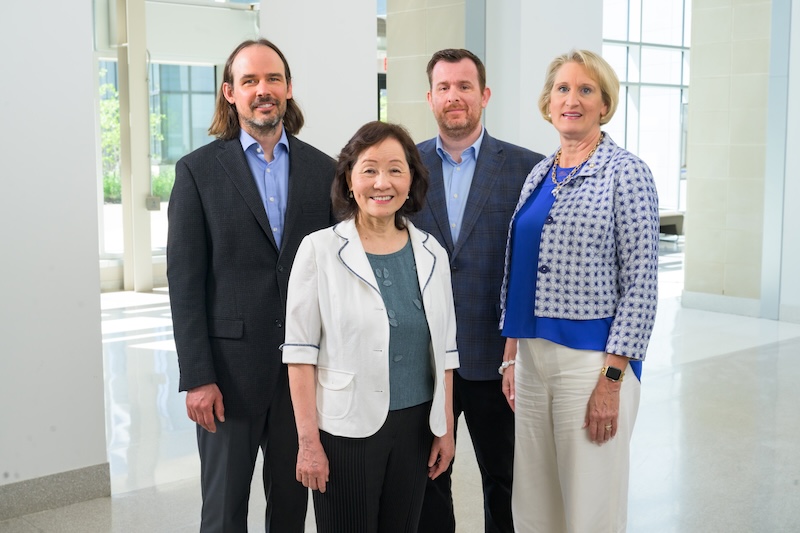
UD to Lead $21.5 Million NSF National AI Institute
Photos by Evan Krape July 29, 2026
New NSF HAIC institute will advance human-AI cooperation
From the teenage soccer player recovering from knee surgery to the grandparent relearning how to walk after a stroke, physical therapy plays a vital role in restoring mobility and helping people live independently — especially later in life.
But what if artificial intelligence could work side by side with physical therapists, adapting to each patient, guiding treatment decisions and accelerating recovery? The University of Delaware will lead a new U.S. National Science Foundation (NSF) National Artificial Intelligence Research Institute to make that vision a reality.
NSF has issued a $21.5 million, five-year award to establish the NSF AI Institute for Human-AI Cooperation (HAIC), headquartered at UD’s Data Science Institute. UD will lead the effort in collaboration with Delaware State University, the University of Pennsylvania, the University of Florida and Princeton University.
“Our goal is to transform artificial intelligence into an adaptive teammate, allowing human users and AI systems to interact in dynamic collaboration,” said HAIC Director Cathy Wu, the Unidel Edward G. Jefferson Chair in Engineering and Computer Science at UD. “By developing AI that enables personalized models tailored to individual needs and decision-making, our institute will chart a new path for health care and cultivate the next generation of leaders in AI.”
HAIC will bring together experts in artificial intelligence and machine learning, physical therapy and rehabilitation, ethics, engineering and robotics, neuroscience and biomechanics, education and workforce development. At UD, the institute will engage 11 faculty members and their teams across multiple departments, centers and institutes.
UD is advancing AI that sharpens a clinician's judgment rather than replacing it — that's innovation with intention."
-UD President Laura Carlson
“With Dr. Wu's leadership and the strength of our partners across the NSF AI Institute for Human-AI Cooperation, UD is advancing AI that sharpens a clinician's judgment rather than replacing it — that's innovation with intention,” said UD President Laura Carlson.
A National Hub for Human‑Centered AI
With more than 40 partners across academia, industry, government and nonprofit organizations, HAIC will serve as a national hub for human‑centered AI — artificial intelligence designed to support, not replace, human decision‑making in health care.
“Rehabilitation and physical therapy present new challenges for AI,” said HAIC Deputy Director Austin Brockmeier, assistant professor of electrical and computer engineering at UD. “These are complex, ever-changing settings where uncertainty is unavoidable. Our work focuses on building AI that can extract insights from data, learn from clinicians and align with both clinical goals and individual preferences, so it becomes a reliable teammate.”
HAIC researchers will integrate multimodal data — from movement and physiological signals to clinical records and patient feedback — to generate both population‑level insights and patient‑specific predictions. They also will use AI‑enabled digital twins to create virtual versions of patients, or avatars, allowing clinicians to safely test movements and refine treatment options before applying them in real-world care. These avatars also will provide a visual reference for patients throughout their path to recovery.
“HAIC reflects what becomes possible when we bring engineering, computer science and health expertise together around a challenge that directly affects people’s lives,” said Pamela M. Norris, dean of the College of Engineering. “By pairing advances in artificial intelligence and robotics with the insight of clinicians and patients, this institute can help shape a more human-centered future for health care.”
Research Embedded in Real Patient Care
HAIC researchers will operate in active patient care settings, including UD’s Physical Therapy Clinic, which advances teaching and research while delivering high‑quality community care during more than 30,000 patient visits each year. The institute is further strengthened by UD’s Physical Therapy Program, which consistently ranks No. 1 in U.S. News & World Report.
“We have an incredible opportunity to make the work of physical therapists faster, more precise and more personalized,” said Darcy Reisman, chair of UD’s Department of Physical Therapy and a HAIC working group chair. “Clinicians collect enormous amounts of data from motion-capture systems, wearable sensors and heart‑rate monitors, but AI will help synthesize that information into meaningful guidance that shapes the next clinical decision.”

Beyond the clinic, HAIC researchers will explore how AI can support patients remotely.
“If someone records themselves at home performing an exercise, AI could help determine whether they’re doing it correctly or need adjustments,” Reisman said. “That kind of feedback could extend high‑quality care beyond the clinic in ways we haven’t been able to do before.
“There’s no magic pill for many of the conditions we study,” she added. “As we age, physical therapy and rehabilitation are critical to helping people live well. It’s exciting to see AI focused where it can truly make a difference.”
From Smart Robotics to Stroke Recovery
Early HAIC projects will emphasize neurologic rehabilitation, particularly stroke, Parkinson’s disease and other age-related motor impairments, alongside musculoskeletal conditions and lower‑limb amputations.
Panagiotis (Panos) Artemiadis, professor of mechanical engineering at UD and a HAIC working group chair, is developing AI‑enabled rehabilitation technologies that combine robotics and digital twin modeling. His lab includes an instrumented treadmill that can simulate different walking surfaces — from gravel to mud, and from uneven to sloping terrain — allowing researchers to study how patients adapt their movements while the training supports motor learning, helping the brain and body relearn movement skills essential to daily life.
“The vision is that a patient walks in the lab, we collect measurements, the AI model identifies their specific impairments, and robot-assisted therapy is tailored to the patient in real time,” Artemiadis said. “Within the next few years, we expect to demonstrate personalized, AI‑driven rehabilitation methods that can improve outcomes for stroke survivors.”

Artemiadis’ research also includes robotic prostheses with patented controllers that adapt to different users and walking conditions, helping individuals navigate varied terrain more safely and confidently. These efforts will draw on UD’s extensive stroke and Parkinson’s patient registries, as well as collaborations with the Department of Veterans Affairs and prosthetic device manufacturers.
Training the Workforce of the Future
Beyond research, HAIC places a strong emphasis on education, workforce development and industry partnerships. Across the participating institutions, undergraduate and graduate students and postdoctoral researchers will gain hands-on experience. HAIC also aims to empower health care professionals to effectively use emerging AI tools. The institute will support certificate programs in AI across partner institutions, summer AI camps coordinated by Delaware State University through its extensive partnerships with historically Black colleges and universities (HBCUs), community colleges and regional institutions, and a public portal for sharing information.
“This is truly an exciting time for the HAIC Institute to significantly advance AI research, instill trust, promote accessibility, connect with community stakeholders, and translate discovery and technology into economic and societal impact,” Wu said.
This material is based upon work supported by the U.S. National Science Foundation under Cooperative Agreement No. 2433450.
Contact Us
Have a UDaily story idea?
Contact us at ocm@udel.edu
Members of the press
Contact us at mediarelations@udel.edu or visit the Media Relations website