




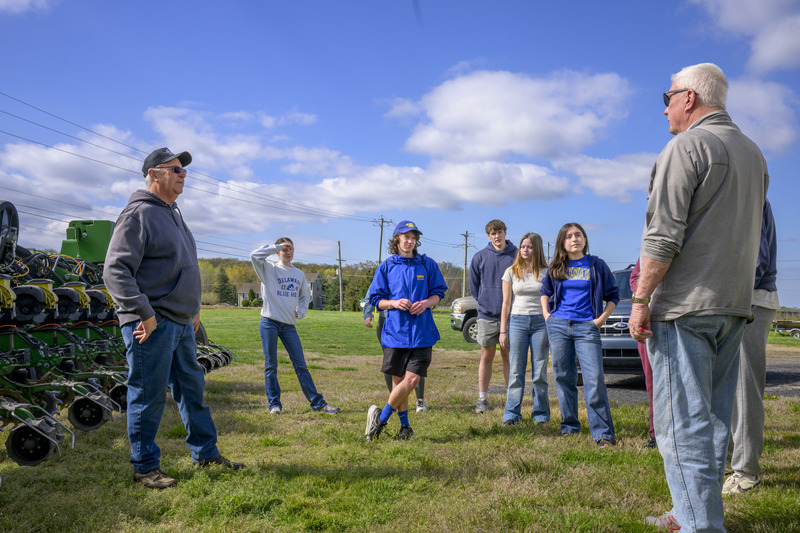
Classroom to cornfield
Photos by Kathy F. Atkinson May 13, 2026
UD applied economics students get a taste of Delaware agriculture
It’s Delaware’s No. 1 industry, generating billions in economic activity and employing nearly 80,000 people statewide.
Agriculture and food is big business in the region, and UD’s Department of Applied Economics and Statistics explores all aspects of it: management, marketing, international trade, land use economics, policy, decision-making and more.
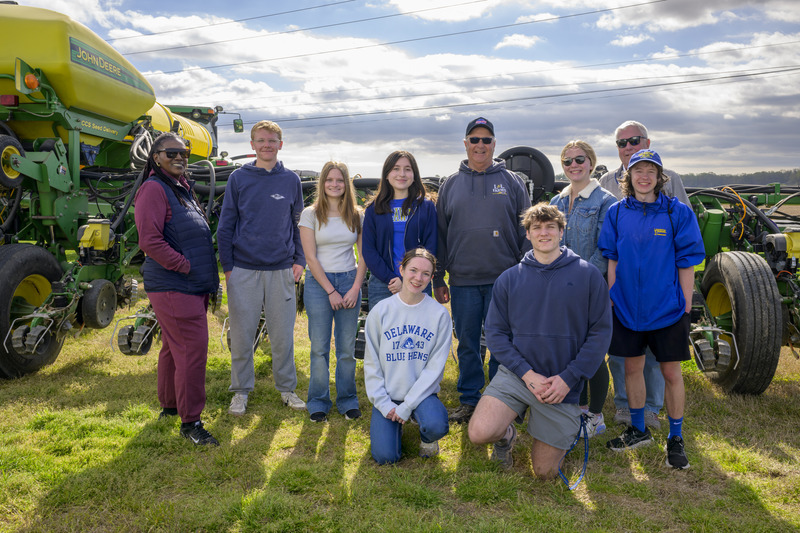
But it’s one thing to learn in a classroom and another to see real-world business applications up close and in person. That’s exactly what students in UD’s Applied Economics Student Association did in April, touring four Delaware farms under the guidance and mentorship of Delaware’s ultimate Ag Ambassador.
“Farmers are business people,” said Ed Kee, former Delaware Secretary of Agriculture, who led the tour. “They’re agronomists, they’re chemists, they’re mechanics — jacks of all trades. They have wisdom to share.”
Kee served as Delaware agriculture secretary from 2009 to 2017 and is a retired UD Cooperative Extension specialist.
The University of Delaware College of Agriculture and Natural Resources is at the forefront of preparing students for agricultural jobs. Research, fieldwork, internships and coursework provide hands-on exposure to various aspects of the industry.
Kee wants to ensure CANR graduates are “broad-minded,” understanding the big picture of agriculture and the people behind them.
So he set out to show them.

Understanding poultry production
Leah Palm-Forster, associate professor of applied economics, connected the student association with Kee. As part of their eight-hour tour, Kee and eight students — six undergraduates and two graduate students — visited Georgie Cartanza’s organic poultry farm near Dover. The UD Cooperative Extension statewide poultry agent raises around 148,000 organic chickens at a time, making her the ideal expert on poultry economics.
One reality: policy. The U.S. Department of Agriculture has delayed implementing a new rule that would prohibit poultry companies from reducing growers’ pay based on how they rank compared to other poultry growers during the week when their birds move from production to processing.
Like all policy decisions, it comes with tradeoffs. “I tried to share the upsides and the downsides,” Cartanza said. “If a grower knows what their base pay is going to be, it may take away a little bit of their motivation.”
Motivation is crucial for a farm like Cartanza’s, which can annually feed 780,000 families each with a rotisserie chicken. Certain decisions can make or break a flock, like conditioning her litter (bedding) between flocks to reduce moisture and ammonia, or making sure equipment is in peak condition.
“At the end of the day, any farm owner is responsible for the care of those birds,” Cartanza said.
Exploring agritourism
From Dover, Kee and his students traveled to Camden-Wyoming to meet Mike Fennemore Jr., who is a fourth-generation co-operator at Fifer Orchards. Fifer’s invites customers to get outside, unplug and experience the old-fashioned farm fun that connects people with their land and food.
Fennemore explained how this “Delaware century farm” adapts products and activities to consumers’ interest and demand.
“We don’t just hear our customers — we listen to them,” Fennemore said. “Every improvement we make is a direct result of their feedback. When you truly care about serving others and pay attention to their needs, delivering a great experience becomes second nature.”
The farm sells homegrown fruits and vegetables in its Farm Store, from asparagus, strawberries, blueberries, peaches, sweet corn, tomatoes, pumpkins, apples and even local honey, apple cider, baked goods and kettle corn. The Farm Kitchen also offers lunch options, ice cream, slushies and more. The outdoor activities offer U-Pick & U-Play with family fun for all ages. Things get extra festive on Saturdays with special guests, live music and extra activities. Fifer’s is open April through December each season 6/days a week (closed Sundays).
But the profession can be volatile.
“Agritourism is a seasonal and weather-driven business. We are completely at the mercy of Mother Nature for the crops and the crowds,” Fennemore said. “Staffing, preparations and inventory management is tricky with uncertain weather forecasts or any type of inclement conditions for customers. We don’t just handle change — we live it, adapting abruptly to keep moving forward.”
Keeley McCormick, a junior food and agribusiness marketing major, called Fifer’s a prime example of farmers working hard to diversify their businesses to succeed.
“Even from how everything is laid out and designed, you can tell it’s from a consumer point of view,” McCormick said. “They’re doing it all. They’re packing their own fruit. They’re doing their own tourism. They’re this leading example.”
Agricultural reflections
Throughout the day, students gained a firsthand appreciation of agriculture — the good, the bad and the ugly.
In Middletown, Larry Jester of Jester Farms, taught the basics of corn, soybeans and wheat. In Hockessin, Jim Mitchell at Woodside Farm Creamery, introduced them to a robot milking cows.
“We talk about the importance of technology in class,” McCormick said. “But to see how those small effects impact real life was eye-opening.”

Cain Carter, a sophomore environmental and resource economics major, has often studied the values of non-market goods — values a person can’t really see. But it wasn’t until walking through Jester’s farm and witnessing the value of preserving farmland so it lasts, or learning how Cartanza integrated environmentally friendly features to lower heat and humidity, that the course material came to life.
“People were so willing to share their story,” Carter said.
Alasqa Farley, a senior honors environmental and resource economics major, marveled at the farmers’ collective passion for the work.
“The tour was very insightful,” Farley said. “All the farmers we talked to were so knowledgeable.”
Kee hopes to do more of these tours, potentially launching tours each semester for each department, possibly even one for faculty.
“Delaware is a remarkable place with remarkable people,” Kee said. “It’s an honor to connect our students to the great work they do day in and day out.”
Contact Us
Have a UDaily story idea?
Contact us at ocm@udel.edu
Members of the press
Contact us at mediarelations@udel.edu or visit the Media Relations website