




Senior Superlative
Photos by Kathy F. Atkinson and courtesy of Mikul Duggal May 19, 2026
2026 High Index Senior Mikul Duggal reflects on memorable classes, lessons learned
As a first-year Honors student, Mikul Duggal was no stranger to his adviser’s office.
“I must have gone there 100 times in the first two weeks of class, changing my major from computer science to neuroscience, back to computer science, back to neuroscience, always intending to declare a pre-med track.”
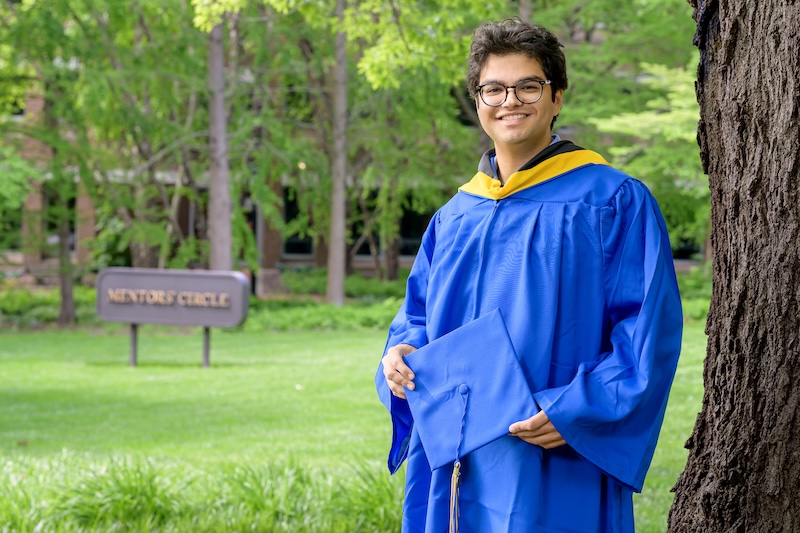
But why choose? Today, the triple major (neuroscience, computer science, liberal studies), double minor (medical humanities, biological sciences) and Medical Scholar will graduate as UD’s 2026 High Index Senior.
Since 1957, the annual award has combined GPA and credit hours to identify the senior with the highest grade-point index. This spring, 51 members of the Class of 2026 boast a perfect 4.0. Of those, only one will have earned 190 credits upon graduation.
“It’s pretty cool,” said Duggal, who only learned of the award’s existence earlier this semester. It’s also a fitting reflection of his path — non-linear, rigorous, fueled by coursework that ignited his interests and will culminate with medical school at Thomas Jefferson University this fall.
“Satisfaction, for me, involves some form of productive exhaustion,” said Duggal. “It’s feeling like I’ve spent my efforts toward something worthwhile and made some sort of impact.”
In four years, that impact speaks for itself. As a freshman, he researched the “niche basic science” of enzyme kinetics. The following year, Duggal earned a Bryant Howard Medical Research Award to conduct a 10-week internship at Johns Hopkins, calling the experience “the most inspired I’ve ever felt.”
As a junior, he discovered the parallels between academic tutoring and bedside manner: “The nature of conversations are perhaps more intimate than people realize. You get to know students on a vulnerable level and bridge a connection in understanding. It’s incredibly gratifying.”
Before entering his senior year, Duggal took the MCAT (“the hardest thing I’ve ever done”), scoring in the 99th percentile. Earlier this spring, he was inducted into UD’s chapter of Phi Beta Kappa, the nation’s oldest and most selective collegiate honor society for the arts and sciences.

Here, the graduating senior with the most course credits to his name reflects on some of his most memorable classes.
Most unique to UD: ARSC480: Medical Scholars Practica. “This is an experience you can fulfill locally with Christiana Care or as part of a study abroad. I did it domestically, with a shadowing rotation in radiology. The class gives you an unmatched level of access to the profession. I got 125 hours, minimum, within a single, 4-week rotation over Winter Session. You hear stories of how difficult it is to acquire clinical experiences, and here we have this program that directly facilitates that opportunity.”
Most surprising: MATH210: Discrete Math. “I’m no mathematician, but the language and approach to constructing arguments are so unique.”
Favorite: HIBC: Honors Integrated Biology and Chemistry. “It’s a notoriously difficult class, but you’re going to get through it, one way or another. The entire teaching team is made up of HIBC alumni [including Duggal, who served as a teaching fellow during his junior year]. It’s probably something you can only appreciate in retrospect.”

Most enjoyable, thanks to the professor: “I’d take anything with Neuroscience Professor [Stuart] McCaughey. He’s awesome in every way possible. His lectures are wildly entertaining.”
Most eye-opening (tie): HIST382: History of Western Medicine: “Learning about atrocities committed against humanity in the name of scientific progress [such as medical experiments from the Holocaust] was an important reminder for how regressive science can sometimes be.” ANTH304: Culture, Health and Environment: “Learning about different environmental disasters, ways authorities have mismanaged situations, and how norms of [medical] fears are grounded in reality helped me understand how we’ve reached a place of distrust.”
Most likely to take again: CHEM527: Introductory Biochemistry. “Not from a curiosity perspective — because it’s incredibly difficult — but for the sake of the MCAT. It’s the sum of all the other intro sciences, simultaneously integrating organic chemistry, general chemistry and biology. To wrap your head around those concepts is to have a really proficient, system-wide understanding of how things work.”
Most grounding: KAAP420: Functional Anatomy. “We each have a donor body [through the Anatomical Gift Program]. Cherishing the humanity of that donor, that body, that life that existed outside of the table—it constantly took me back to a place of appreciation and gratitude.”
Contact Us
Have a UDaily story idea?
Contact us at ocm@udel.edu
Members of the press
Contact us at mediarelations@udel.edu or visit the Media Relations website