





Ocean energy
Photos by Evan Krape | Video by TreVaughn Ellis July 28, 2026
UD scientists deploy device that uses microbes to power ocean sensors
The sun beat down on the Delaware Bay as the water slowly engulfed an eight-foot-tall power source that could change the game for ocean research.
When it finally disappeared under the water shortly after noon, it left two blue floating airbags in its wake. Jennifer Biddle breathed a sigh of relief.
“Our fingers were significantly crossed,” said Biddle, University of Delaware Mary A.S. Lighthipe Professor in the School of Marine Science and Policy. “I was certainly holding my breath waiting for it to sink.”
This giant device was the product of a $7.8 million grant from the Defense Advanced Research Projects Agency (DARPA), the research arm of the U.S. Department of Defense. Scientists call the device a Persistent Oceanographic Device Power (PODPower) system.
University of Delaware researchers teamed up with University of Maryland, George Washington University, Johns Hopkins University, Harvard University, Oregon State University and Battelle to sink the PODPower to the bottom of the bay earlier this month. After divers released the airbags, the device sank about 15 feet deep. The team will monitor the system and extract it from the bay once a test run is complete.

The engines behind the large fuel cell are tiny living organisms called microbes that are able to use ocean carbon to create electricity. PODPower harnesses that electricity to activate and charge various sensors and other research devices in the ocean.
Ocean sensors give scientists a window into the depths of the Earth’s largest bodies of salt water. They clue researchers into temperature, how salty the water is, how high ocean waves are, and even how marine life behave beneath the surface.
Usually, these sensors need batteries or long underwater cables to work. And when a battery runs out or a cable frays, researchers have to replace them. It’s expensive and can disrupt important data collection.
That’s where the PODPower comes in.
“The idea is that you could do turtle monitoring programs or sensing of other marine organisms,” said Stephanie Lansing, environmental science and technology professor at the University of Maryland and the lead researcher on the project. “Any sort of device that you would need to do research or draw electricity in the open water could be powered by this microbial system. We're creating renewable energy from the microscopic organisms that are in the ocean at the exact place where an energy source is needed.”

Over the last 1.5 years, Lansing’s research team worked to “coax” freshwater microbes into adapting to a more saltwater, marine environment. Over time, Biddle said, the microbes adapted and are able to produce the chemical compound acetate from digesting the marine organics, like they could in digesting organics in freshwater.
“Microbes are little engines and it seems like they can do almost anything we want them to do,” Biddle said. “It’s a matter of learning how to coax them into doing what you want them to do, and trying to keep them alive and working.”
The PODPower uses two chambers near its top that act like manta ray gills, inhaling water and trapping particles like zooplankton, phytoplankton and detritus that are then fed to a fermenter. The fermenter breaks down the organic matter into acetate, which is fed to another set of microbes in the fuel cell that move electrons from inside the cell onto a direct circuit outside the cell, creating an energy circuit, which can power ocean sensing devices.
Matthew Rau, an associate professor of mechanical and aerospace engineering at George Washington University, helped design the collection system for the PODPower that filters small particles out of ocean water, taking in biological organisms like algae and passing them to the fermentation microbes, while allowing sand and silt — particles that are not organic matter — to pass right through.
“We tried to mimic the complex mouth structures of filter-feeding fish like manta rays to scavenge particles from seawater as passively as possible,” Rau said. “The collection system is designed to work passively with the ocean currents, so as the currents move through our devices, they extract the particles and then feed them to the microbes downstream.”
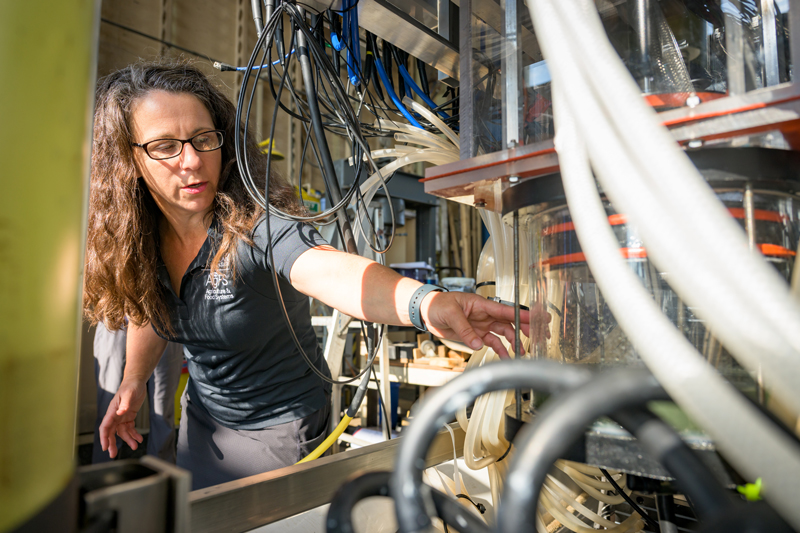
Rau said the filter-feeding-inspired technology works well, but still “falls short” in areas where the water has few particles. He hopes further advancements will fix this. And future improvements to the technology can shrink the unit smaller and smaller while still producing energy outputs. Think of computers from the 1950s and how much bigger they were compared to now.
“Originally, those took up entire rooms and can now fit in our pockets,” Rau said. “We'll see through further research and development how small we can shrink this technology."
What Rau said resonated with TreVaughn Ellis, a second-year doctoral candidate in the UD marine biosciences program. Ellis is monitoring the microbes in the PODPower’s vicinity, seeing how the surrounding microbes interact with the device’s microbial community.
“Science is about daring to do things that are outlandish or don’t seem feasible,” Ellis said. “I’m thankful to be a part of it. I think it’s courageous what’s going on and I think that’s needed in science.”
The PODPower project is a partnership between the University of Maryland, Johns Hopkins University, Harvard University, George Washington University, Oregon State University, University of Delaware, Battelle, and Yokogawa Corporation of America.
Ocean energy: https://capture.udel.edu/media/1_uh02ouz6/
Contact Us
Have a UDaily story idea?
Contact us at ocm@udel.edu
Members of the press
Contact us at mediarelations@udel.edu or visit the Media Relations website