





Art, activism and memory
Photos courtesy of Aaron Terry February 19, 2026
Students on a study abroad program in Chile learn how the country’s artists reflect on its political past and present
The Winter Session study abroad program in Chile was full of memorable experiences—visits to artist studios, contributing to a community mural, eating the freshest food imaginable, time in the mountains, beach days—but a moment Hannah Morgan will never forget involved just a few minutes with a stranger.
A woman on the street noticed students holding bags from the Museum of Memory & Human Rights in Santiago, Chile’s capital city, and she approached the group of University of Delaware students to thank them for visiting and learning about this era in the country’s history.
The museum commemorates victims of Chile’s military dictatorship, led by August Pinochet from 1973 through 1990, which left several thousand Chileans dead, imprisoned or in exile.
“We were getting ice cream after, and this woman came up and said, ‘I’m so happy you went,’” said Morgan, a junior visual communications major who has a writing minor and studied in New Zealand with the World Scholars Program. “She was alive during that time and talked about her life. We didn’t realize that it is still a big deal to a lot of people.”
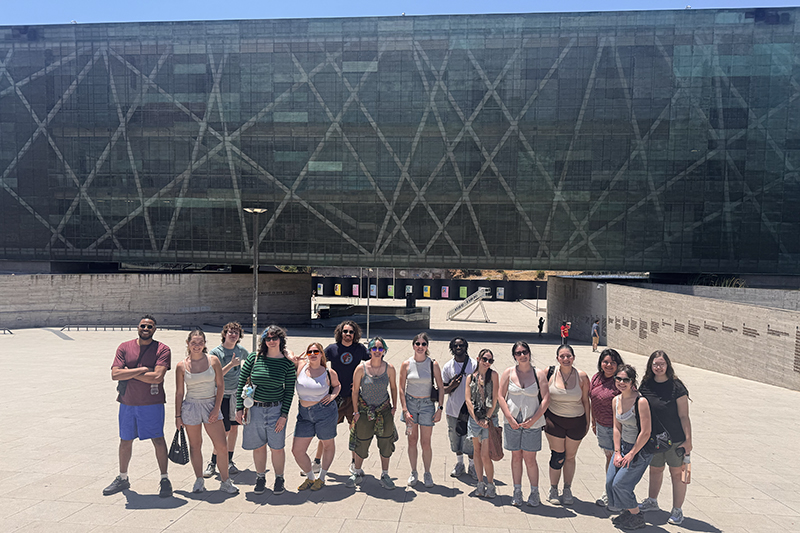
The incident also reinforced faculty leader Aaron Terry’s goals for the program. Terry, associate professor in the Department of Art and Design in the College of Arts and Sciences, wanted students to experience the power of art for social change and learn about the relationship between art and memory.
The program centered on two distinct urban centers of Chile: Santiago, a political center at the base of the Andes Mountains, and Valparaiso, an educational center of steep hills facing the Pacific Ocean.
“Exploring these cultural and geographic locations allowed students to see how Chilean artists reacted to decades of military dictatorship and oppression, as well as recovery and contemporary politics,” Terry said. “In studying this history, students gain an understanding of how societies relate to tragedy through personal and collective memory.”
Art and resistance
Her time in Chile inspired Morgan to rethink the art she creates. Although she can be outspoken in her personal life, she never wanted to use her printmaking for political statements, but the program changed her mind. Even as a visitor who didn’t know the full history or understand the culture, the Chilean art she saw had a huge impact.
“Listening to these artists share their stories and witnessing their passion firsthand gave me a deeper understanding of the responsibility and potential artists hold within society,” she said. “If I can do that for one person, if I can make a difference or get one person to think more deeply about an issue, I want to do that.”
Their time in Valparaiso showed students how art, culture and activism can coexist in an urban setting.
“In Chile, they use art as resistance. You see it everywhere,” said Sofia Glassman, a junior psychology major with minors in Spanish and Africana studies.
Valparaiso embraces street art, not just permitting it but actively encouraging the vibrant expressions of creativity.
“Sure, some of it is like a tag,” Glassman said, “but a lot of it is murals, and they’re beautiful and they show the history.”
In viewing murals and meeting local artists like Klaudia Kemper, students learned about symbolism in art.
“Klaudia told us what different symbols represent, like how people put the country upside down to represent the fact that it was a territory named by colonizers and not the Indigenous people,” Glassman said.
Preserving memory
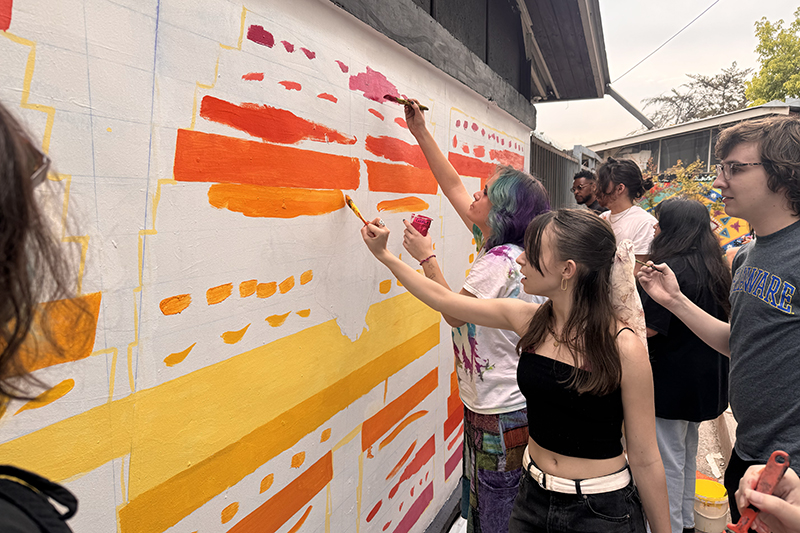
Students took that knowledge with them as they created art projects throughout the program, including working on a mural in a community center with artist Juana Perez, who shares her work on Instagram. Perez has created murals in Chile, Peru, Ecuador and Mexico reflecting each country’s visual, indigenous traditions.
“We integrated it into the mural, which was beautiful,” Glassman said, “and we saw how Juana uses symbolism in her work by using just words in the form of resistance. Also her work looks like a Mapuche textile.”
Mapuche are the largest group of Indigenous people in South America, known for their textile works (often used as clothing, tools, shelter and status symbols). Perez’s mural work often references Mapuche textile/weaving patterns as well as indigenous words.
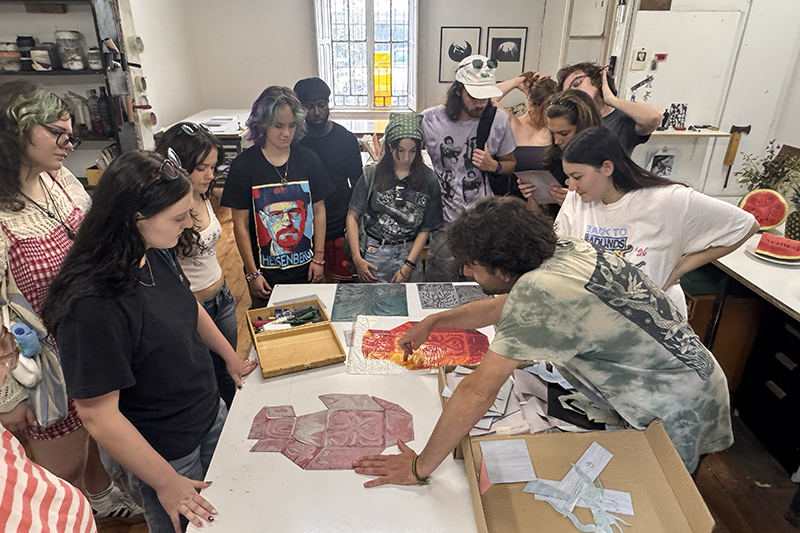
Their final project drew on Terry’s expertise in printmaking while creating unique mementos for each participant.
Students received rubber blocks, like oversized erasers, and learned how to create a stamp by carving a design. They were instructed to create one stamp to represent Valparaiso and one to represent Santiago.
Every student had their own stamp “passport” to collect images from the group.
They learned the artistic technique and created personalized keepsakes of the experience that reflect their individual thoughts.
For one of her stamps, Morgan chose to preserve two seemingly minor moments: when she first saw azulillos, small blue flowers that cover Chile, when arriving in Santiago after a difficult travel journey, and a slice of melon tuna, what Chileans call honeydew, that she shared with Juana Perez while they chatted about art and their views of the world.
“Both of these small interactions had a bigger impact on me than I thought they would,” she said.
Glassman chose to mark the intersection between nightlight and nature that she found in Santiago, with a stamp depicting mountains, the sun and moon, and the city.
“My parents were overjoyed. Showing them pictures was one thing, but seeing what I created and my perception of the trip was awesome,” she said.
About Study Abroad and the Center for Global Programs and Studies
The Center for Global Programs and Services (CGPS) at the University of Delaware is home to the operations of UD Global, which includes Study Abroad, International Student and Scholar Services, World Scholars Program and Global Outreach and Partnerships.
In 1923, UD founded the first study abroad program by a U.S. institution. Today, UD offers 100+ programs in about 40 countries — and over 30% of UD undergrads study abroad at least once.
Students choose from semester-long programs in the fall and spring and shorter programs during winter and summer sessions. While abroad, Blue Hens take a full load of academic credits, choose to engage in internships or community service, and sharpen language and intercultural skills. Accommodations range from hotels (for some shorter programs) to residence halls, hostels and homestays.
Scholarships and financial aid are available for UD students participating in UD study abroad programs.
Follow and engage with @UDGlobal on Instagram and LinkedIn for the latest updates on everything global happening at UD and #UDAbroad.
Contact Us
Have a UDaily story idea?
Contact us at ocm@udel.edu
Members of the press
Contact us at mediarelations@udel.edu or visit the Media Relations website