




Watch: The Power of Paradox: Wendy Smith receives UD's highest faculty honor: youtube.com/watch?v=m8iBnc3wDPU
Power of paradox propels UD’s Wendy Smith
Photos by Kathy F. Atkinson and courtesy of Wendy K. Smith | Video by Sam Kmiec and Ally Quinn February 17, 2026
Pioneering business professor wins Francis Alison Award, University’s top faculty honor
Editor’s note: Wendy Smith's Alison Award lecture — “Paradox Theory: How Both/And Thinking Is Reshaping Leadership and Decision-Making” — has been rescheduled for Monday, April 27, 3-5:30 p.m. in the Trabant Multipurpose Rooms. Register online.
Sometimes the best choice is pretty obvious. You want to get on the freeway? You use the on-ramp.
Steering a huge vessel through complex, changeable conditions is a different matter. It requires a much different tack. You want to make progress, of course. You also want to avoid the icebergs.
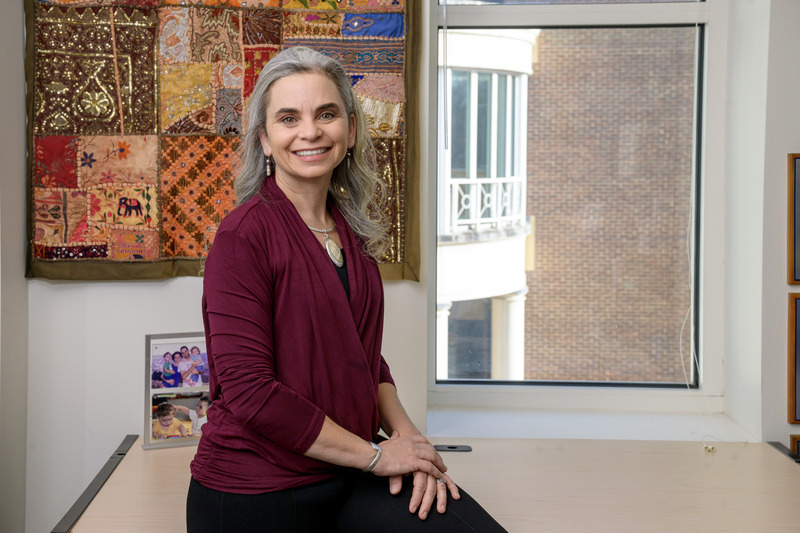
This is the wheelhouse of Wendy K. Smith, the Dana L. Johnson Professor of Management in the University of Delaware’s Alfred Lerner College of Business and Economics. Smith studies how leaders manage complex challenges. Her research has demonstrated the strategic advantages of getting comfortable with tension and embracing the power of paradox, using what seems contradictory, disconnected — unbelievable even — to find innovative and productive opportunities in business and many other life applications. Her 2022 book Both/And Thinking, written with collaborator Marianne Lewis, draws on decades of research to offer insight and practical tools for effectively embracing paradoxes.
Now the University has recognized Smith with its highest faculty honor — the Francis Alison Award — for the global impact of her research and instruction. Named for the University’s founder, the Rev. Dr. Francis Alison, the award is bestowed on faculty whose rigorous scholarship and teaching expertise exemplify his “scholar-schoolmaster” skills.
Smith, the first Lerner professor to win the award since its inception in 1978, will deliver her Alison Award lecture — “Paradox Theory: How Both/And Thinking Is Reshaping Leadership and Decision-Making” — at 3 p.m., Monday, Feb. 23, in Gore Recital Hall.
The path to paradox
It wasn’t always obvious along the way, but Smith can look back now and see how her journey — winding as it did through so many different contexts — led her to study paradox.
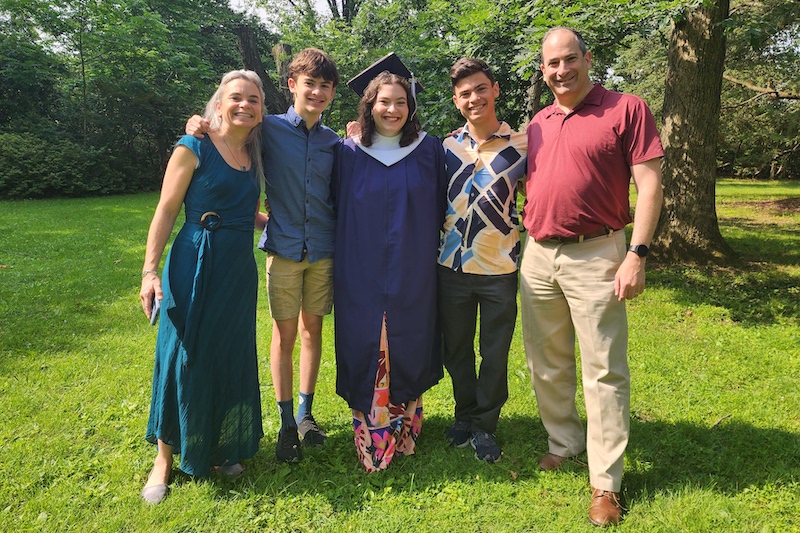
Smith is the daughter of Larry and Jewel Smith, a business professor and an educator, respectively, and grew up in a home that valued education and community impact.
She was born in Montreal, Canada, but moved with her family to South Florida when she was 3 years old.
And off she went, exploring, studying and finding out what it’s like to be a Canadian growing up in the United States and an emerging female leader collaborating with established male leaders. When she was 13, she and her family spent a sabbatical semester in China at a time when there were few people from the United States in the country.
“I knew there were different ways to be in the world,” she said. “There were lots of early influences inviting me to value multiple and often opposite perspectives.”
In her teens, her mom pointed her to BBYO, an international youth group that now reports more than 700 chapters, 70,000 high school members in about 60 countries and more than 350,000 alumni around the world. As a high school senior, she was elected international president of the group and took a year before starting college to travel across Europe, Canada and Israel — on her own, with no cell phone — to learn and teach about leadership and social innovation. This period provided a foundational introduction to the power and complexity of leadership.
At Yale, she created her own major — political psychology. She was interested in applied psychology, which led her to take a doctoral class as an undergraduate — Professor Sigal Barsade’s class on organizational management at the Yale School of Management. Excited by the topic, she became Barsade’s research assistant.
As she prepared for graduate school, a pivotal question came into focus.
“I had seen the power of leadership to make a difference in the world,” Smith said. “But do I want to do leadership or study leadership?”
It took awhile for her to move from that “either/or” question to the broader, more satisfying “both/and” answer. She found opportunities to explore that idea while studying with her doctoral mentor, Michael Tushman, senior fellow and Paul R. Lawrence MBA Class of 1942 Professor of Business Administration Emeritus at Harvard Business School.
Tushman’s research focused on “ambidextrous” organizations, a model that pursues innovation and efficiency simultaneously, supporting a firm’s sustaining work while also positioning and moving it toward the future. Moving from the old to the new requires high-level finesse.
For her dissertation, Tushman connected Smith with contacts at IBM, where she met with senior leaders struggling with how to enable innovation in their organizations. How do they balance the tension between maintaining client servers while moving to cloud computing — a constant state of transition?
That’s a scenario where paradox often lives, Smith said.
“Much of the literature looked at how organizations can move quickly from the old to the new,” she said. “But that’s not what I was seeing at IBM. These leaders were not just worried about innovating. They were grappling with how to innovate while continuing to support existing customers and products. Attending to both the old and the new was really hard for them.”
This challenge led her to explore paradoxes to understand the synergies between the opposing tensions of old and new, today and tomorrow, stability and change.
Tushman said Smith’s enthusiasm in exploring the complexity of innovation and change was contagious.
“She zoned into this notion of contradiction, paradox and chaos,” Tushman said. “And she was super brave to go there. That was not as well-trodden a space as it is now. She has brought that notion of paradox to the field in a big way.”
Smith’s publication prowess is well documented, as 2025 marked a seventh consecutive year on Clarivate’s list of Highly Cited Researchers, awarded to the top 1% of scholars. Also in 2025, she was named to the Thinkers50 list of the top 50 global management thinkers, honoring her work to ensure that these ideas have impact beyond academia.
“The biggest thing with Wendy is this issue of rigor and relevance,” Tushman said. “She is rigorous in theoretical and empirical work in very different settings — for profit and nonprofit. And she brings relevance. Many of our colleagues do great work, but it’s completely irrelevant. It has no impact on practice or it’s theoretical in ways people don’t care about. She puts the real world in theory and puts theory in the real world. It’s very rare.”
Curiouser and curiouser
Paradox is not always an intuitive way for leaders to think. How do you hold and value approaches that are aimed in different directions? How do you square ideas that just seem to contradict each other? What is the value of strategic inconsistency?
Smith points to team dynamics as an example.
“You’re here to row together collectively, but the most successful teams need individuals to be their best selves,” she said. “It’s not about the individual or the team. It’s not competition or cooperation — you need both. How do you create an organization that enables both individual accomplishment and collective success at the same time?”
How do you negotiate with someone with whom you strongly disagree?
“There’s a level of complexity you need to hold these ideas together,” Smith said. “If you have the horse-race mentality that one side needs to win out over the other — that it’s not this, but it is that — that’s an easy sound bite. And people like simplicity and consistency. But that either/or mentality is limited at best and detrimental at worst. Paradox is much more complex and harder. It’s actually about this and that.”
Paradox is not a new idea.
“We are drawing on ideas that have been around for thousands of years,” Smith said. “We see these ideas embedded into cultures from indigenous culture to Eastern theology to Greek philosophy.”
But Smith was captivated when — as a doctoral student — she read a foundational paper by Lewis on the topic. Few were writing about paradox in organizational theory, Smith said, and she contacted Lewis immediately.
“I want to know everything you know,” Smith told Lewis.
Soon the two researchers had built strong collaborative traction together.
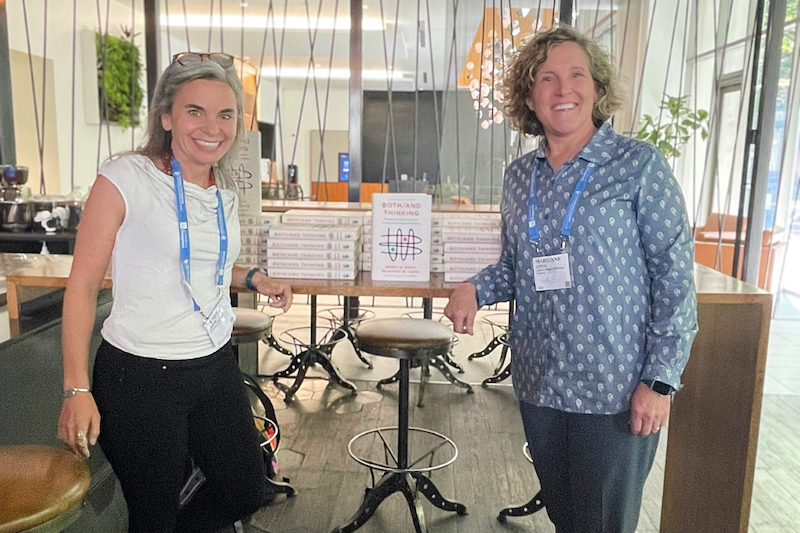
“She is one of the most intellectually curious people I’ve ever met, which I love,” said Lewis, who is dean of the Carl H. Lindner College of Business at the University of Cincinnati. “I guess I’m similar in that. But she does it a little differently. It was like finding a kindred spirit, but we are yin and yang. We’re really visual, with conceptual figures. But we’re also very different.
“She was like a spitfire — so energized,” Lewis said. “It takes me two days to write a paragraph. I’m way too meticulous. She can put things down fast, whether visually or in outline. She has to get it down to see if it works. Once we would do that, once she would do that, we can start to detail it. It has been a remarkable partnership because we work differently.
“And we believe the world is full of contradictions. You need to look at it from as many angles as you can. Do the angles look like they’re contradicting — or are we just seeing different parts? What angles are we missing?”
Making room for inconsistencies and opposing viewpoints lays a foundation for greater creativity, innovation and collaboration.
Eriselda Danaj saw that in Smith soon after she arrived at UD, a wide-eyed student from Albania coming to study at a big U.S. research institution and trying to find her way to wherever she was going.
Smith, an expert in making room for difference, took Danaj seriously and helped her think through many things.
“It must have been a headache for her to have me in the class,” Danaj said. “She would start the class with questions and invite people with very different experiences to reflect. They brought layers of knowledge and emotions. We had people on opposite sides.
“For me, these questions are so obvious. I’d rush to give the answer — case closed. Class is over. I know the answer. How did she put up with me? Why did she make me feel I was so welcome? She figured out how to negotiate with me so I felt I belonged in her class and others felt the same.”
Now, 10 years later, Danaj is a postdoctoral researcher at Macquarie University in Sydney, Australia, and she and Smith continue to collaborate on research projects. Danaj said she remains excited about these ideas, but in a more structured way. She sees Smith’s influence as transformative in her life.
“The theory of paradox — which everybody knows Wendy for — was for me the reality of my life,” she said. “… And what I love about the theory is it does so much more than offer an explanation to some phenomena.”
It validates a worldview common in the East, Danaj said. Unlike the West’s preference for consistency and empirical neatness, views in the East sit more easily with tension.
“It gives voice to what the rest of us felt — that it’s how things work,” she said. “It’s life. It’s messy. This theory is an attempt to reconcile realities that exist. Wendy has the amazing ability to see realities that exist and dedicate her life to figuring out how to bridge those differences.”
Building community
Bridging differences is one of Smith’s superpowers. It’s work that can’t be done in isolation, so Smith has been intentional about building community — around the world.
“This was frame-breaking,” Lewis said. “Early on, she said we need a community. I was thinking ‘co-authors.’ But she was thinking bigger. And because of Wendy, there is now a global paradox research community. We sometimes have events that start at 11 p.m. so people in Singapore and Australia can be on the call. It’s crazy and beautiful. The only way writing about paradox in organizational theory becomes less risky is if more people are on the boat.”
Amy Stengel met Smith at a leadership training program her bank offered to high-potential employees. They reconnected later, when Smith was developing what became the Women’s Leadership Initiative’s RiseUP program for executive leaders. Stengel was in the first cohort of that program and later became an integral part of the Women’s Leadership Institute, co-founded by Smith and Lerner colleague Amanda Bullough, professor of management.
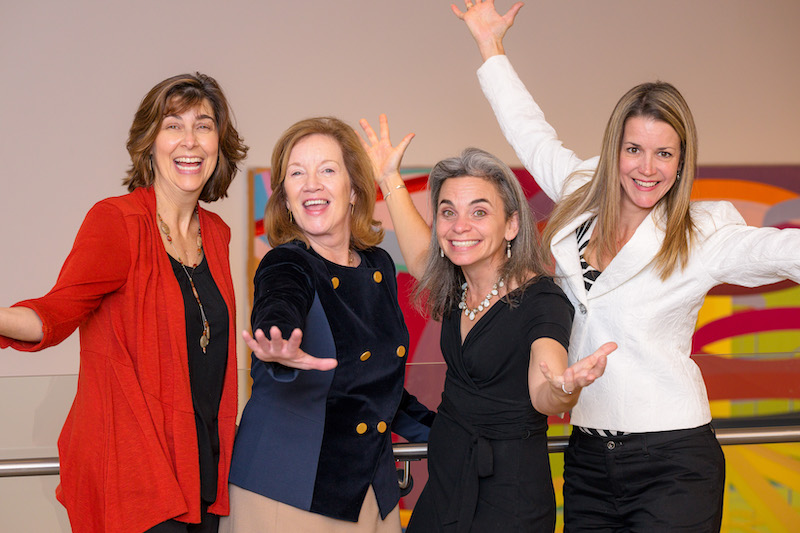
Stengel recalled how Smith developed and launched a webinar series with the Women’s Leadership Initiative in the spring of 2020 to create and maintain connection during the COVID-19 pandemic. WLI ran three series — with 18 webinars — across three semesters.
“It was very important for Wendy to create community at a time when the world was shut down,” Stengel said. “The world was struggling. Big things were going on. What could we bring to women all over the world?”
The webinars attracted more than 5,000 people. They were dialing in from around the world — Germany, Africa, France and more, Stengel said.
“She’s an incredibly brilliant woman and also one of the most humble people I’ve ever worked with,” Stengel said. “She can make people feel invited in. She finds common ground with people very quickly. This has certainly helped her as a professor. And in the professional world, she can go from working with executives in a financial institution to a group of non-profit leaders. She just has an amazing way of connecting with people and bringing out the best of them. Her natural curiosity makes her really good at asking questions.”
Stengel, the Chief People Officer at BestEgg, a financial technology firm that is in the process of getting acquired by Barclay’s, said those connections have long-term effects.
“Barclay’s sent about 50 women through the Women’s Leadership Institute programs,” she said. “And now, as I am getting introduced to the women at Barclay’s — they’re saying, ‘Oh my, I remember you!’”
Stengel said she takes the paradoxical “both/and” approach to differences often.
“One of the biggest gifts of working with her was adopting that mindset,” Strengel said. “Over and over again, when two things seem impossible to reconcile — she would ask ‘How do we create ‘both/and’ instead of ‘either/or?’ I have used that extensively in my work.”
Persistent progress
It’s not magic, mind you. Forward progress requires struggle and the resilience to deal with setbacks, failure even. As any veteran researcher will attest, those experiences are many — and they provide important insight if you let them.
“There were plenty of times when things felt like they went wrong in my research or teaching, or maybe just didn't go as right as I wanted,” Smith said. “There were the paper rejections from journals, the talks I gave that went flat, the classes I taught where I didn't connect with the students, the times I shared my research and senior colleagues rejected it.
“In my early days, I would feel the sting of these moments for days, weeks. They would feel like a catastrophic failure. Over time I've learned several things. First, these moments are not failures, but signs that I'm trying something new. I actually worry now when I don't have these moments as it suggests that I’m getting too comfortable and complacent.
“I also see these moments as a chance to learn, trying to get curious rather than concerned. To be fair, these moments that feel like failure still sting when they happen, but the sting only lasts for minutes — OK, maybe sometimes hours — but not days.
“What has continued to push me along in my work is how much I believe in the power of paradox theory to change how people live, lead and work.”
Embracing the tension of paradox — recognizing that contradictions exist, can’t be solved but also persist with interdependence — can be exhausting, Lewis said, but it’s essential.
“We are facing lots of challenges in our world today,” Smith said. “Our research on paradox shows that we can all find much more creative approaches if we hold the space for multiple, competing ideas.”
About the researcher
Wendy K. Smith is the Dana L. Johnson Professor of Management in the University of Delaware’s Alfred Lerner School of Business and Management. She studies how leaders effectively navigate complexity and has played a key role in development of paradox theory. She earned her undergraduate degree at Yale University and her doctorate at Harvard University/Harvard Business School. She joined the faculty at the University of Delaware in 2006 and was a co-founder of the Women’s Leadership Institute, which offered leadership development programs for students, faculty and professionals for eight years. She is a Fellow of the Academy of Management and has been on Clarivate’s list of Highly Cited Researchers for seven consecutive years, recognizing scholars whose publications rank among the top 1% of citations worldwide. She was named one of the Top 50 Management Thinkers for 2025 and received the Thinkers50 Breakthrough Idea Award in 2023.
About the Francis Alison Award
The Francis Alison Award was established in 1978 by the University of Delaware Board of Trustees. It is awarded annually to the faculty member who best characterizes the “scholar-schoolmaster,” as exemplified by the Rev. Dr. Francis Alison, who founded the institution that is now UD in 1743. His first class of students became distinguished statesmen, doctors, merchants and scholars. Three signed the Declaration of Independence, and one signed the U.S. Constitution. A list of previous winners is available online.
Contact Us
Have a UDaily story idea?
Contact us at ocm@udel.edu
Members of the press
Contact us at mediarelations@udel.edu or visit the Media Relations website