
Arctic ally
Photos by Joe Mastrullo and Kathy Newton and courtesy of Erin Curry | Photo illustration by Molly Schafer September 01, 2026
Alumna’s research with zoo polar bears helps to conserve wild population
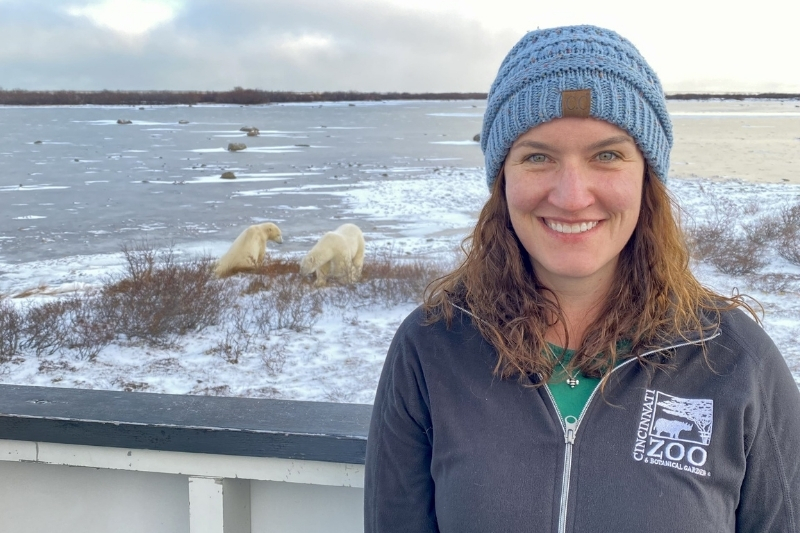
Polar bears are synonymous with wildlife conservation. Their reliance on imperiled Arctic sea ice perfectly illustrates the impact of a warming climate. In zoos, the charismatic megafauna rank among the top attractions. With the help of researchers like University of Delaware College of Agriculture and Natural Resources alumna Erin Curry, these zoo bears play an important role in the conservation of their wild brethren.
Curry is the director of the Polar Bear Signature Project at the Center for Conservation and Research of Endangered Wildlife (CREW) at the Cincinnati Zoo and Botanical Garden and the co-chair of the Polar Bear Research Council. Her role involves collaborating with more than 35 zoological institutions and numerous national and international partners, including field researchers.
“One of the main objectives of my research program is to develop monitoring techniques using zoo bears that we can then use to learn more about wild polar bears,” said Curry, who graduated in 2003 with a bachelor’s degree in animal science.
Wild polar bears are difficult to study; their remote location in the Arctic necessitates travel by helicopter. Freezing temperatures, months of darkness and a species that can travel up to 15,000 square miles in a year, over land and sea, add to the challenge.
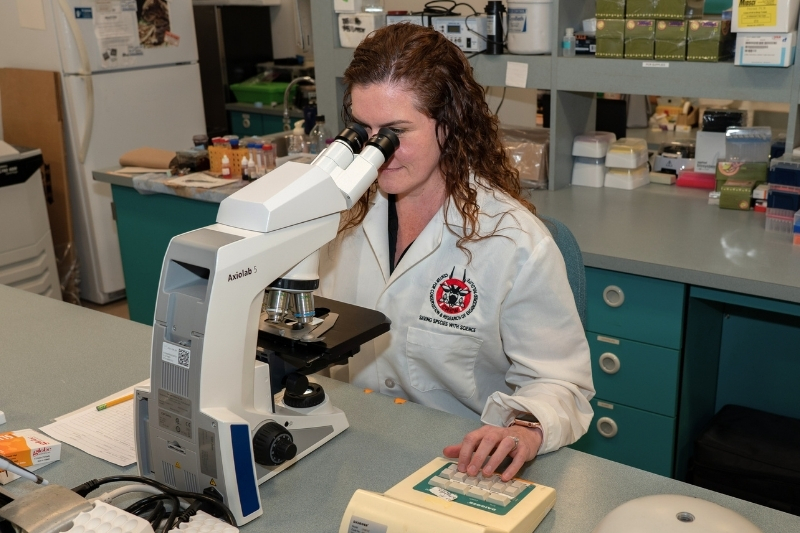
“We really don't have the ability to monitor wild bears year-round in their natural habitat,“ Curry said. “Whereas with our zoo population of polar bears, we can monitor them 24 hours a day, 365 days a year.”
Zoo bears provide easy access to biological material like fecal samples, which can be collected and studied on a daily basis over a bear’s lifetime. Although samples can be taken from wild bears, they are only a piece of a much larger puzzle.
“With wild bears, we don’t know what has happened between those samples,” Curry elaborated. “We don’t know if they’ve had cubs, how many seals they’ve eaten, whether they're fighting an infection or have an underlying health condition. Their history is a big mystery, which can make it difficult to interpret their blood values.”
Zoo bears, whose health and history are well documented, allow researchers to put the samples into context.

“We can learn a ton from our zoo polar bears, and then we can apply that knowledge to conserving wild polar bear populations,” said Curry.
One goal is to identify blood biochemistry reference intervals for healthy polar bears. Reference intervals allow scientists to define the normal range for all values measured via blood tests. Similar to the blood work panel that a veterinarian may order for your dog.
“The results show where an animal's liver enzymes fall within the normal range, for example,” Curry said.
While scientists can collect blood samples from wild polar bears, they don’t yet know what a normal liver enzyme level is for a healthy polar bear.

“We’re probably missing some early indicators of disease by not knowing what a normal reference interval is,” Curry explained.
The health of zoo bears, on the other hand, is monitored meticulously. Even their cause of death is investigated and recorded.
“By pulling reference values from zoo bears of known health status, we can establish what a normal polar bear blood glucose level is or what a normal insulin level is, for all the different biochemistry values that we can use to better assess the health of wild bears,” Curry said.
Polar pregnancies
Curry specializes in reproductive biology. When she started working with polar bears, their reproductive physiology was poorly understood, and wild birth rates were in decline. In 2012, Curry and a team of CREW scientists completed the world’s first artificial insemination on a polar bear. They have since repeated the procedure 17 times.
“Usually, when we’re asked to do an artificial insemination, it’s because the female isn’t getting pregnant naturally, even though she’s been breeding for years,” said Curry, who notes that no cubs have yet resulted from the procedure. “We know that the success rate will probably be very, very low.”

Curry and her colleagues have published more than 30 scientific papers contributing to the advancement of our understanding of reproductive physiology in animals.
There is currently no way to test for pregnancy in polar bears. Curry is searching for pregnancy biomarkers in blood samples.
“Most zoos are training their bears for voluntary blood collection,” Curry explained. “These bears will put their paw into a blood port, and they’re trained to have their fur shaved, and to be poked with a needle to give a blood sample.”
So, how do you get an animal that can weigh up to 1,400 pounds to cooperate? Luckily, polar bears will work for food. Peanut butter, apple juice and marshmallows are among their favorite bribes.
January through April is the pre-breeding season and Curry’s busiest time of the year. She visits zoos throughout the U.S. while the bears are anesthetized during their annual physical exams.
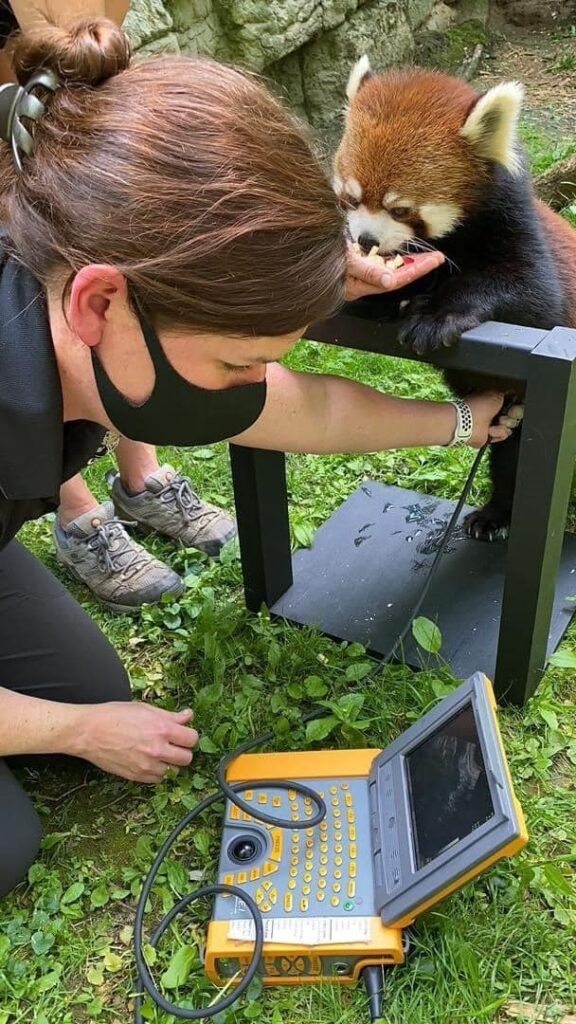
“One of my biggest roles is to do reproductive examinations in bears to see which ones might be a good fit for breeding situations,” Curry said. “For males, we’ll do a semen collection to try to assess their fertility, and we’ll cryopreserve the sperm if we get a good sample. For females, we’ll perform a vaginoscopy, hysteroscopy, ultrasound exam, and collect endometrial biopsies, if warranted, to make sure there are no obvious abnormalities.”
A reproductive physiology course at UD, taught by Robert Dyer, emeritus professor in the College of Agriculture and Natural Resources, sparked Curry’s interest in the field.
“Dr. Dyer’s class opened my eyes as to how I could marry my interests in animal science and wildlife conservation to study reproductive physiology of wildlife,” Curry said.
When Curry couldn’t find a graduate program that was a perfect fit, she asked her advisor, Bill Saylor, a former associate professor in the Department of Animal and Food Sciences, for advice.
“He suggested that I study livestock reproduction, and then take what I’d learned in livestock and apply it to wildlife species,” said Curry, who attended Clemson University, earning both a master’s degree and a Ph.D in animal and veterinary sciences, with a focus on Reproductive Biology and Molecular Genetics.
Curry, who is also the research advisor to the Red Panda Species Survival Plan, suggests a similar approach to students looking to follow in her footsteps.
“A lot of times students will have a species in mind that they are determined to work with,” said Curry. “Instead, I encourage them to pick a system that they’re interested in, whether that is immunology, nutrition or reproduction, and try to focus more on that than on a specific species.”
Contact Us
Have a UDaily story idea?
Contact us at ocm@udel.edu
Members of the press
Contact us at mediarelations@udel.edu or visit the Media Relations website