
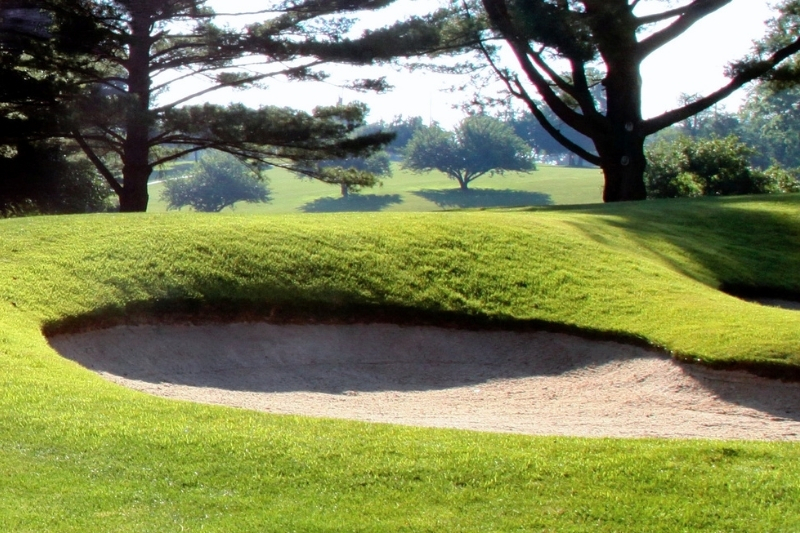
Behind the greens
Photos by Monica Moriak and courtesy of John Apgar, John Jacob, Ian Williams and Ryan Sarnoski April 06, 2026
Plant and Soil Sciences’ alumni, faculty and students get to work on the golf course
Before the pros tee off at the 2026 Masters Tournament or amateurs take their first swing on their local links, an entire industry lays the groundwork for the perfect golf course. It’s a process that starts years in advance and involves landscape architects, irrigation designers, turfgrass managers and other professionals.
“People think our job is just showing up and mowing every day, but that’s the easiest part of the job,” said John Jacob, University of Delaware Class of 2000 alumnus and golf course superintendent at Deerfield Golf Club in Newark, Delaware.
Behind the scenes, these professionals rely heavily on science and technology to create a tranquil expanse of green. Designing and maintaining 200 acres of turf requires a variety of tools, including Global Navigation Satellite System (GNSS) technology, weather stations, soil laboratories, mathematical formulas and dozens of unique and specialized mowers.
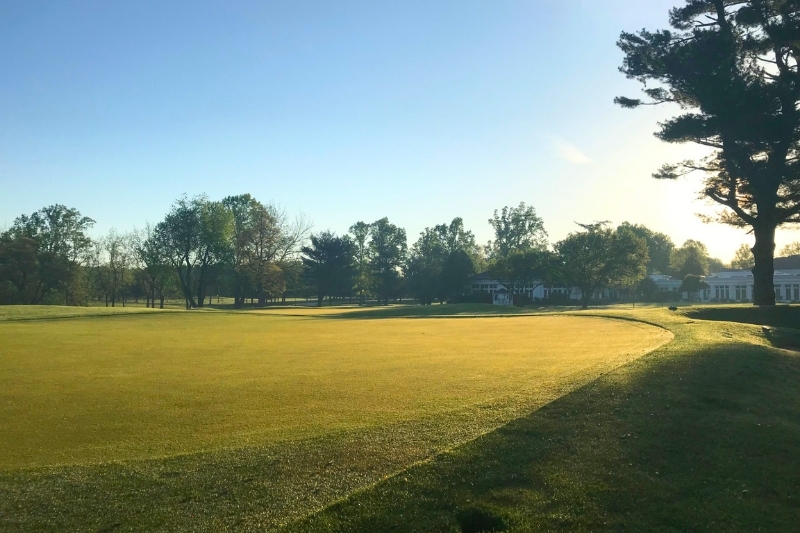
On a golf course, consistency is paramount; the ball should roll the same on every green. That can be a challenge when each course uses a variety of grasses on varying terrains. Not to mention shifting weather patterns.
“If the grass is growing too much, conditions can even be different for morning players compared to afternoon players,” Jacob said.
Grass grows quickly during humid summer months and slowly when temperatures plummet. So, how do golf professionals engineer a consistent course year-round?
Soil science
“Everything starts with soil in this business,” said Jacob, who began working at Deerfield Golf Club the week after his UD graduation.
First, soil samples are sent to a laboratory for analysis, then it’s up to Jacob and his team to interpret the data and create a plan for the months ahead.
“In our area, we do need fungicides for disease prevention,” Jacob said. “We use a rotation of fungicides to avoid resistance.”
Fungal disease is an expensive problem for golf courses. Harsh Bais, professor of plant biology, and his colleagues in the College of Agriculture and Natural Resources (CANR) developed a beneficial bacterium that can help plants to mitigate fungal disease.
Sprouting sod
All that beautiful grass comes from a sod farm.
Sod, the term for a surface section of grass and topsoil, is grown off-site. Sometimes rolled out like a green carpet, sod offers near instant gratification.
“Sod establishes fairly quickly,” said John Apgar, UD Class of 1978 alumnus and owner of Apgar Turf Farm. “Once you get the roots in the ground, you stabilize the soil and prevent soil from entering the water system.”
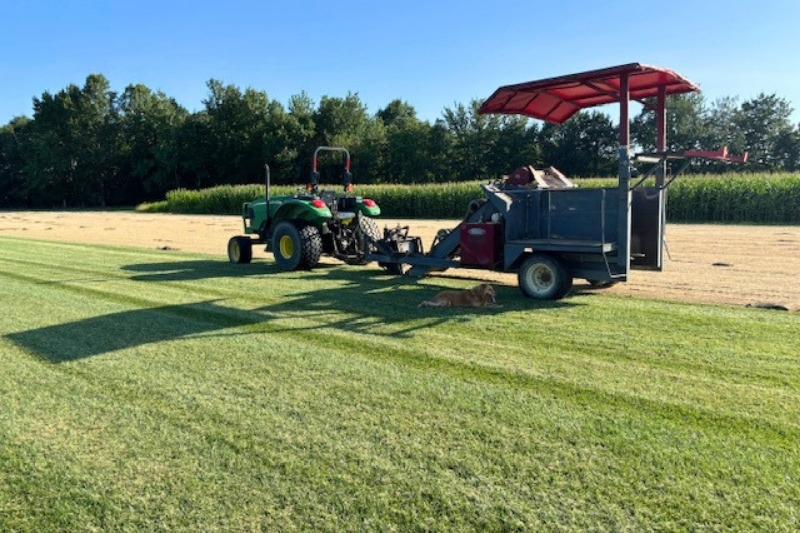
Apgar got his start in sod while assisting William Mitchell, CANR professor emeritus, with his greenhouse research.
Apgar, who installed sod at multiple golf courses, including a congressional golf course in Washington, D.C., and Merion Golf Club in Delaware County, Pennsylvania, says sod offers a quick fix for golf courses.
“When you’re trying to repair a damaged area of the course,” Apgar said. “You can put it back in play a lot quicker than if they had to use seed.”

Inventive irrigation
Under the sod, an intricate arrangement of pipes crisscrosses the golf course. Ian Williams, UD Class of 1997 and owner of Green Irrigation Solutions (GIS), designs these irrigation systems. Williams started working in the golf industry at the age of 15. He leveraged his degree in plant and soil sciences to pursue a career in golf maintenance and construction, ultimately focusing on sustainable irrigation solutions.
Williams said applying water to specific areas with greater control is key to responsible irrigation.
“Today, you can irrigate one area quite differently from an adjacent area,” Williams said. “When you get into different heights of cut, different turf types and soil conditions, these are microenvironments we can address through design.”
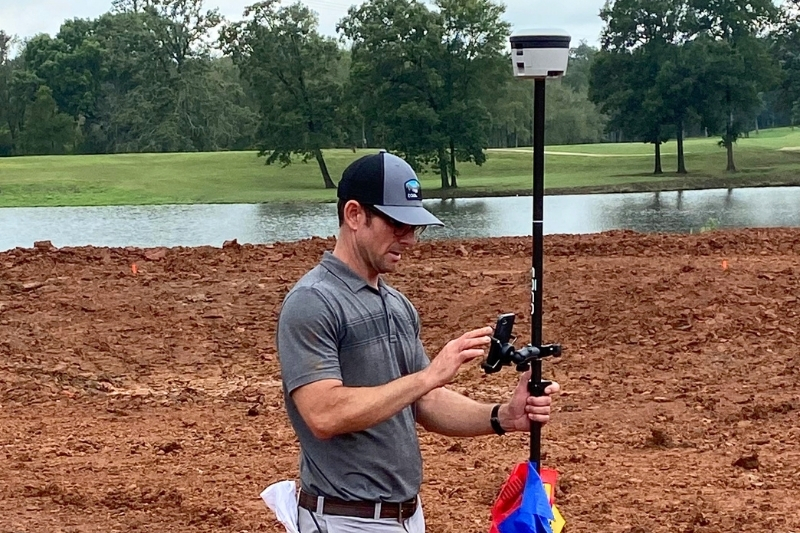
Technological improvements help take the guesswork out of irrigation as well as the application of pesticides or fertilizers. The amount of water that golf courses use today is significantly less than it was 20 years ago. Williams uses advanced mapping software and equipment to maximize efficiency.
“A weather station on the golf course can calculate evapotranspiration (ET) data from a number of sensors,” Williams explained. “Control systems software can take data from a weather station, a soil sensor or equipment attached to mowers that reads soil moisture. Data is then sent to a computer, which calculates soil moisture in different areas, and based on that calculation, you can suggest a runtime for each sprinkler head.”
Horticultural innovations, such as specialized grasses and the use of native plant material in golf course design, also help conserve water.
“There are all kinds of new and improved varieties of turf grass that use less water, or stay greener longer in cooler temperatures and under greater environmental stress,” Williams said.
Mowing and maintenance
Keeping the course consistent is a daily undertaking. Putting greens, fairways and roughs are all trimmed to varying heights utilizing a fleet of mowers, each designed for specific areas of the course. Turf rollers, large metal cylinders, are used to smooth the surface of the grass. Rolling erases footprints and ball marks left from the previous day’s play.
“Every day we mow, measure, add data to a spreadsheet and track it against the weather,” Jacob said.
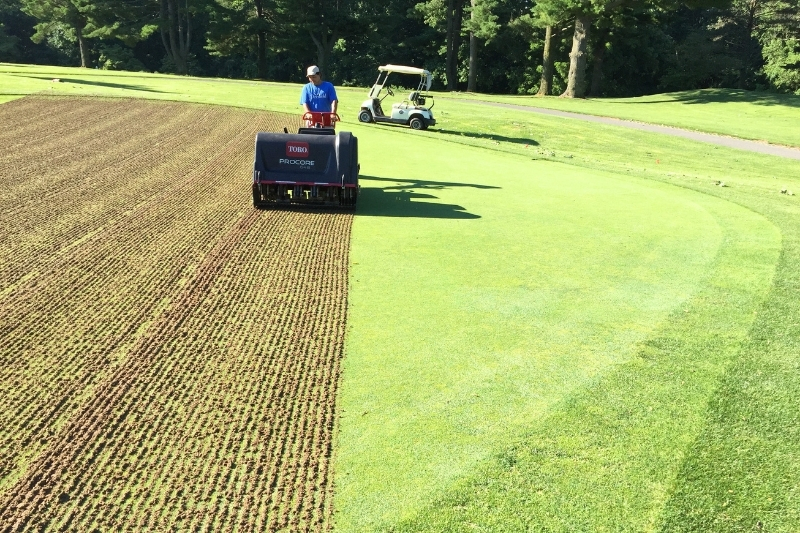
Decisions on whether to mow, fertilize or roll are based on how fast the grass is growing. One way to determine the rate of growth is to measure the volume of grass clippings after mowing. Jacob’s ideal clipping volume is 10 milliliters per meter squared.
“If we’re seeing a lot of growth, we don't need to fertilize, or we may need to apply a plant growth regulator to slow the growth rate,” Jacob said. “And if we’re not getting enough growth, we know to add fertilizer.”
Mathematical formulas help determine the proper course of action.
“In formulas for growth potential, we’d look at the average temperature each day versus how much grass we’re getting off the greens, and it tells us how much growth we should be getting that day,” Jacob said. “I take the growth we are actually getting and put that into a ratio of growth expected versus growth seen.”
But machines and technology can’t do everything.
“UD gave me a good foundational education in plant health, from weed and tree identification to identifying disease and basic plant physiology,” Jacob said.
Jacob often finds himself going back to the basics.
“Air, light and sun go a long way compared to N, P and K,” said Jacob, referring to the fertilizers nitrogen, potassium and phosphorus. “You realize if you clear an area to create air movement, the grass will do a lot better than any kind of chemical or fertilizer you could put down.”
Taking lessons
At UD, the Department of Plant and Soil Sciences prepares the next generation for careers in landscape architecture and plant science. Erik Ervin, professor, turfgrass and horticultural systems, who also serves as interim associate dean and interim director of Cooperative Extension, co-wrote the book on Best Management Practices for Delaware Golf Courses. Ervin also worked with Delaware golf courses on choosing beneficial native plants for out-of-play areas. His research examines the adaptation and management requirements of cool- and warm-season turfgrasses used on golf courses, lawns, parks, athletic fields and roadsides.

Like Jacob, Williams and Ervin, UD senior Ryan Sarnoski is turning his love of the game into a career. This landscape architecture student’s capstone project redesigns a golf course in Bergen County, New Jersey, with an eye on making the game more accessible to young players and families. Sarnoski’s project also explores adding native plantings and wetlands in areas prone to stormwater drainage problems.
“My favorite part of golfing is being outside enjoying beautiful landscapes, turning the phone off for a while and playing a game,” Sarnoski said. “It’s just fun to be out there.”
Contact Us
Have a UDaily story idea?
Contact us at ocm@udel.edu
Members of the press
Contact us at mediarelations@udel.edu or visit the Media Relations website