
Educator to executive
Photos by Kathy F. Atkinson and Evan Krape and courtesy of Mary Dozier | Photo illustration by Jeffrey C. Chase April 28, 2026
Mary Dozier launches nonprofit out of her UD academic research
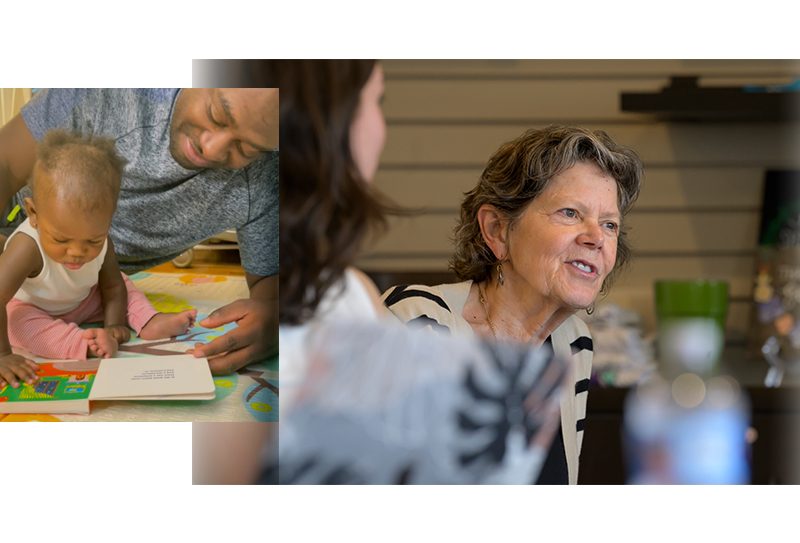
It was about three years ago when University of Delaware Professor Mary Dozier began thinking about her global legacy — what would become of her ABC program when she retired? No, she is not retiring, at least not yet. But she has been working to transform herself.
Dozier, Unidel Amy Elizabeth du Pont Chair in Child Development in the Department of Psychological and Brain Sciences, is known for creating the Attachment and Behavioral Catch-up (ABC) program to help parents and primary caregivers develop nurturing bonds with children who have experienced adversity through separation, international adoption or trauma.
She’s been a UD professor for over 30 years, during which time she has mentored 30 graduate students. Each year, an additional 30-plus undergraduates have helped collect data and served as research assistants in the Dozier lab — which has received $30 million in research funding over that time period.
They say good things come in threes, and for Dozier, that includes multiples of three.
Today, Dozier’s work impacts about 3,000 families annually. It’s a number she wants to expand over the next decade, hopefully tenfold. You read that right — 30,000 families. That’s the target, and the reason Dozier translated her UD research program into a nonprofit organization called the ABC Parenting Institute to scale her efforts for the benefit of families.
Adding nonprofit executive to the list of titles Dozier has held over her career did not come lightly.
“It was a heavy lift, I’ll tell you. I’m not a businessperson and we had a lot to learn,” Dozier said. “Now, we’re closing in on two years as a nonprofit, and I’d say we've been very successful. It was a good move for us.”
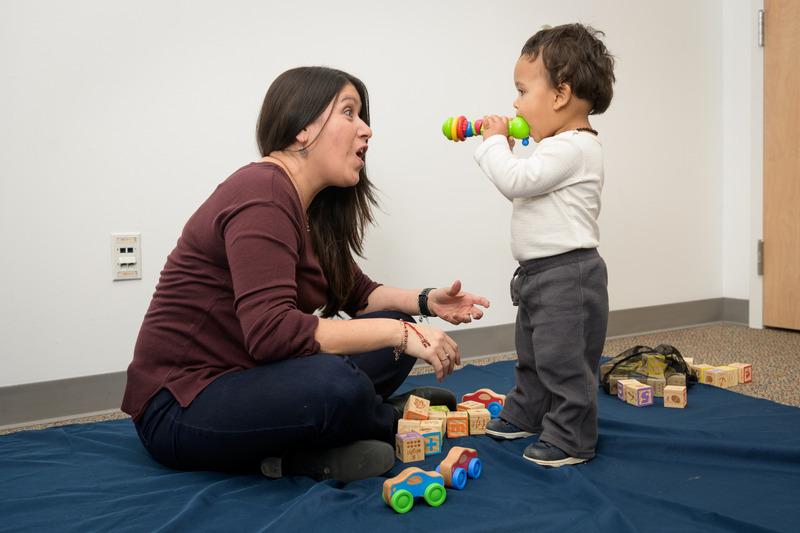
The ABC Parenting Institute trains and supervises parent coaches in local communities to deliver Dozier’s 10-session home-visiting program for parents and caregivers at risk of neglecting children in their care. Through the program, these parents and caregivers learn to become effective at three things — nurturance, following their baby’s lead and avoiding frightening behavior — all of which support healthy growth and attachment in childhood and deliver lasting effects into adolescence.
Each coach is trained to provide one comment per minute during each 60-minute session, focusing on in-the-moment observations for individuals who may be struggling. Dozier gave the example of walking into someone’s home where they may be using substances or suffering from depression and feeling like they can’t take care of their child. They may have heard many negative things about themselves from others.

“Having an expert come in can feel threatening,” Dozier said. “We might say something like, ‘Hey, he picked up his toy, and you said, you’ve got your truck there. You're following his lead. That may not feel like a big deal to you, but that's the kind of thing that builds brain connections and will allow him to be able to sit and pay attention better when he's in kindergarten.’”
These active comments are the program’s secret sauce.
Over the 10 weeks, parents hear 600 comments that can change their parenting trajectory in ways that positively affects attachment, self-regulation, language development and more for children.
The ABC Parenting Institute currently offers the proven program in 25 states and 10 nations, including Norway, Australia and Taiwan.
As the nonprofit nears completion of its second year, Dozier is excited about what lies ahead. If there is one thing she learned, it’s that continued curiosity can lead to wonderful places. Below, she shares three (yes, three) key messages that are adaptable to others, no matter what their interests or career trajectory.
Stay the course when naysayers weigh in
It’s not always easy to keep going when people question your approach. Prior to joining UD, Dozier spent a decade working with adults with serious psychiatric disorders at another institution. When she was looking for a move, Dozier knew she wanted to switch her focus to children. Friends and colleagues generously offered their unsolicited advice — don’t change course from what you know. It was guidance she actively ignored.
Inspire others to join your journey
Involving students in research has been a key part of Dozier’s journey at UD, and she lights up when working with undergraduate and graduate students in her lab. She’s amazed by their intuitiveness and depth of knowledge in their areas of study — and by their dedication. Several former students have continued working with the nonprofit as parent coaches in various parts of the country, extending the reach of Dozier’s UD-developed method. In fact, Sydney Ballenger, who earned an honors bachelor’s degree at UD in 2024 and now works as a parent coach and program coordinator with the ABC Parenting Institute, recently was recognized as a National Home Visitor of the Year by the Institute for the Advancement of Family Support Professionals for her work.

Dozier also expressed gratitude for the federal funding, particularly from the National Institutes of Health, that provided crucial resources for conducting research, developing her program, training students, collecting data and verifying the efficacy of her approach. Early support from Edna Bennett Pierce, and more recent support from the Longwood Foundation, the State of Delaware and the Bennett Family Foundation, has enabled her to take her program directly into the Delaware community and has positioned the nonprofit organization for growth.
Stay curious and lead with joy
Ask what’s ahead, and Dozier’s eyes glimmer with possibility. There is much left to learn, data to examine, papers to write. She and her team are just beginning to analyze data from a study on children born to mothers addicted to opiates. Then there’s that nonprofit, the ABC Parenting Institute she runs and those 30,000 families she wants to reach annually.
“I'm 71 years old now. I could do this for the next 30 years if I were younger, because I think there are so many questions to ask, and the work is so exciting,” she said.
Contact Us
Have a UDaily story idea?
Contact us at ocm@udel.edu
Members of the press
Contact us at mediarelations@udel.edu or visit the Media Relations website