
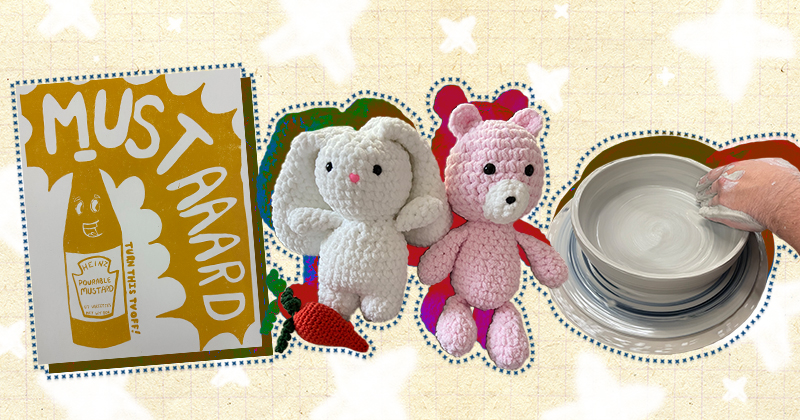
The arts and crafts of making
Photos courtesy of Josie Bradley, Madeleine Cameron, Chava Herniter, Nicolaus Myers and Valentina Turano January 13, 2026
More than just hobbies, ‘granny crafts’ clubs provide stress relief and friendship
Nicolaus Myers fell in love with clay as a high school freshman, and working a pottery wheel is still a stress reliever for the University of Delaware sophomore.
“I find it very therapeutic throwing on the wheel,” he said. “I don’t really go into it with a mindset of what I want to create. I just let the clay go where it wants to.”
An environmental engineering major with a minor in environmental sustainability, Myers pursues his passion as president of the UD Ceramics Club, one of the Registered Student Organizations (RSOs) at UD that offer students a shared space to foster creativity and connection.
UD’s active hobby-based clubs like ceramics, origami, knitting and crochet, and printmaking illustrate the growing popularity of “granny crafts” or “slow crafting,” and how teens and young adults are rediscovering the mental and emotional benefits of mindful, hands-on creativity.
“Mental health research shows that fiber arts can boost well-being by fostering belonging, social connection, self-expression and a sense of accomplishment,” said Brooke Kohler, associate clinician at the Center for Counseling and Student Development, which offers services to students.

Crafting for connection
Don’t be surprised if you see Madeleine Cameron around campus busy with her yarn and knitting needles.
While she was growing up, Cameron’s mother only allowed her daughters to watch TV if they were knitting at the same time.
Today, she carries her yarn in her backpack wherever she goes.
“It is a good escape. I take a break, close my laptop and make something small,” she said.
Cameron joined the Knitting and Crochet Club when she started at UD and is currently a co-president.
“I joined to meet other people who just want a casual hobby and get to know each other,” she said.
A nursing major and Buxbaum Scholar, Cameron knits, crochets and paints and is learning embroidery. She even added her passion for crafts to her academic life by adding the minor in functional and wearable design.
“UD is great because not all nursing programs let you have a minor, and I learned a lot of hand sewing and machine sewing techniques from those classes. Now I can even make my own clothes,” she said.

Cameron isn’t alone in pursuing multiple crafty hobbies. Senior art conservation and fashion design and product innovation double major Chava Herniter joined the Knitting and Crochet Club as well as the Origami Club spring semester of her freshman year after spending fall semester abroad with the World Scholars program.
“I just really like art, and I kind of just joined every art-related club that there is,” she said.
As secretary of the Origami Club, Herniter appreciates it’s an activity she can work on independently, but can also contribute to collaborative projects, like the “1,000 Cranes” project or filling a giant jar with folded paper stars.
“Genuinely, we have so much fun. Everyone that comes makes friends, and it's just really great,” she said.
Even when she feels overwhelmed by school work, she makes time for the club. “I don’t necessarily have time for it, but it’s a conscious choice to have the community.”
Clubs welcome members with no experience who want to learn.
“A nice thing about the club is there's a lot of experienced members, so then they'll be on the wheel with less experienced members to help them, guide them along,” Myers said.
Calm through creativity
Today’s college students were in middle school or junior high in 2020 when the world shut down, and several said that boredom and isolation spurred them to find new activities, which led to a resurgence of traditional crafts and hobbies.
Their popularity doesn’t seem to be waning any time soon. Herniter said that membership in the Origami Club has grown as more students continue to seek creative outlets. In the past, as few as three people would come to meetings, but now between 15 and 30 members regularly show up.
She added that working with her hands is a way to keep her mind focused.
“I like to do it while I do something else because it really occupies all of my senses,” she said. “My mind wanders, so it’s helpful for me to be doing multiple things at once so I don‘t end up distracted."

Myers said that in addition to the therapeutic nature of working with his hands, ceramics has taught him to be more patient and resilient in other parts of his life.
“I used to think that if one thing goes wrong in the pot, then it’s just trashed, and I don’t want to keep working on it,” he said. “But I have been able to change my mindset, so if something doesn't go as planned, I’m able to adapt. I’ve been able to take that into my classes. If I get one bad grade on something, I don’t just shut down; I’m able to look back over it and see what I did wrong, talk to my professors, and then figure out how not to make the same mistake next time.”
Mindfulness
As a visual communication major, Josie Bradley is focused on digital art. She founded the Printmaking Club last spring as an outlet for tactile art-making.
“Staring at a screen all day can just be so draining, mentally and emotionally,” she said. “My generation, Gen Z, we grew up on screens, and I think crafts are making a big comeback because people realize they need stress relievers and time to be away from their devices.”
A junior, Bradley has minors in art history, architectural studies, advertising, integrated design and interactive media, and she said that working with her hands is an important way to reset and regenerate her energy.
Valentina Turano, senior cognitive science major with a minor in disability studies, is co-president of the Knitting and Crochet Club. As someone who said she feels unproductive when she spends all of her free time on her phone, she said it’s important to step away from digital media.
Even students who don’t completely disconnect from screens while they craft appreciate that incorporating creative hobbies into their days helps them find balance.
“Doomscrolling and excessive social media use can make it challenging for students to be present with themselves and their emotions, as these coping mechanisms operate by allowing the mind to distance itself from reality,” said Ashton Winslow, staff psychologist with the Center for Counseling and Student Development.
The center recently launched the "Knit Happens" group aimed at easing anxiety and perfectionism while strengthening community through knitting. This group was so popular that additional sections are already being explored. For more information, visit Student Wellbeing.
Contact Us
Have a UDaily story idea?
Contact us at ocm@udel.edu
Members of the press
Contact us at mediarelations@udel.edu or visit the Media Relations website