
UDairy: From Cow to Cone: youtube.com/watch?v=UAJM0_Rjr9w
The inside scoop
Photos by Kathy F. Atkinson and Evan Krape | Video by Sam Kmiec September 23, 2026
How UDairy Creamery makes ice cream from cow to cone
Even on a hot, humid summer afternoon, 50 Holstein cows at the University of Delaware’s Newark Farm are calm as they’re about to be milked.
“We start at 4:30 every morning,” said Claire Jennings, a full-time milker at the UD College of Agriculture and Natural Resources’ Dairy Farm. “The cows are milked until 6 a.m. In the afternoon they’re milked between 3 and 4 p.m.”
Jennings cleans the cows’ udders and checks for infections, then hooks them up to an automated milker. She presses a button and milk starts flowing from the udders into tubes, traveling outside of the barn into a bulk refrigerated tank.
"The more relaxed the cows are, the better and more milk they’re going to give you, because they’re not stressed,” said Jennings, who has seen a cow so relaxed it gave 100 pounds (about 12 gallons) of milk in one sitting.

On a traditional production day, UDairy will use approximately 200 gallons of milk from the UD Dairy, mixed with approximately 130 gallons of cream from a local producer to make ice cream mix. The ice cream mix is frozen to yield more than 575 gallons of ice cream. UDairy freezes more than 40,000 gallons of ice cream each year.
“We are a cow-to-cone operation,” said Jennifer Rodammer, director of operations at the UDairy Creamery. “It’s only a short walk from where the cows are milked to where our customers enjoy their ice cream.”

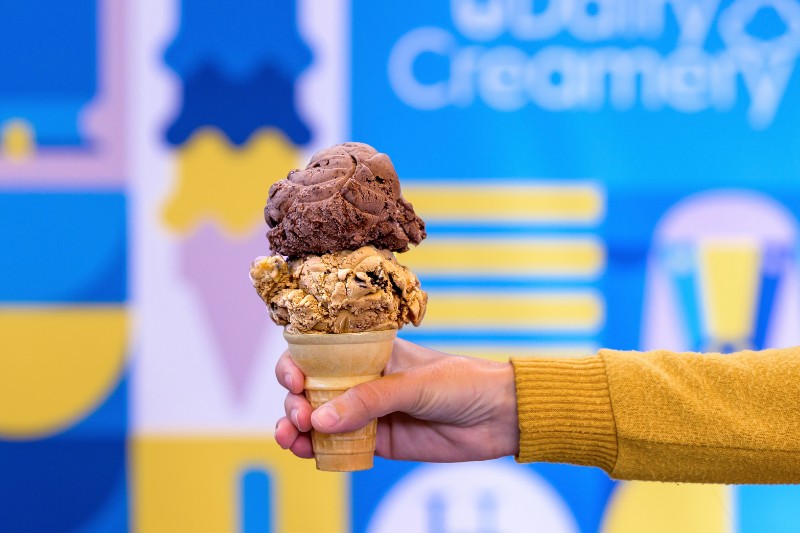
Since 2011, UDairy Creamery has been making and serving delicious ice cream to students, faculty, staff and the general public. Beyond the unique flavors like U Be-Be Baby (purple sweet potato ice cream with vanilla wafer pieces mixed in), seasonal flavors like 1st State Cobbler (peach ice cream with a blueberry swirl and cinnamon crumble), and all-time favorites like Delaware River Mud Pie (chocolate sandwich cookie ice cream with fudge swirls), the business thrives on its hands-on process creating a delicious treat from cows to cone.
This year, the flagship location (adjacent to CANR’s Townsend Hall) got a major facelift to add more space and outdoor seating to improve the customer experience. It’s the perfect time to share the inside scoop on what makes this legen-dairy ice cream so good.
So come along this tour de scoop with us!
Ice cream innovation
Since 2025, UDairy has been making its ice cream at the Genuardi Food Innovation Laboratory (GFIL) in the College of Agriculture and Natural Resources’ Worrilow Hall, just blocks away from the milking parlor.
Michael Gould and Sam Gartley, UDairy’s plant manager and lab coordinator, work with students to pick up raw milk from the UD Dairy Unit and bring it back to GFIL, pumping it through stainless steel pipes into a large tank. The foamy mixture swirls around, rising inch by inch as more accumulates. Gould, Gartley and students work together to add the ingredients that change it from milk to ice cream mix, adding about 10 bags (512 pounds) of sugar, non-fat dry milk powder, emulsifiers and stabilizers to the raw milk.

In late July, they’re making two fan-favorite flavors: Coffee and All Nighter.
“All Nighter is inspired by college students staying up late pulling an all-nighter to finish a paper or project together,” Gartley said. “What are you going to have to keep you awake while you’re trying to get that done for your final? You need a little bit of coffee, you need some cookie dough because it's delicious. Why not throw in some Oreos and a chocolate swirl!”
Gartley adds non-fat dry milk powder, cream and sugar to the mix. As Gartley shakes the bags into a big funnel to add to the mixture, residual dust fills the air, coating her eyebrows and eyelashes with white powder. She doesn’t even flinch.
“I’ve gotten used to the point where it gets everywhere,” Gartley said with a laugh.

The process is often messy, as Gartley and Logan Rose, a quality assurance student intern, can attest.
“We were making the Raspberry Cheesecake flavor and I had raspberry syrup all over me,” said Rose, a senior food science major. “I had food coloring on me. I had bits of graham cracker variegate stuck to my lab coat.”
Despite the mess, it’s a rewarding job for all.
“When I clock out, I step outside and I get to see people enjoying the ice cream that I’ve helped make,” Rose said. “I don’t think it gets much better than when you can step outside of work and see the rewards and happiness that your job brings to people.”
Homogenization and pasteurization
UDairy employees move the ice cream mix through a homogenizer, which breaks up fat globules, dispersing them evenly through the mix. This gives the ice cream mix a smooth, creamy texture.
“We use a 14% fat content, which is higher than many other ice creams,” Gould said. “Ten percent milkfat is the minimum and most common for products legally labeled ice cream in the U.S.”
Then they need to pasteurize the ice cream mix. Raw milk can contain harmful bacteria that can make people sick. The harmful bacteria are eliminated by heating up the ice cream mix to 175 degrees Fahrenheit to kill them.
“We think about food safety holistically — from milking the cows and keeping them healthy to ensure they’re producing the highest quality ingredients to transporting the milk and keeping it cold so we don’t allow bacteria to grow to how we pasteurize our mix and clean our equipment and environment to prevent reintroducing bacteria back into our products,” Gartley said.

Once pasteurized and homogenized, they send the mix to aging tanks for at least four hours but often overnight to thicken before it’s ready to be frozen into ice cream. During the aging step, flavors like Vanilla or Coffee extract are added.
Ice cream mix then heads in one of two directions: Employees package the ice cream mix into 2.5 gallon bags and transport it to refrigerators at either the flagship or the GFIL, where it sits ready to be batch frozen. Or the mix moves through the continuous freezer at the GFIL.
Brainstorming flavors
The ice cream mix travels through a continuous freezer, and then exits through an ice cream filler, (a machine that dispenses the ice cream mix) emerging looking like a soft serve as it flows into boxes for storage. The softer texture makes it easier to mix the cookie pieces and cookie dough in.

Chocolate sandwich cookies and cookie dough pieces are put into an ingredient feeder and piped through a machine called a variegating pump that blends the pieces into the ice cream mix in a swirl.
“One thing that sets UDairy apart is we put so much into our ice cream. It’s not a light serving of chocolate chunks,” Rodammer said. “The swirl gives it texture and flavor.”

Some UDairy flavors are happy accidents. Delaware River Mud Pie, a signature flavor, was meant to be cookies and cream. Once they put the cookies into the batch freezer, the ice cream came out looking muddy in color and the cookies were crushed. They decided to add a fudge swirl and thus, Delaware River Mud Pie was born.
Sometimes UDairy releases more unique flavors: Old Bay to celebrate the College of Earth, Ocean and Environment’s signature Coast Day event, or CANR Cone-nection (cherry ricotta ice cream infused with spicy Ancho chili and a nutella swirl) to celebrate CANR’s annual Ag Day.

UDairy has even launched “mystery flavors” on Halloween. Wasabi Ginger, Chicken and Waffles, Cilantro Lime and Thanksgiving Dinner have all made it to the display case and the stomachs of those daring enough to try them.
Some flavors flop. Backyard Barbecue — ranch-flavored ice cream with bacon bits — never made it to market.
“We have some really creative minds,” Rodammer said.

The brains behind new flavors are usually food science interns. They often pay attention to food trends to come up with ideas for seasonal flavors or experiment with popular trends that could become a permanent part of the lineup.
Once the ice cream is packaged into pints, half gallons, or 2.5 gallon containers, it goes back to the freezer to harden at -20 degrees Fahrenheit. After two to 12 hours, it’s ready to eat!
Serving scoops
If you want to buy UDairy ice cream by the scoop, pint or half gallon, your options are the UDairy Creamery Cafe at 83 E. Main St., the flagship location at 535 S. College Ave., UD’s dining halls or the Moo Mobile, UDairy’s ice cream truck that travels the state.
After a summer of much-needed improvements, UDairy reopens its flagship location to the public Friday, Sept. 25. UDairy gutted the front of its store to remove a small seating area, added an additional door to make a separate entrance and exit, improved the flow of customer traffic through the store and created separate ordering and pick-up windows. All to “improve the customer experience,” Rodammer said. The renovations were made possible by a generous gift from the Delaware Atlantis Foundation.
The renovation happened alongside the construction of the College of Agriculture and Natural Resources’ Townsend East Lawn and Garden, which will better connect the college to UDairy, the UD Botanic Gardens and the broader community.
“Our product tells the story of the College of Agriculture and Natural Resources. Students make it; students serve it,” Rodammer said. “The interior renovation is going to give you a more enjoyable experience of just getting ice cream, but the Townsend East Lawn and Garden will keep you on campus to eat your ice cream.”
Now that you have the inside scoop from cow to cone, why not try some UDairy ice cream yourself?
Contact Us
Have a UDaily story idea?
Contact us at ocm@udel.edu
Members of the press
Contact us at mediarelations@udel.edu or visit the Media Relations website