




Knotted Belly Bind textile modernizes ancient tradition: youtube.com/watch?v=flvzeehHK4U
Modernizing an ancient tradition
Photos by Evan Krape May 06, 2026
Fashion student combines technology and design to create a belly binding garment for postpartum mothers
Childbirth can be a traumatic experience for a woman’s body. Now an innovative combination of fashion and technology is breathing new life into an ancient tradition that offers support for improved posture, circulation and muscle recovery for postpartum women.
University of Delaware graduate student Casey Tyler, a master’s student in fashion and apparel studies in the College of Arts and Sciences, combined their experience in research and design with inspiration from spacesuit engineering to create a flexible, easy to use and sustainable garment called a knotted belly bind™.
The project came to Tyler via UD’s Wearable Innovation Lab. Led by Adriana Gorea, assistant professor and principal investigator, the lab focuses on inclusive, user-centric functional apparel design, and often seeks to address community needs.
For doula Brittany Mason, the fashion challenge was clear: “How do you modernize a tradition and technique that we know is so beneficial, to work in a society where women have to go right back to work after having a baby?”
Belly binding has been used by postpartum women across cultures for centuries. Traditional methods require at least two people to wrap a long length of fabric — as long as 36 feet — in strips around the body to make a series of knots that are stacked in the front of the torso, in a method similar to lacing a shoe. The binds compress the abdominal muscles and support the torso and the pelvic floor, helping the body heal.
The technique has gotten lost in today’s fast-paced society as wrapping and tying the fabric is complicated, time consuming and can’t be done by the mother alone.
“That was the challenge,” said Mason, co-founder of This is Spacewear, alongside Amanda Deng, a spacesuit designer at ILC Dover.
Deng’s work with spacesuits shares the same core design philosophy as the belly bind: supporting biomechanics, physiology and recovery through intentional, body-centered design.
Naturally, the duo sought out UD.
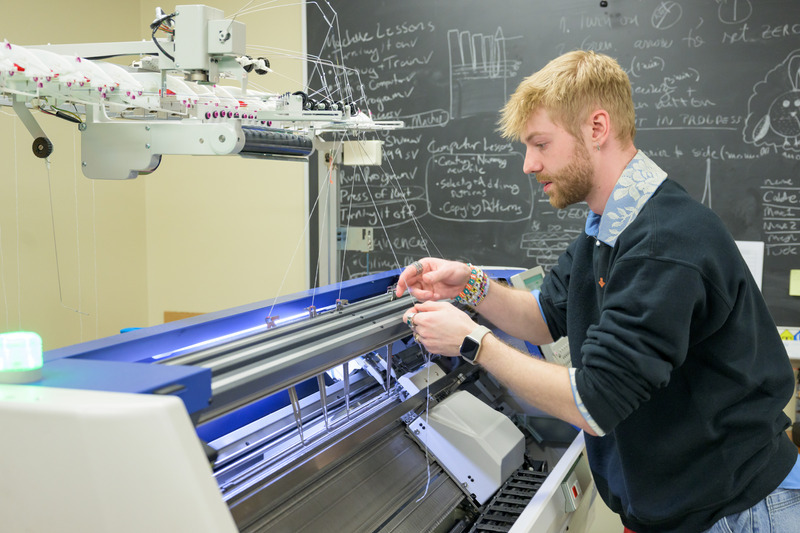
To meet the challenge, Tyler and Gorea turned to the department’s Shima Seiki knitting machine, a highly specialized system that produces seamless, three-dimensional garments. Tyler learned to program the machine in half the time of most other people.
“Casey was ahead of everything we taught,” Gorea said. “They picked it up right away.”
A warm fall day on campus provided an inspiration. Gorea had taken off a hoodie she was wearing and knotted it around her waist, realizing how much support it gave. Tyler then used the machine’s templates for making gloves to mirror the concept.
“We made a couple of gloves and then played with finding different ways to wrap the gloves around the body,” Tyler said. “Once we got the design to work at half scale we pumped it up to full scale.”
The result is a single textile that supports the back, and has five “ties” the wearer, on their own, can wrap around the torso and knot in the front of the body. The easy-to-use garment allows the wearer to adjust the compression across different parts of the body, providing support where it is needed most.
Mason gave the early prototypes to new mothers to test, and Tyler and Gorea adjusted their designs based on comfort, flexibility and functionality. The team refined everything from materials to the placement of compression zones, ensuring the garment meets real-world needs.

The composition and construction also reflects Tyler’s commitment to creating sustainable fashion. The garment is made from polyester yarn sourced from recycled water bottles combined with other fibers. And unlike traditional cut-and-sew garments, which generate fabric waste, the knitting machine produces complete pieces with a minimum of excess material.
“That’s the waste right there,” Tyler said, holding up a small piece of yarn during a demonstration. “Two inches out of over two thousand yards.”
The project’s interdisciplinary nature — blending fashion, engineering and health — reflects a broader shift in how design problems are approached.
Now, the work is moving beyond the lab. Mason and Deng have filed a provisional patent, and the team is working with a manufacturing company to bring it to market later this spring. There will be both a functional line intended for everyday use and a more expressive version that incorporates color, pattern and personal style.
As the product moves closer to market, the team hopes it could eventually expand into clinical settings, offering improved support for patients recovering from childbirth and other abdominal procedures.
Tyler expects to graduate in May, and this experience means they will leave UD with much more than a degree. Tyler is expected to be included on the final patent tied to the design — a remarkable achievement for a student.
“I never would have thought I would have done as much in fashion as I’ve done. From runway design to research to production I’ve learned how to combine the artsy side with function and how to make fashion meet human need,” Tyler said.
Contact Us
Have a UDaily story idea?
Contact us at ocm@udel.edu
Members of the press
Contact us at mediarelations@udel.edu or visit the Media Relations website