

Lifting as we Climb
Photos by Evan Krape June 30, 2026
As America turns 250, a library exhibition explores how Black Delawareans built pathways to opportunity
As the nation commemorates the 250th anniversary of America’s independence, a featured exhibition at the University of Delaware invites visitors to consider a broader question: Whose stories go untold?
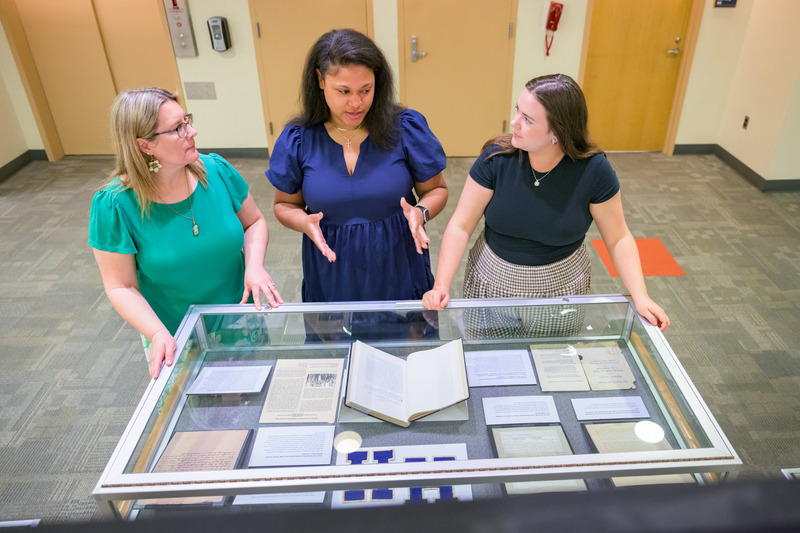
Lifting As We Climb: Churches, Schools and the Formation of Delaware’s Free Black Communities, on view through Aug. 7 in Morris Library, explores how African Americans in Delaware built institutions, pursued education and strengthened the community in the decades following the Civil War. Drawing from the University’s Special Collections, the exhibition highlights the people and organizations that worked to expand opportunity and realize democratic ideals that remained out of reach for many Americans long after the nation’s founding.
“One of the themes that inspired the exhibition was the idea of an unfinished revolution,” said Hillary Kativa, associate librarian and head of Special Collections. “The efforts to realize the promises of American democracy didn’t begin and end in 1776. We wanted to explore how Black Delawareans continued that work through community building, education and civic engagement.”

The exhibition was developed with support from a Delaware 250 grant, which funded student curators Kallie Comardelle, a doctoral student in English, and Dhazhea Freeman, a graduate student in Africana Studies. Four local historians also contributed research and guidance.
Rather than focusing on the Revolutionary era, the curators turned their attention to a period spanning roughly 1870 through the 1930s.
“As we dug into the collections, we became interested in the institutions people created for themselves,” said Comardelle. “Churches, schools, women’s clubs, for example.”
The exhibition begins with the rise of the independent Black church in Delaware and the leadership of Peter Spencer, founder of the Union Church of Africans in 1813. Spencer recognized that education was essential to freedom and self-determination. In many communities, churches served as the first schools for African Americans, providing educational opportunities when access elsewhere was limited or denied.
The connection between liberty and education is a central theme of the exhibit, which also includes rare manuscripts, pamphlets, photographs and ephemera.
Among Freeman’s favorite discoveries is a 1932 manuscript by poet, educator and activist Alice Dunbar-Nelson describing Wilmington’s Big August Quarterly, a tradition founded by Spencer that continues today.
Black history is American history. What we don't teach is often as important as what we do.
-Dhazhea Freeman
The exhibition also examines the role of Black women in expanding educational opportunities throughout the state. In organizations like the State Federation of Colored Women’s Clubs, women like Dunbar-Nelson and pioneering educator Edwina Kruse advocated for schools, social services and educational reform.
The exhibition’s title comes from the Women’s Club motto: “Lifting as we climb.”
“The work these women did changed the entire landscape of education for African American students in Delaware,” said Comardelle, lamenting that their contributions have often been overshadowed by larger institutions and historical figures.
For Freeman, the project revealed a side of history often missing from textbooks.
“We’re taught the suffering but not the strength,” she said. “I was amazed by the prosperous Black communities that existed in Delaware and the ways people created spaces for themselves.”
The exhibition also underscores the importance of archives in preserving stories that might otherwise be lost.
“Black history is American history,” Freeman said. “What we don’t teach is often as important as what we do.”
For Kativa, that message closely aligns with the goals of Delaware 250.
“There are peaks and valleys throughout American history,” she said. “When we tell a fuller story, more people can see themselves reflected within it.”
“Lifting As We Climb” is free and open to the public during Morris Library’s regular hours. Many of the items from the exhibition and related materials are also available online.
Additionally, visitors can explore a complimentary pop-up exhibit in the display case adjacent to the Interlibrary Loan office. Curated by Arline Wilson, senior assistant librarian and digital humanities and Africana scholar, “Haunted and Hidden: Folklore, Memory and Delaware’s Unfinished Past” examines how ghost stories, legends and oral traditions preserve histories that formal records often overlook. Through stories connected to Indigenous communities, Delaware’s colonial past and historically marginalized groups, the exhibition explores folklore as a form of cultural memory. It is also on display until Aug. 7.
Contact Us
Have a UDaily story idea?
Contact us at ocm@udel.edu
Members of the press
Contact us at mediarelations@udel.edu or visit the Media Relations website