




Phosphorus detective
Photos by Kathy F. Atkinson and courtesy of Deb Jaisi July 16, 2026
UD’s Deb Jaisi innovates how to trace environmental contaminant
You may remember seeing phosphorus on a high school chemistry test or two. It’s one of the less abundant elements found on our Earth, yet needed more for all living things.
“Of all the elements on the periodic table, phosphorus has a very extreme characteristic,” said Deb Jaisi, professor of environmental biogeochemistry in the University of Delaware College of Agriculture and Natural Resources. “It makes us all alive and it makes us all die.”
It’s a double-edged sword. Phosphorus is the backbone of our DNA, and builds our bones and teeth. But too much phosphorus can damage kidneys and increase the risk of heart failure.
Phosphorus gives plants their daily nutritional needs. But whatever phosphorus a plant can’t consume stays in the environment. It creeps into waterways and speeds up algae growth that can kill fish and aquatic plants.
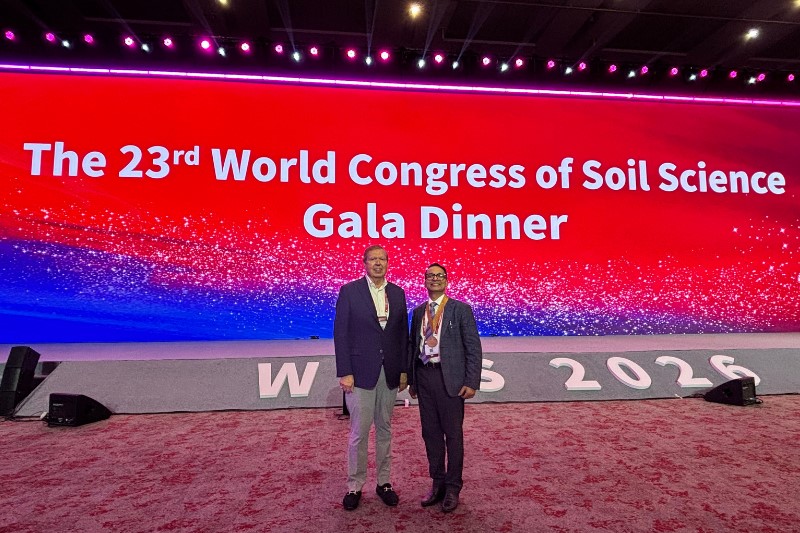
Fascinated by these properties, Jaisi has dedicated his academic career to exploring phosphorus and its presence in the environment. His innovative research has unlocked new ways to pinpoint where the phosphorus causing environmental damage is coming from. The UD soil chemist and Fulbright U.S. Scholar was recognized in June at the World Congress of Soil Sciences in China as a 2026 recipient of the International Union of Soil Sciences (IUSS) Innovation Award, an honor given to one scientist around the world every two years.
“It’s a big honor,” Jaisi said.
Phosphorus forensics
Jaisi thinks of himself as a phosphorus detective. The big mystery: Where the phosphorus in the environment actually comes from.
“Is it coming from what farmers apply to their crops?” Jaisi said. “Is it coming from what the soil already had? Or is there another way, such as geological sources?”

The geochemist uses stable isotopes to solve the mystery on earth and track elements in the environment.
Isotopes are families of the same element where the atoms each have the same number of protons but different numbers of neutrons than the basic form of the element, making them have different masses. Think of it like holding five identical chocolate bars, but some are heavier than others.
In Jaisi’s field, isotopes can clue researchers into where a chemical element comes from.
“The oxygen isotopes in phosphate act like a fingerprint as it moves from farm soil into water,” Jaisi said. “They help us pinpoint whether the phosphorus came from fertilizer, manure, or other sources. Identifying those sources helps us diagnose and solve the problem.”
Two forms of phosphorus can be found in the environment: inorganic and organic. Inorganic phosphorus is the simplest form, most readily accessible to soil microorganisms and plants. Organic phosphorus compounds are much more complex, making them difficult to identify and track in the environment.
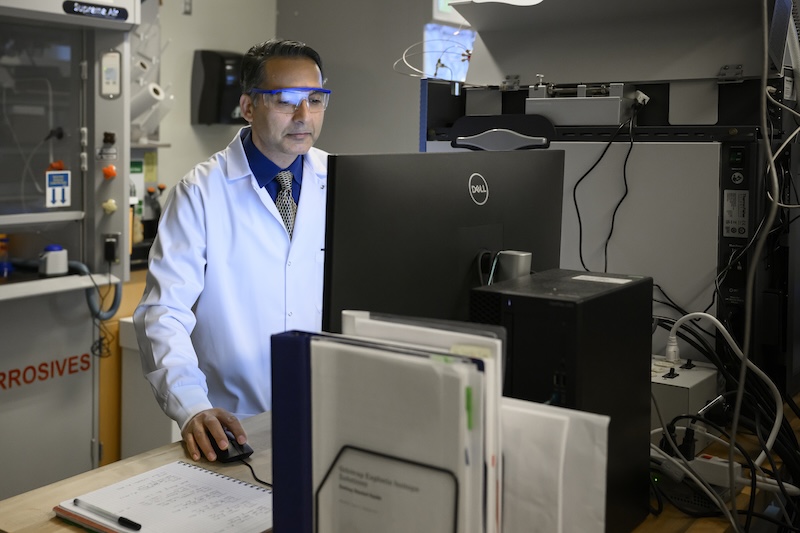
That’s where Jaisi’s research comes in. While at Yale University from 2007–2010 for postdoctoral research as a Bateman Scholar, his adviser, Ruth Blake, professor of earth and planetary sciences, was using an oxygen isotope system with phosphate molecules.
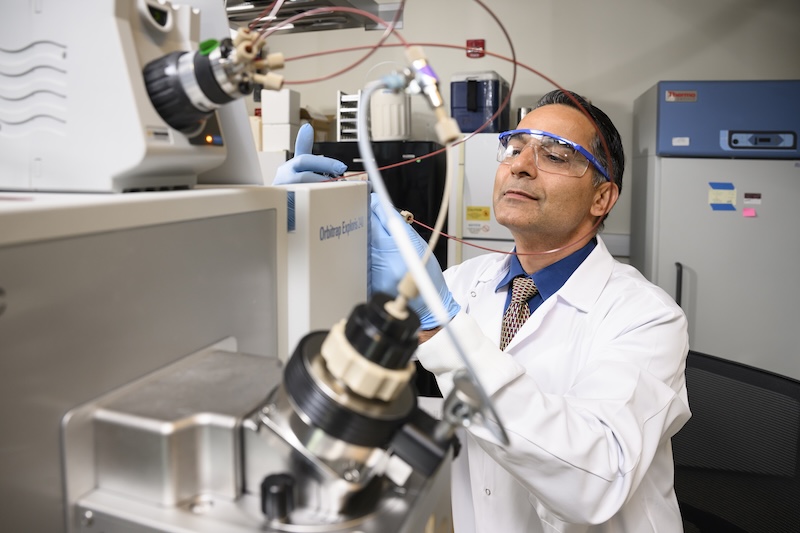
Jaisi was captivated by this concept and in his career at UD developed a new method to measure isotopes of organic phosphorus compounds, using a tool called an electrospray ionization-based Orbitrap isotope ratio mass spectrometer (Orbitrap IRMS). The tandem mass spectrometry based isotope measuring method originated at the California Institute for Technology, where Jaisi visited as the National Science Foundation (NSF) Fellow, but is used for other compounds, not phosphorus.
To measure isotopes of organic phosphorus compounds, Jaisi injects a solution containing about 20 nanograms (a billionth of a gram) of phytate, one type of organic phosphorus compound, into the Orbitrap IRMS. The molecules travel through ionization and then a mass filter to separate phytate ions from any contaminant ions. Then they are channeled to a mass spectrometer to measure accurate isotopes. Once Jaisi gets the fingerprint, he can map out where it came from based on known sources of the contaminant.
“Isotopes give so much power,” Jaisi said. “Isotope fingerprinting is the only robust way to track where contaminants come from.”
His new method allows researchers to identify isotope fingerprints across hundreds of organic phosphorus compounds — something that until now was essentially a black box.
“We did not have an appropriate method to identify the source or track how organic phosphorus converts into inorganic forms — which fuel biological activity, including algal blooms,” he said.
Protecting waterways
Sandy Raimondo, chair of UD’s Department of Plant and Soil Sciences, praised Jaisi’s research as being “paramount” to protecting waterways like the Delaware and Chesapeake Bays.
“His research has global impacts, which is really impressive,” Raimondo said, “but it also serves a major role in Delaware, where agriculture is practiced in such close proximity to coasts and the sensitive estuarine systems of the Delaware and Chesapeake Bays. Estuaries, such as our surrounding bays, are the most productive ecosystems on earth, and we have a responsibility to ensure their sustainability.”
Ultimately, Jaisi hopes the method he’s developed to track organic phosphorus compounds in the environment could inform strategies to manage water pollution.
The Chesapeake Bay watershed — the largest estuary in the U.S. — is home to more than 18 million people and 3,600 species of plants and animals. The bay suffers from excess nutrient pollution from contaminants such as phosphorus (receiving about 21 million pounds of phosphorus annually), which drives algae blooms that trigger “dead zones.” These “dead zones” remove oxygen from the water, killing fish and other aquatic species.
“It’s a critical piece of information for management,” Jaisi said. “If we know what forms of phosphorus are causing the problem, or what source contributes more to the problem, then we can have a very directed effort on specific sources to control.”
Jaisi has also looked into pre-emptive solutions of this problem. Phosphorus is a key ingredient in the fertilizer that farmers apply to their crops to feed the world, and Jaisi sees room for improvement in modern-day synthetic fertilizers. He is developing next-generation nanofertilizer, a fertilizer that improves nutrient use efficiency while reducing environmental impacts.
There’s plenty of room for growth in Jaisi’s field, and room for more soil scientists interested in the isotope method Jaisi has been working on.
Devraj Maidali, a doctoral student in Jaisi’s Environmental Biogeochemical Lab, is studying an organic phosphorus molecule called inositol phosphate, which is present in soils. He uses the Orbitrap IRMS to measure oxygen isotopes. Methods to measure these oxygen isotopes in the inositol-phosphate molecules using the Orbitrap IRMS are not fully developed, so Maidali hopes to refine a method by learning from Jaisi’s expertise.
“Working with an instrument like Orbitrap IRMS needs great patience, troubleshooting skills, and theoretical knowledge about analytical chemistry,” Maidali said. “The old school supervision patterns Dr. Jaisi brings to EBL is a great place for graduate students like me to develop a scientific career.”
As Jaisi works with students like Maidali, he hopes to see long-term solutions for phosphorus and other nutrient-related pollution in waterways, and more students with a thirst to solve these problems.
“Water quality is a major issue, driven largely by unsustainable agricultural practices — a generational challenge,” Jaisi said. “We still don’t fully understand how plants choose among different forms of phosphorus in soil, which means excess nutrients can end up in waterways. Finding answers will require innovative technologies and the next generation of researchers trained to use them."
Contact Us
Have a UDaily story idea?
Contact us at ocm@udel.edu
Members of the press
Contact us at mediarelations@udel.edu or visit the Media Relations website