

The hidden forces behind winter sports
Photos by Kathy F. Atkinson and iStock and courtesy of Alfredo Sánchez | Photo collage by Jaynell Keely February 12, 2026
UD professor explains how Olympic athletes optimize physics to reach peak performance
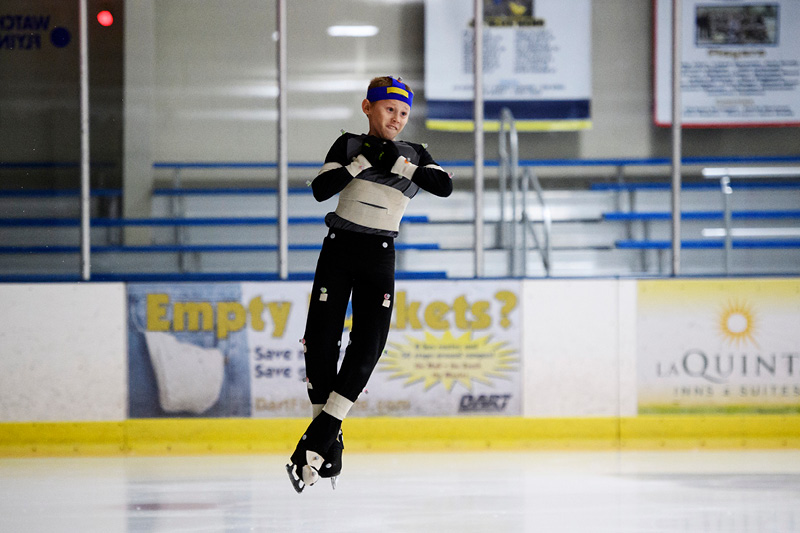
Long before he earned the nickname the “Quad God,” U.S. men’s figure skating champion and gold medalist Ilia Malinin was part of a University of Delaware biomechanics study that measured jumping ability and motion, part of a broader effort to understand how forces, speed and body mechanics impact an athlete’s performance.
Now when Malinin launches himself into the air to do a quadruple axel — four and a half rotations — he’s not only making history as the only skater in the world to consistently land the jump, he’s putting his knowledge of that science to work.
All of the sports at the Winter Olympics in Milano Cortino involve some physics in action. For figure skating, ski jumping and curling, two of the basic laws of the physics of motion are at play: Gravity governs motion, and friction resists it.
UDaily spoke with Alfredo Sánchez, assistant professor in the Department of Physics and Astronomy in the College of Arts and Sciences, about the science behind the three sports, and how athletes test those laws of motion and the limits of their bodies to create a peak performance.
Figure skating: the challenge of rotational inertia
Figure skating jumps require a balance of strength, timing and body control. Athletes have to generate enough force and speed to lift off the ice high enough and spin fast enough to complete all of the revolutions before gravity pulls them back to the ice. Throughout the rotations they are fighting resistance to the spin, called rotational inertia.

But there’s a trick to combatting inertia.
“When skaters pull their arms close to their bodies, they reduce their rotational inertia, that resistance to rotation,” Sánchez explained. “That allows them to spin faster without having to propel themselves.”
Each additional rotation requires more jump height, more speed and more precise control. For the quad axel, Malinin has optimized both his strength and how his body mass is distributed while rotating.
Does that mean a quintuple axel is on the horizon?
“I would never say never, but at some point we run into the limits of the human body,” Sánchez said. “There are limits as to how much energy can be burned in a short time interval, how far the muscles can stretch, how far the joints can rotate. The question is where are those limits?”
Ski jumping: fighting gravity and air resistance
While skaters manage resistance to rotations, the biggest challenge for ski jumpers is managing air resistance, or drag, in a straight line. Once a jumper leaves the starting point at the top of the ramp, gravity immediately takes over, pulling them down. Controlling how air flows over and around the athlete while they descend determines how far they go.
“At those speeds, air resistance becomes the dominant factor,” Sánchez said. “Resistance increases dramatically the higher the speed, so one of the goals is to have a position that causes air resistance to be minimized.”

To do that, jumpers get as close as possible to their skis, using a tuck position while on the ramp and leaning over while in the air, shaping themselves so air moves smoothly around them. Athletes adapt their style to their individual body shape and size to achieve the best “aerodynamics of the technique,” according to Sánchez.
While the familiar V-shape may seem to contradict the idea of reducing resistance because the front of the skier’s body seems more exposed to the air, it has resulted in longer jumps. Sánchez said the form allows the athletes’ bodies to have more of a curved shape overall as they fly, making the air flow in streams around it and providing an upward lift force.
Curling: steering with friction and spin
Curling may look easy, but it may be the most strategically complex winter sport from a physics standpoint, according to Sánchez. It is the only winter sport that allows athletes to actively alter an object’s path after it has been released, requiring the athletes to understand the forces that contribute to the trajectory of the granite stone, and how the sweepers can change that trajectory.
The stone’s curved motion, or curl, is determined by how much it is spinning and how much friction there is with the ice. When it is spinning, friction acts unevenly across the stone’s surface, causing its path to bend.
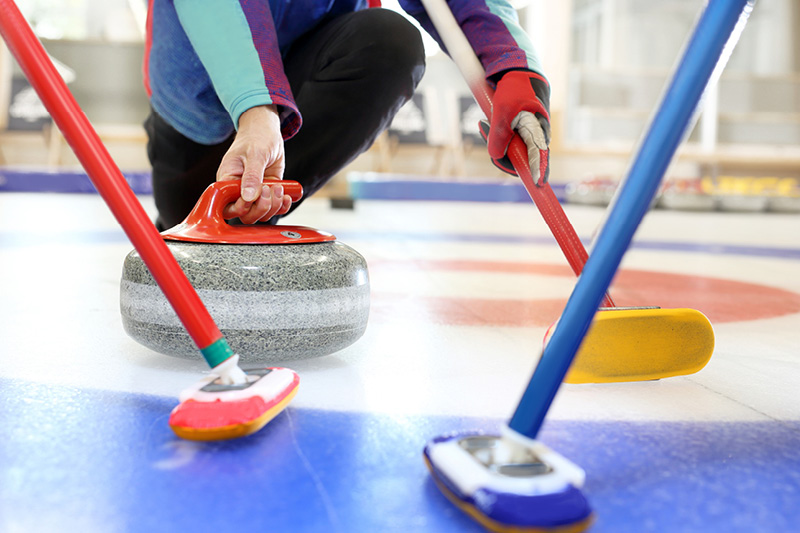
By brushing the ice, sweepers slightly warm and smooth the surface, reducing friction. This can help the stone travel farther or curl less sharply, allowing teams to fine-tune shots in real time.
The key to success lies in consistency. Teams must know exactly how much spin, force and sweeping will produce the exact trajectory they want for any situation.
“The question for the athletes is, how they can, with practice, make sure they consistently give the stone the force and the spin they want,” Sánchez said. “You plan based on that. Some people could be better at throwing to consistently hit the other stones, or consistently giving spins. Or you might want to plan for something more defensive. It’s all about what you want to accomplish.
“It's interesting how friction, this fundamental phenomenon which we experience every day, can lead to this interesting sport with its own strategy and tactics,” he said.
Contact Us
Have a UDaily story idea?
Contact us at ocm@udel.edu
Members of the press
Contact us at mediarelations@udel.edu or visit the Media Relations website