




Ice breakers
Photos courtesy of UD Athletics March 26, 2026
UD’s newest Division I team is a force to be reckoned with
A women's hockey puck at the collegiate level typically travels between 70 and 80 miles per hour. At 8:37 on a recent Wednesday morning, Kaitlin “Finny” Finnegan took one to the hip. She winced through her facemask and peeled away from the bulldog drill, a two-on-two activity that looks equal parts elegant choreography and feral improvisation. A moment later, the team captain shook it off and skated back into the action.
"It wouldn't be practice if Finny wasn’t throwing herself in front of a puck," smiled Allison Coomey, the head coach of women's ice hockey at the University of Delaware.
A little farther down the rink, from the player’s bench, athletic trainer Alex Davisson shook her head. (She’s both a rehabber of injuries and keeper of the “graveyard,” a pile of broken sticks accumulated through hard shots and harder collisions.)
“I cringe sometimes,” she said. “I want to yell, ‘Be careful! I just put that player back on the ice!’ But they just laugh. They’re really tough.”
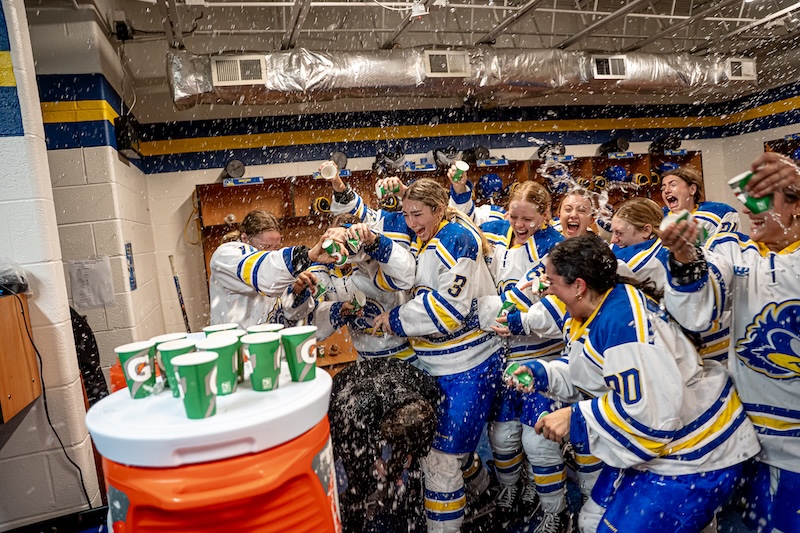
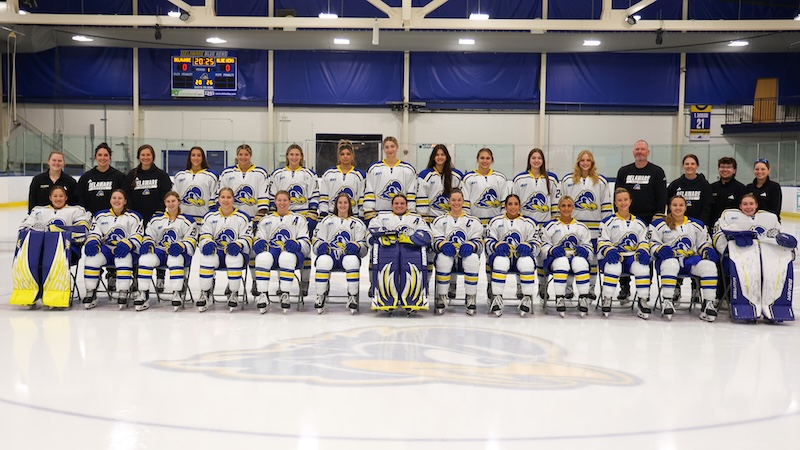
That word — tough — surfaces often around this Division I team. As the inaugural class of women’s ice hockey at UD, they’ve just closed out the final game of a punishing season. On paper, the numbers read exactly as you’d expect from a brand-new roster carrying 17 freshmen: two wins, 31 losses, plenty of growing pains. But the box score misses the more compelling story: a foundation taking shape through grit, conviction and the particular ferocity of women whose place at the table — and at center ice — has never been a given.
Historically, girls with championship dreams have found themselves in the penalty box before ever lacing up a pair of skates. Equipment is costly, rink time is limited and developmental leagues are scarce, meaning female players have fewer places to learn and compete. While the U.S. women’s team recently captured hearts and headlines after a gold-medal win at the Milan Olympics, igniting fresh momentum, media coverage still lags behind the men’s game, narrowing pathways to collegiate and professional play.
So when UD decided to establish a Division I women’s team —only the 45th program of its kind in the country — the call was not made lightly. University leaders understood the difficulties of this landscape, especially in a mid-Atlantic state with limited hockey infrastructure. For a real chance of success, entry into the sport couldn’t be tentative or halfhearted; this had to be a full-on slap shot (hockey-speak for a powerful, fully committed move). Blue Hen equipment managers, facilities personnel and athletic directors undertook a methodical process: digging into the details, studying peer programs and leveraging their Division I network for insight.
“I wasn’t even at the institution yet, but this effort spoke volumes to me about UD’s dedication to excellence,” said Coach Coomey. “There was a commitment to doing this at a very high level — a commitment to getting this right.”
That thoughtfulness stuck with Coomey, a former Niagara University player whose coaching pedigree includes the U.S. national team at the Beijing Olympics and, most recently, the women’s team at Penn State University, one of the most accomplished programs in the nation. In March 2024 she signed on as head coach of UD’s inaugural team, bringing more than two decades of leadership experience.
Immediately, Coomey and assistant coach Melissa “Samo” Samoskevich, also hailing from Penn State, embarked on a recruiting process that required 18 months and thousands of air miles. Traveling as far as Finland, they met with prospects eager to build a new program from the ground up. And they curated a roster that includes one Norwegian player (Ida Haave, who plays on the Norway National team and narrowly missed the Olympics), six Canadians and 14 Americans from 13 states.
“We were looking for great hockey players, but we were also looking for great people,” Samoskevich said. “More important than winning games at the beginning stage is finding the women who are going to set standards and build a team culture that will last for years to come.”
One of these players is Wren Abboud, a freshman forward from Massachusetts who always makes sure to thank the team’s bus driver and who carries up to five equipment bags at once, just to help out. Another is Finnegan, the graduate student from Kansas who took a puck to the hip and whose mentorship of younger players has earned her the nickname “ancestor.”
“There are so many life lessons to be learned on the ice,” said Finnegan, winner of the league’s Individual Sportsmanship award for the 2025-2026 season, voted on by program coaches. “Hockey has taught me that actions will always speak louder than words.”
Then there’s Billi Roman, a native of Hockessin, Delaware, who grew up playing on an all-boys team because there was no other local option. Some of her male teammates complained about taking the ice beside her; others refused to speak to her on the bench.
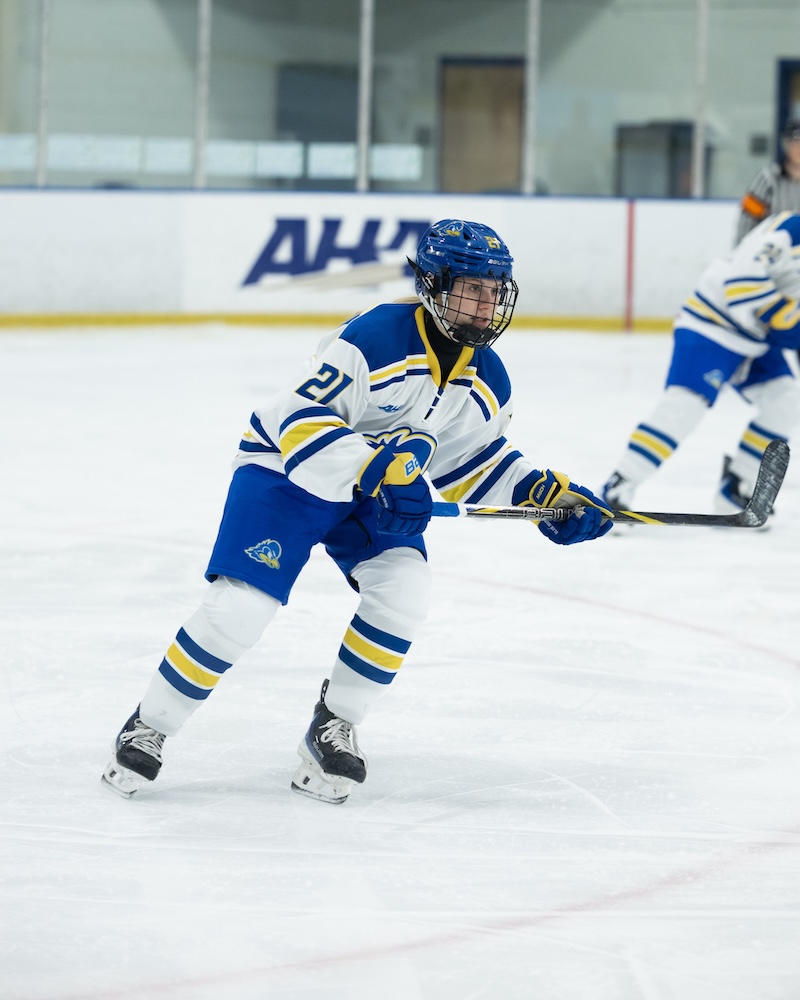
“I never cared; I wasn’t going anywhere,” Roman said. “I love this sport and I’ve loved it my whole life. As a kid, I used to tell my mom, ‘When I’m skating, I feel like I’m flying.’ I still do.”
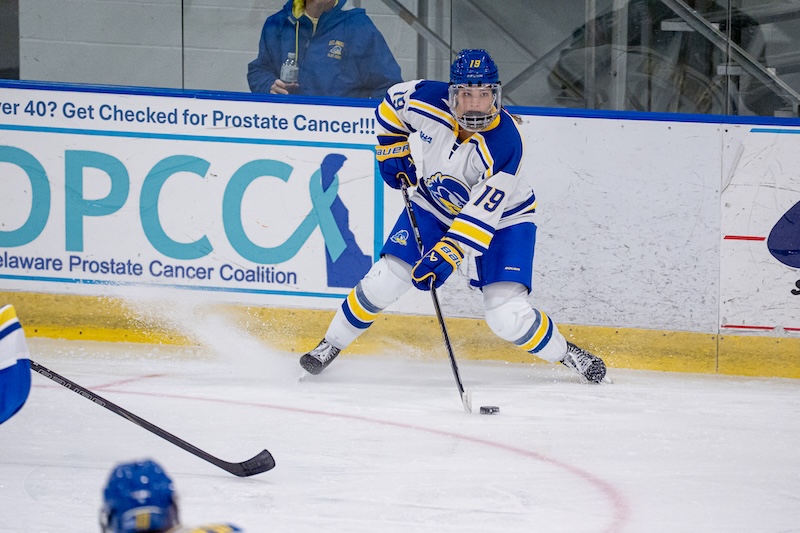
Eventually, at 14, Roman began traveling out of state for elite training; by her final year of high school, she was commuting five hours round-trip daily to practice with a women’s team in New Jersey. Now, she brings this passion to UD’s Fred Rust Arena, where she has a legacy to uphold. Her Uncle Tim played ice hockey for the University’s club team as an undergraduate in the early 1990s — until he died in a car accident at the age of 20. His jersey hangs above the ice, and Roman wears number 21 to keep his memory close.
“It’s so special to me to honor him in this way,” she said. “The first time I stepped on the ice as a Blue Hen, my whole family cried.”
Together, the women of UD’s inaugural cohort embody the team’s core values of respect, grit and gratitude, displayed outside the locker room. In season, they train for four hours a day, Monday through Thursday, and they travel for games on the weekend — Lindenwood University in Missouri is their farthest opponent. When they’re not on the ice or in the weight room, they’re building their team chemistry via a book club and intense rounds of a volleyball-style game called spikeball.
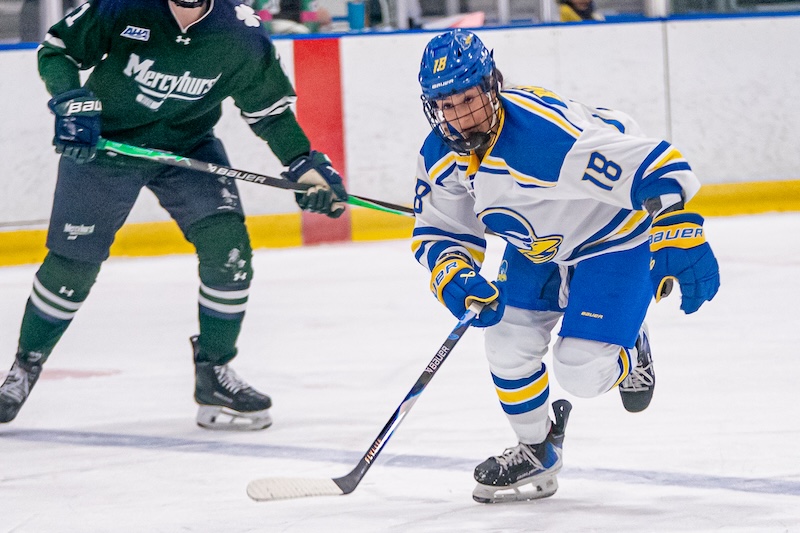
All of this has translated to winning moments, even in losing games — like that time Roman, clocking in at 5’3”, faced off against Tessa Janecke, the 5’8” powerhouse forward for Penn State who recently won gold at the Milan Olympics — and the Blue Hen got the puck. (“Greatest moment of my life,” she said.) Or that time the team took the nationally ranked Mercyhurst Lakers to overtime, even though “a lot of people thought we had no business being on the ice with them at all,” Samoskevich said. The team quickly earned a reputation for tenacity, diving to protect their net even when down by an insurmountable number of goals with less than a minute to go. (Defenseman Lexi Lonask leads the country in blocked shots, and she’s got the ice packs to prove it.)
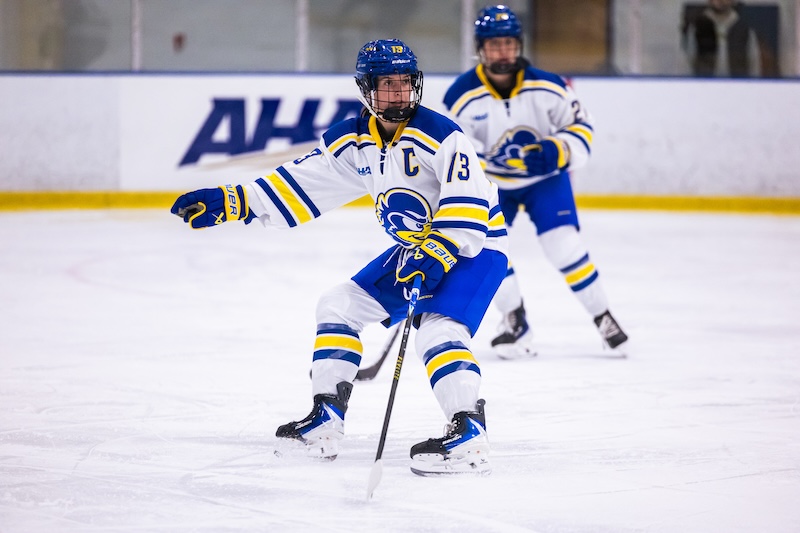
“We embraced being hard to play against,” said Coach Coomey. “And we heard it repeatedly from our opponents: You didn’t make this easy.”
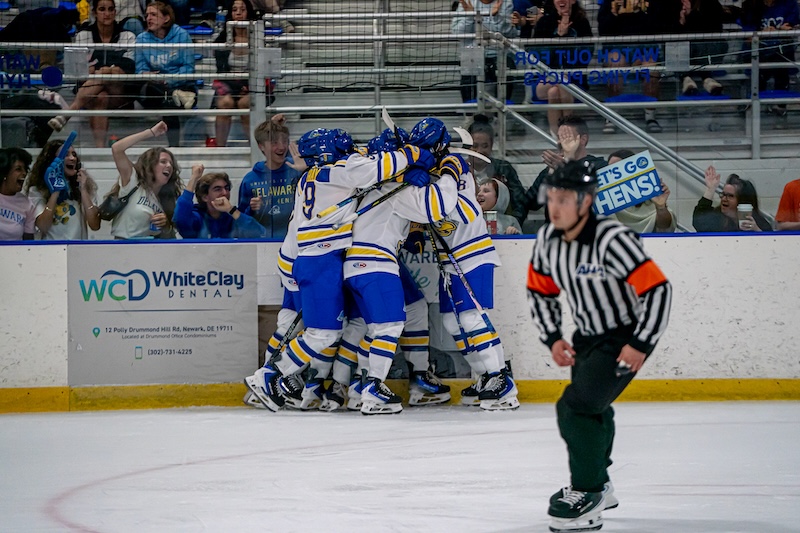
These underdog moments consistently brought fans to a roar — eagle-eyed observers may have noticed even famously objective statisticians fist bumping in the press box after Franki Barresi, a freshman forward from Ontario, put the first goal in program history on the board. But for the Fightin’ Blue Hens, cheers ricocheting off the metal walls of the Fred Rust Arena weren’t the most rewarding part of this inaugural season. That came during quieter moments spent volunteering at local kids’ clinics and encouraging up-and-coming players, boys and girls, at post-game free skates.
“These are some of our favorite memories as a team,” Barresi said. “And they’re a good reminder: This is so much bigger than just us. We are so grateful for the opportunity to grow this sport and to introduce a new generation to all that hockey has to offer.”
In the meantime, you’ll find the team taking their knocks in the arena and preparing for all the power plays — on the ice and off — yet to come.
“Right now, the future of this sport looks very bright in Delaware,” Finnegan said, the year’s bruises and breakthroughs still fresh. “And it’s only getting better.”
Contact Us
Have a UDaily story idea?
Contact us at ocm@udel.edu
Members of the press
Contact us at mediarelations@udel.edu or visit the Media Relations website