




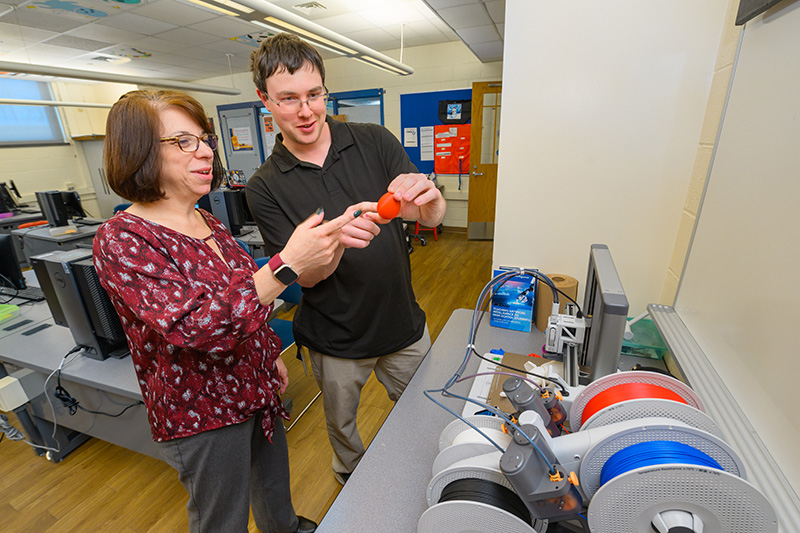
Demystifying microelectronics
Photos by Evan Krape and courtesy of the Center for Cybersecurity, Assurance and Privacy March 04, 2026
Engineering workshops pull back the curtain on the mysteries of modern technologies for teachers and students
Microelectronics are the building blocks of most modern technologies, from nanobots to supercomputers. But for many people, the science and mechanics of microchips are a mystery.
The University of Delaware’s Center for Cybersecurity, Assurance and Technology (CCAP) in the College of Engineering pulled back the curtain on the magic of microelectronics through a series of workshops and events over the past year to develop a pipeline of skilled workers and a better-informed public.
Funded by the federal CHIPS and Science Act, these community science programs were aimed at high school students, families and — critically — teachers.

“For many, a computer chip is just a black box,” said Associate Professor Nektarios Tsoutsos, CCAP associate director and co-director of UD’s FinTech Innovation Hub. “Through this program, [we aimed] to transform that abstract idea into a hands-on, creative experience.”
Tsoutsos and Kenneth Barner, Charles Black Evans Professor of Electrical and Computer Engineering and director of the CCAP, developed the learning activities to help students see themselves as belonging in STEM fields while building awareness of career opportunities.
“Even if people don't ultimately become engineers, they still interact with all of these [internet of things] devices — microelectronics — throughout their day,” Barner said.

More intensive programs, Barner said, were offered for “people that might pursue degrees in engineering or technology, or they might be teaching material that is technology-related.”
Jeannette Wilt, a longtime math and computer science teacher at Brandywine High School, signed up for the teacher workshops hoping to bring new ideas back to her classroom.
Wilt teaches the computer science pathway, which includes an introductory course and two Advanced Placement (AP) courses in programming. Through engaging activities like programming ping pong ball launchers, she aims to spark curiosity in students who might otherwise not have pursued the pathway.
“One of my goals has been trying to increase the number of females in my program, of students of color, and of students with disabilities,” said Wilt. “A lot of what we do is try to make it more interesting for the students.”
The CCAP program provided Wilt with a new understanding of the future of the field. Lessons showcased ways that microelectronics appear in our lives—such as in drones and robots. An introduction to side-channel attacks, a hacking method that exploits a computer’s physical and electronic processes, underscored the growing importance of cybersecurity in an increasingly virtual world.

The College Board is currently piloting an AP course on cybersecurity, which Wilt hopes to add as a fourth year for the pathway.
“That's where [students] need to concentrate more,” said Wilt, who has a distinctive perspective as her son recently graduated from UD’s Electrical and Computer Engineering program. “They need to know about how programming works, but they also need to know how it's being used in certain ways.”
Wilt’s students have already benefitted from the classroom’s new 3D printer provided by the CCAP program, and her AP students can look forward to programming new robots later this year.
The community science program was rounded out with opportunities for students. High school students participated in a weeklong immersion program, a series of weekly community science days were offered for high school students along with a parent or guardian, and teams of college and high school students were invited to participate in a five-week security competition.
“When a student builds their first circuit or programs a robot, they're not just learning a technical skill — they're building the confidence and curiosity to become the next generation of innovators who will power our tech future,” Tsoutsos said.
Community Engaged University
The University of Delaware has a long tradition of applying knowledge, creativity and civic commitment to the critical challenges facing communities in Delaware, across the nation and around the world. Community-based projects and activities strengthen UD’s identity as an engaged research university.
UD was reaffirmed in 2026 as a Community Engaged University, after its original 2015 designation, by the Carnegie Foundation for the Advancement of Teaching, which recognizes institutions of higher education for reciprocal collaboration with their larger communities.
Contact Us
Have a UDaily story idea?
Contact us at ocm@udel.edu
Members of the press
Contact us at mediarelations@udel.edu or visit the Media Relations website