




From Living Lab to safer streets
Photos courtesy of the Institute for Public Administration February 24, 2026
UD’s Living Lab Research Group leads pop-up demonstrations in Wilmington and Middletown that lead to pedestrian safety improvements
In the heart of downtown Middletown, tucked between the town library and an elementary school, East Cochran Street should have been one of the community’s safest streets. Instead, speeding cars quickly took over.
But thanks to a partnership between the University of Delaware’s Living Lab Research Group and the Middletown Town Council, the town was able to drastically improve pedestrian safety — reducing average speeds from 25 miles per hour to 17.
Funded by DelDOT, Living Lab uses temporary pop-up demonstrations to help Delaware communities test pedestrian safety improvements, placemaking initiatives, and built-environment changes before committing to permanent installation. The program brings together local governments, community-based organizations, schools and other partners to collaborate with stakeholders throughout the planning, execution and evaluation process.
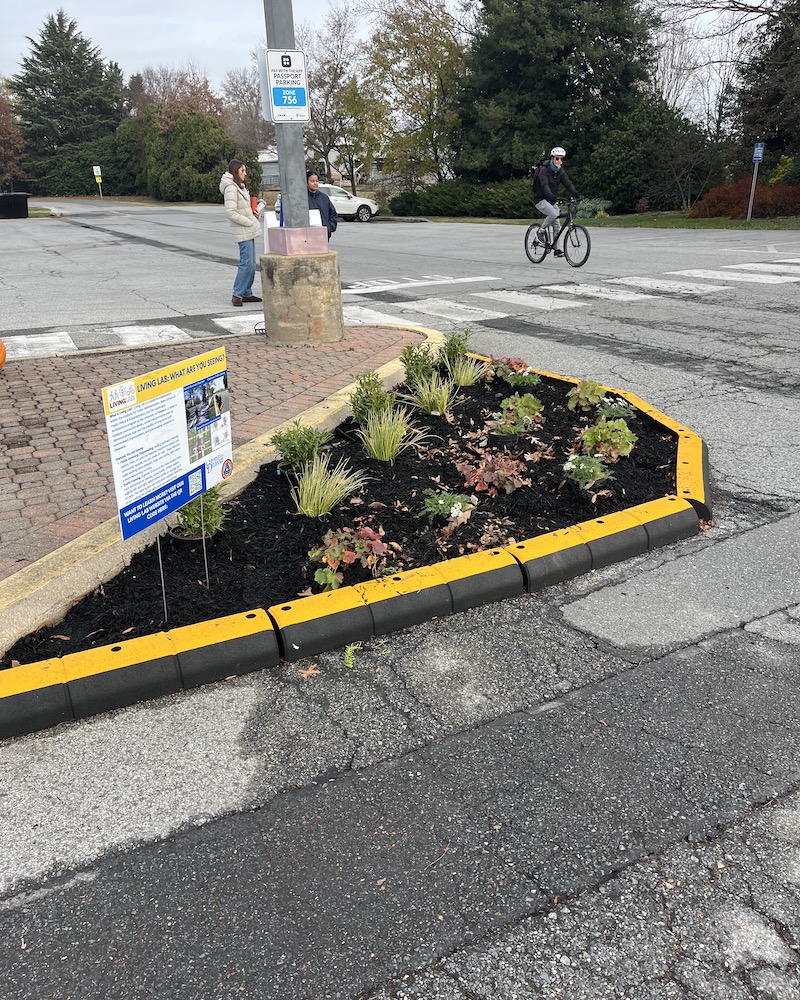
“The Living Lab program is truly unique in that communities can identify roads that feel unsafe and work with the Living Lab team to plan for transportation safety improvements,” said Matt Harris, IPA associate policy scientist and Living Lab principal investigator. “Through the work of the Living Lab, they are given the opportunity to implement those improvements, live with and experience the improvement in the community prior to committing to anything permanent.”
East Cochran Street comprises a three-block section and is home to the town library, an elementary school and a local YMCA. Over time, town leadership identified the area as a corridor where speeding had become a significant issue. To address this challenge, the Living Lab team engaged in public outreach and coordinated with city staff and leadership to design pedestrian improvement strategies, including traffic calming and placemaking.
To better understand community needs, the team attended several local events, including storytime at the library and the Middletown Farmers Market, to speak with residents about their concerns and ideas. Based on these conversations, the Living Lab team designed improvements that would address concerns.
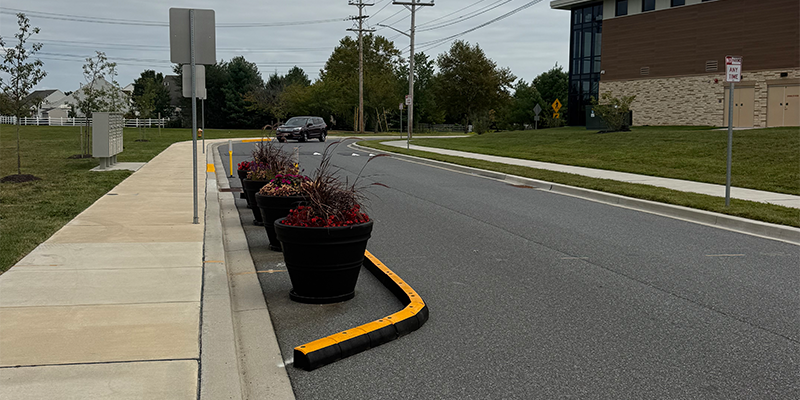
The team installed a traffic-calming measure called a chicane and speed humps along the corridor to reduce vehicle speeds. The team added floral planters to help identify the area where pedestrians might be walking or biking. The project was primarily funded by the Delaware Pedestrian Council and implemented by the Town of Middletown Public Works Department in close coordination with DelDOT.
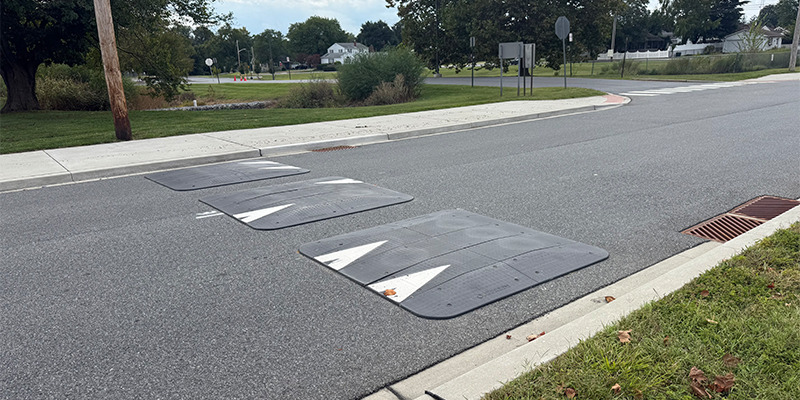
The improvements significantly reduced speeding: The highest observed speed dropped from 64 miles per hour to 43. These improvements not only led to a significant reduction in traffic speed, but fostered a more walkable and friendly environment for the community. Middletown has begun moving toward permanent installation of the improvements, both on Cochran Street and on other streets throughout the community.
“Through the program we were able to expose Middletown to traffic calming measures that had previously not been considered,” Harris said. “This not only proved successful but will allow the town to think about traffic calming and how to implement improvements as part of future street and road improvements throughout Middletown.”
Improving the Baynard Boulevard corridor
In fall 2023, the Living Lab program implemented long-planned safety improvements along the Baynard Boulevard corridor in Wilmington, Delaware. The project began with community conversations about neighborhood values during the Baynard Boulevard Open Streets events, where residents shared what they loved about their neighborhood and areas that needed improvement. One primary concern centered on speeding and pedestrian safety along the boulevard between 18th Street and Concord Avenue.
The Living Lab team partnered with the Jefferson Street Center, the local community development corporation, to facilitate ongoing community discussions about solutions.
“Our partnership with Living Lab proved to be highly impactful for the residents and neighborhoods we serve,” said Amanda August, executive director of Jefferson Street Center.
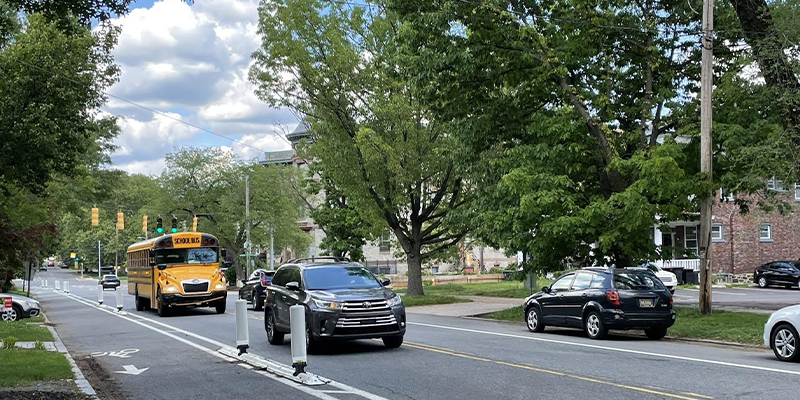
Key issues included the lack of safe crossings, vehicle speeding, unpredictable parking patterns and limited connectivity between the Triangle and Baynard Village neighborhoods. Several design options were presented, ultimately leading to a configuration with a curb-protected bike lane on the Triangle side and permanent parking on the Baynard Village side of the boulevard.
“Through a multi-faceted, collaborative approach, we were able to work with Living Lab to leverage pop-ups, facilitate community workshops, implement several data collection strategies and eventually install a road diet and the first protected bike lane in the City of Wilmington,” August said.
This design significantly reduced extreme speeding — from one in every 100 cars traveling over 50 miles per hour to just one in every 1,000. The project was funded with approximately $45,000 from Healthy Communities Delaware and has since received additional funding from the DelDOT Bicycle and Pedestrian Pool for permanent installation and future expansion to connect the facility to downtown Wilmington.
“One component about this process that I think is so important is how important community partners are for the Living Lab project process,” August said. “Every area's needs, residents and street components are different, so moving into this partnership requires flexibility, creativity, transparency and community input. Living Lab’s approach is not a one-size-fits-all, which can produce a really beautiful outcome in collaboration with an organization's priorities and needs.”
Learn more about Living Lab
In the fall of 2025, a webinar featuring speakers from UD’s Living Lab Research Group and DelDOT explored how temporary pop-up demonstrations can evolve into lasting improvements that create safer, people-centered public spaces.
UD’s Living Lab team is a research collaborative comprising staff and faculty members from the Joseph R. Biden, Jr. School of Public Policy and Administration, the Institute for Public Administration (IPA) and a faculty member from the College of Agriculture and Natural Resources’ Landscape Architecture Program. The Living Lab team includes Matt Harris, IPA associate policy scientist; Paul Moser, transportation engineer at the Delaware Department of Transportation (DelDOT); Nina David, associate professor in the Biden School; Anna Wik, associate professor of landscape architecture in the Department of Plant and Soil Sciences; and Alexandria McClellan, graduate student in the Master of Public Administration program and IPA public administration fellow.
About the Institute for Public Administration
The University of Delaware's Institute for Public Administration (IPA) addresses the policy, planning, and management needs of its partners through the integration of applied research, professional development and the education of tomorrow’s leaders. As a research and public service center in the Joseph R. Biden, Jr. School of Public Policy and Administration, IPA collaborates with state agencies, municipal governments, nonprofits, communities and businesses to examine complex policy issues and improve quality of life in Delaware and beyond.
About the Joseph R. Biden, Jr. School of Public Policy and Administration
Established in 1961 and named in 2018 for the University of Delaware’s most distinguished alumnus, the 46th President of the United States, the Joseph R. Biden, Jr. School of Public Policy and Administration prepares students with the knowledge and skills necessary to engage in research and public service to improve the quality of life in communities around the world. Biden School faculty, staff, students, and alumni create and use interdisciplinary, nonpartisan research and empirically based analysis to inform effective decision-making and policy and to improve leadership and administration. The Biden School partners with organizations from all sectors to discover innovative and equitable solutions to the critical challenges of our time.
Contact Us
Have a UDaily story idea?
Contact us at ocm@udel.edu
Members of the press
Contact us at mediarelations@udel.edu or visit the Media Relations website