




The path to writing
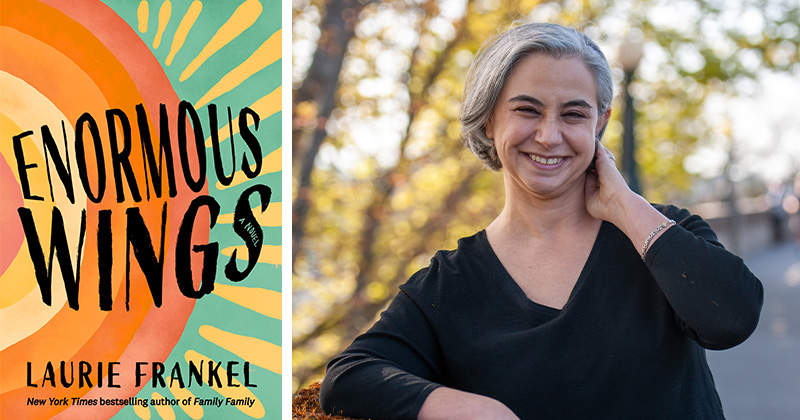
Photos courtesy of Laurie Frankel April 09, 2026
English alumna and novelist Laurie Frankel on literature, unlikely paths and asking big questions
Laurie Frankel didn’t set out to become a novelist. She came to University of Delaware as a graduate student to study literature, specifically Shakespeare, because at the time UD had a partnership with the Folger Shakespeare Library in Washington, D.C., and students could take courses there.
Frankel earned her master of arts in literature and completed her doctoral coursework before leaving UD for a teaching position. After writing her first novel in 2009, she started writing full time, crafting stories about family, transformation, love, loss and identity.
Her work has appeared in The New York Times, The Washington Post and The Guardian. Her bestselling 2017 novel This is How It Always Is, about a family of five boys, one of whom transitions to become a girl, was a Reese's Book Club Hello Sunshine selection. Her sixth book, Enormous Wings, comes out this spring and explores issues of autonomy and agency.
UDaily spoke with Frankel about her time at UD, her path to becoming a novelist and the advice she has for today’s UD students.
Q: You didn’t study creative writing. How did you end up becoming a novelist?
Frankel: I had about six months off between two jobs. It was the first time in my life that I wasn’t employed or enrolled in school full time. At that point I had read, like, 10,000 novels, and I wondered if I could write one. Writing a novel is one of those things that you don’t know whether you can do until you do it. You can sit down and try to write a sonnet in an afternoon, but a novel takes a huge chunk of time.
Q: How did your study of literature impact your decision and success?
Frankel: I think what UD did for me, and what graduate school, in whatever you are studying, can do is immerse you in text and discussion. At UD I had a community of people who wanted to take reading seriously, and talk about it, what it meant, how it meant that and how that was communicated. We had those conversations in seminars, and also in the hallways, in our apartments, over ice cream at the bar. We were constantly, constantly reading and talking about what we were reading.
Q: Who was your biggest influence at UD?
Frankel: Tom Leitch, who is retiring this year, was a profound influence on me — both inside and outside the classroom. He was teaching texts in ways that felt completely different from anything I’d experienced before, often rooted in theory but also expansive in terms of what counted as a “text.”
It opened up possibilities for me — not just in how to read, but in how to think about my own path. He helped me see there wasn’t just one way forward. That realization is a big part of why I found my way to writing novels.
I remember some of the essays I wrote for him, too, and sometimes I think, “Oh, I should have said that this way.” I’m still thinking about it 25 years later.
Q: Your novels have touched on controversial topics. How do you choose what to write about?
Frankel: I write novels about what I’m ranting to myself about while I walk the dog, or the things that are pissing me off — the tirades I’m having to myself in the shower. In our current political climate, there is so much that is very much “This is the answer. Anyone who disagrees with this answer is wrong.” I think that’s all the more reason to find topics that are mucky and muck about in them.
Q: People talk about controversial topics on social media all the time. Why write novels about them?
Frankel: Social media posts on topics tend to be arguments — pro and con. I’m not interested in making an argument
Novels let you have conversations because they give you space — hundreds of pages — to sit with competing ideas, to see them play out in characters’ lives. In a time when so much discourse is reduced to quick takes, I’m much more interested in slowing down and asking harder questions.
Q: What advice would you give students today?
Frankel: First, read everything. Then write about what you read so you’re engaging with it critically. If you want to write novels, I think you largely have to learn by doing it — it’s hard to replicate in a classroom setting.
Mentorship is important. When I started, I didn’t know a single person who had written anything that wasn’t academic. I’m very grateful to the people I met along the way who gave me advice and support.
I also think if you don’t love the writing part, get out. It’s a long, often solitary process. You have to genuinely enjoy sitting down and doing the work.
Contact Us
Have a UDaily story idea?
Contact us at ocm@udel.edu
Members of the press
Contact us at mediarelations@udel.edu or visit the Media Relations website